skip to main |
skip to sidebar
[ NB: This post was written for the Ball State English Department Blog, and is mirrored here. ]
The more interesting question is "how am I reading?"
My workflow is constantly evolving, and right now, my reading is largely shaped by the combination of a few different mobile applications and devices.
I try to do 50 pages of research reading every day (more on that here). Consequently, most of the stuff I read is likely to be of little interest to all but the most intrepid grad students in Rhetoric and Writing. I'm assuming here that you don't enjoy research articles and technical reports about computer-supported cooperative work, distributed writing practices in the workplace, and the direction of ambient, networked writing activities. Like I do.
Some folks love to curl up with a good book of poems or short stories; I'd much rather read the methods section for a well-planned and executed qualitative study. So, I'll tell you what I'm reading, but I want to talk a bit about how I'm reading, since reading, writing, and publishing practices are currently in the midst of massive change.
Here's how much of my daily reading is likely to start. I open Google Reader and also browse links shared by folks I follow in Twitter. Thus begins the sifting and winnowing of information from the sources I've instructed to hail me each day. Clay Shirky says there's no such thing as information overload, just filter failure.
So my reading starts with filtering—selecting appropriate RSS feeds and Twitter accounts to deliver the things I need to do my job.

When something looks interesting, I'll click the link and navigate to the article. If it's more than two or three hundred words, and if it looks really interesting, then the magic starts. I use a bookmarklet that saves the article to Instapaper.
Instapaper is pure genius.
The application takes the article I'd like to save (let's say it's this 13,000 word gem of an interview with John McPhee in the Paris Review), strips away all of the banners, ads, and social networking detritus, and then serves up the written word in a clean, customizable interface on the device of my preference.
If something gets Instapapered by me, that means it's going to my iPad.

Reading on the iPad is amazing, but you know what Instapaper does that makes it even more useful? It downloads and stores every article I save so that I can read them no matter where I am, even if I'm offline (perish the thought!).
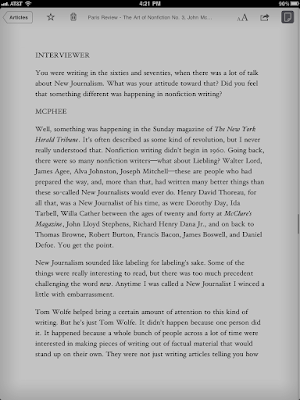
Because I don't want to keep hundreds of articles at all times in my Instapaper application on my iPad (I usually keep around 50 or so), and because I want to keep track of this river of reading for later reference, I made sure to link my Instapaper account with my bookmarking service, Pinboard. So, every time I save an article with Instapaper, that URL is archived for later retrieval on Pinboard.
Pinboard allows me to group items by using tags; here, for example, are all the items I've collected that might be used in ENG 213, our Intro to Digital Literacies course...
But I digress, this is about reading, yes?
So, let's get serious. Research articles, books, annotations of said items. Scholarly work. Instapaper usually isn't so good for those kinds of things (well, annotations, that is). That's where iAnnotate PDF and Dropbox come in to play.

If you don't have a Dropbox account, go get one immediately after finishing this post. Here's Dropbox in a nutshell: online backup of your files, synced among all of the computers and devices that you use. For free. Never lose a file again. Hard drive crashed? So what—files are in Dropbox. Elephant stepped on your Macbook? No worries—files are in Dropbox. Dog ate your homework? You get the picture. In fact, go sign up now. With this link, you'll get an extra 250 MB of space.
Many of the articles—and, increasingly, many of the books—that I read are available in PDF format. I upload those files to Dropbox, which means they're accessible from any internet-enabled device I might use to access them, which means I can choose from hundreds of articles or books to read pretty much anywhere.
Because I read so much on my iPad, I use iAnnotate to read the books and articles I have in PDF. Here, for example, is a book that students in my Rhetoric, Writing, and Emerging Media course will read this semester, Program or Be Programmed:
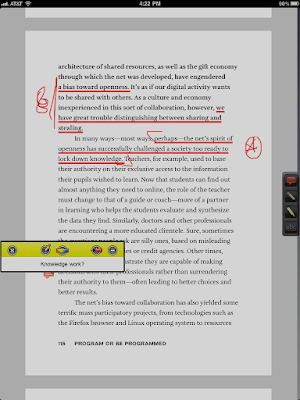
With iAnnotate, I'm able to read in ways that are similar to (but still very different from!) the practices I use when reading an article or a book the old-fashioned way, pen in hand.
I can underline, star important points, and make comments in the margins. Because I type these comments instead of scrawling them in my horrible handwriting, I can actually read my notes later. Best of all, I can save the PDF as is, so that all of my edits and annotations are viewable (and shareable) elsewhere—in my DEVONthink database, for example (but that's fodder for another post...).
So, what am I reading?
Denise Schmandt-Besserat's How Writing Came About. A recent article by Clay Spinuzzi in Written Communication. Bill Moggridge's Designing Interactions. Howard Rheingold's Tools for Thought. A recent article about multimodal storytelling. Dave Winer's blog, Scripting News. The tweets of Jan Chipchase and Kevin Marks. Malcolm McCullough's Digital Ground. Mitchell Duneier's Sidewalk. And a whole host of other interesting articles in the "Read Later" archive of my Instapaper account...
A screencast showing a specific use case in favor of RSS within the context of the RSS vs. Twitter debate.
Here, we see how ineffectual Twitter search can be for finding older tweets, and how important a feed-reader can be for archiving and retrieving those same tweets...
As I've argued on this blog and elsewhere, the mobile component of Twitter is essential to a rich user experience. Having SMS updates enabled or using a mobile client such as Tweetie or Twitterific is a key factor in getting the most out of Twitter as a robust communications platform and as a framework for ambient research. While I've maintained this position over the last few months, I recently had the misfortune/opportunity to experience Twitter sans mobility, and I didn't like it much.
As you may know, one of my primary areas of research is the study of writing and rhetorics on ubiquitous and mobile small-screen devices. In fact, my impending move to Ball State University includes support for a new, more robust mobile device and data plan, as well as affiliation with the Center for Media Design, where I hope to procure funding and develop empirical studies of mobile media consumption and ambient communication.
The long and the short of the story is that my phone broke last week. More specifically, my phone's screen functioned intermittently and not very well, mostly not at all (though banging it on my desk seemed to help at times). There was no disruption is service or functionality--messages and calls still came through just fine--but I couldn't read those messages or determine who might be calling. As you might imagine, this presented some problems. I'm the type of person who will go on using something until it just won't work anymore (I still have--and use--a Palm Vx, for Pete's sake!), but this was something different.
My first order of business was to remove device updates from Twitter. That "solved" some of the problem, but I was still faced with incoming calls that I couldn't see, and additional text messages from others that I couldn't read. Moreover, my engagement with Twitter was rather poor. I figured it would be easier to elaborate on some of this via video:
So, certainly my experience here is purely anecdotal, but I am left wondering how mobile adoption might enrich one's experience of using Twitter, how it might make it easier for a new user to engage in conversation and to feel as though they are part of a larger community, and how their reading and writing practices travel with them. My unintended experiment in reverse-engineering the mobile UX of Twitter gave me a very different, rather underwhelming perspective on the service. In explaining Twitter going forward, I know that I'll be emphasizing mobile usage even more.
 Mitch Ratcliffe (@godsdog) recently posted a lengthy treatment on the future of the book for his occasional ZDnet column. It's an intriguing read, and definitely worth your time if you're interested in such things (as I am). Ratcliffe is a cerebral journalist, and he's likely to invoke theorists like Deleuze or Foucault to support an argument. This is one of the reasons why I like him, and why I follow him on Twitter.
His post, "Books: Entering the Age of Glosses," begins with the following assertion: Here’s the key to thinking about the future of writing, something straight out of the manuscript era: the humble gloss or “scholia,” for those who prefer the Latin.
Ratcliffe follows this thread, picks up on others (including a very interesting discussion of curation and cryptography that's worth concerted attention), and generally covers substantial ground in his exploration of reader-response in digital environments. However, I'm troubled by the reverse-engineering I see here (and in so much new media scholarship); why should the "key" to the future of writing be formulated from within a paradigm fundamentally at odds with digital discourse? Why should the "key" be found among our print-based past, amongst dusty, closed, self-contained artifacts that talk to each other in only the most rudimentary form possible?
I've been known to comment on blog posts from time to time, and I took a moment to relay my thoughts on the "future of writing" as conceived from within print-based paradigms of the past: A Normative Approach
Some very interesting insights here, Mitch. I'm excited about your work on the future of writing, and I eagerly look forward to your forthcoming book.
I do, however, have some trouble with the general framework from which you seem to be exploring the future of writing. Based on this entry, you are applying norms of print-based textuality to digital space, and this, I think, is a mistake. It's one that continues to be repeated in a variety of fields (not the least of which is my own--Rhetoric and Writing Studies--which continues to proffer hermeneutic norms of print-based textuality to all manner of meaning-making).
This is to be avoided, I think, if we are ever to effectively explore the potential of writing in digital environments. Quite simply, print-based norms are not seamlessly analogous to digital writing, and remediating those norms brings along all of the baggage of book culture and applies it, ipso facto, to digital writing (even when we pretend or hope that it does not).
In a certain sense, marginalia seems quite a suitable analogy to commenting, for example. But it's dangerous to extend that analogy into discussions of what writing might be in digital environments, because it so profoundly limits what we can see, reverse-engineering digital writing through the framework of book culture. Marginalia and glossing privileges The Text, not user interaction (see for example, C. Davidson, 1986 for more on marginalia). Glosses are furtive, individual acts, isolated and contained. Blog comments, tweets, et al., are fundamentally social and public, privileging interaction between users rather than the hailed alphabetic text. It's not about the book alone, but about the writing that extends beyond.
This is but one example, and the prevalence of normative, print-based approaches to writing in digital environments is overwhelming. So, more than anything, I stress caution in privileging such a framework.
A way of seeing is also a way of not seeing.
I am encouraged by novel approaches to writing in digital environments (like the unbook, for example), and am skeptical of those that attempt to seamlessly graft old ways of seeing onto new, and drastically different paradigms. In some sense, this grafting and reverse-engineering is natural--and therein lies the heart of the matter--the "key" to productively exploring the future of writing. We need to rethink what we assume we no longer have to think about (Kopelson, 2008).
Okay, not really. You may remember that my daughter's birthday was on Saturday, and we were very excited to give her an iPod Touch. She's had a little over two full days of use by now, and I thought I'd talk a bit about how she's actually using the device so far. I must say that I'm not surprised, as I've always seen the Touch as more analogous to a laptop than to the Nano, for example. So, this is all very informal, very anecdotal, and by no means rigorously tracked. First, some details on what she actually received:
 - iPod Touch 2nd Generation, 8GB
- Preloaded with: Twilight movie (a gift from my son), third Twilight book via the Kindle app, 2 free games and one paid game (Labyrinth), new Hannah Montana album (thanks to @amazonmp3), another full album and one other song that she likes, several tv shows that were already on her Nano, and the free Pandora app
- Wifi via WEP encrypted home connection, which I set up before unwrapping
That's pretty much it. So much for actual content loaded on the iPod (a device that originated as a way to conveniently store and disseminate lots of content). When she powered up and began to explore the device, she spent some time looking at the basic apps (weather, time), the games that were loaded, and the gifts she received (album, movie, book).
Then she hopped on YouTube. Then she closed out and headed to her email. Then she set up her contacts. Then she went to her feed reader. Then she streamed music from Pandora. Then she played games, and on her brother's advice, downloaded a couple more free games (Papi Jump is now a family favorite). See a pattern here?
What's most interesting (to me anyway) is what she didn't do: she didn't head over to the desktop and transfer music from iTunes. She didn't really even listen to music (other than through Pandora).
In the afternoon, she had a few friends over for a birthday party. They played outside, and generally did the things that normal 11 year olds do. Then my daughter connected her Touch to the main television, and they watched a little YouTube and then Twilight while eating pizza. Still no music playing. . .
Yesterday, I set up the TextFree Unlimited app from Pinger. She spent much of the afternoon and evening periodically texting her friends, cousins, grama, and mom (who was at Starbucks grading papers) from her iPod. She spent more time playing games and checking out viral videos on YouTube.
I'll not bore you with more details; my point should be abundantly clear by now. The overwhelming majority of the time my daughter spent on her Touch was in activities that we traditionally associate with "computing." Even most of the media consumed (everything other than watching Twilight, it seems) was obtained via the cloud. To me, this pattern of activity is not surprising in the least, yet completely fascinating.