Showing posts with label CSCW. Show all posts

2.20.2012

Annotations | Nardi, 1996: Studying Context

Annotations | Nardi, 1996: Studying Context

[ NB: “Annotations” are occasional posts that explore selections from my research reading—articles or books—in rhetoric, technical and professional communication, and related fields. ]

Nardi, B. (1996). Studying context: A comparison of activity theory, situated action models, and distributed cognition. In B. Nardi (Ed.), Context and Consciousness: Activity Theory and Human-Computer Interaction (69–102). Cambridge, MA: MIT Press.

In my last post, I considered how and why human beings become attached to particular artifacts and technologies. Trauman offered a compelling response in the comments area, and I thought I’d respond to at least part of his query here: how to get started with activity theory…

This semester, I’m teaching a special topics graduate seminar exploring activity theory and writing technologies. I’ve posted the syllabus for the course on Scribd, but the actual reading list is hardly innovative—it’s all the usual stuff to get one primed on the basics of AT and its application in rhetoric and writing studies. For deeper reading, have a look at Clay Spinuzzi’s list of activity theory sources on Mendeley.

But I thought I’d address some of the basics of activity theory by considering one of its primary applications: studying particularized contexts and situatedness by deploying a methodological framework (activity theory) that moves a given researcher beyond an overdetermined particularity. This is actually one of Nardi’s (1996) goals in her excellent chapter comparing activity theory to situated action models and distributed cognition.

I thought I’d kill two birds here by exploring some AT basics through an annotation of Nardi’s chapter.

This chapter of Context and Consciousness is, like the one before and the one that follows, essential reading for the budding activity theorist. Nardi explores the notion of context in a given research site by considering perspectives from three similar methodological/theoretical approaches: activity theory, situated action models, and distributed cognition. In this chapter, she asks:

  • What exactly is context?
  • What is the correct unit of analysis if the individual is no longer the primary locus?
  • What are the relations between artifacts, individuals, and social groups?

Nardi begins by making the argument (drawing on several other studies) that it is simply not possible to understand how people learn or work when the unit of analysis is “the unaided individual with no access to other people or to artifacts” (p. 69). In other words, artificial lab settings are no longer sufficient for truly approximating the complexity of human beings acting with technology. She also asks, crucially, how we might study complex, situated contexts while still producing research findings that are generalizable (p. 70).

Essentially, Nardi’s goal is to explore the three approaches noted above to see how each deals with the problem of research contexts, considering the benefits and drawbacks of each for studying HCI in particular.[1]

A situated action model, Nardi argues, “deemphasizes study of more durable, stable phenomena that persist across situations” (p. 72). Situated action models, therefore, are highly particularistic: “These analyses offer intricately detailed observations of the temporal sequencing of a particular train of events rather than being descriptive of enduring patterns of behavior across situations” (p. 72). She adds that situated action models suggests that the structuring of activity emanates from the immediacy of a given situation. This is extremely problematic, of course, because it essentially elides cultural-historical factors that surely impinge upon how a human being uses a particular artifact, for example.

Nardi moves next to a discussion of activity theory, where activity systems are the unit of analysis, comprised of “subject, object, actions, and operations,” and where the object held by any one subject “motivates activity” and gives it shape and direction (p. 73).[2] “Actions are goal-directed processes that must be undertaken to fulfill the object,” she states. Actions are conscious, and different actions may be linked in the service of the same goal. Chains of actions work in support of the more complex activity.

Objects, Nardi notes, are not immutable structures, but they also don’t change on a moment-by-moment basis, thus offering some stability (p. 74). Actions also have operational aspects—routinized, unconscious operations (such as accelerating and breaking while driving a car). Nardi points out that “Activity theory holds that the constituents of activity are not fixed but can dynamically change as conditions change. All levels can move both up and down” (p. 75).

Nardi then describes mediation as a key notion in activity theory approaches. “Artifacts carry with them a particular culture and history,” she argues, drawing on Kuutti (1991), and they are “persistent structures that stretch across activities through time and space” (p. 75). Activity theory, she argues, has a very strong notion of context: “the activity itself is the context. What takes place in an activity system composed of object, actions, and operation, is the context” (p. 76, emphasis in original). Moreover, “People consciously and deliberately generate contexts (activities) in part through their own objects; hence context is not just ‘out there’” (p. 76).

Nardi takes us next through the particulars of the distributed cognition approach, where the representation of knowledge is both in the head and in the world, that is, in and between individuals and artifacts (p. 76–77). For distributed cognition, “we cannot understand how a system achieves its goal by understanding ‘the properties of individual agents alone’” (p. 77). Distributed cognition “moves the unit of analysis to the system and finds its center of gravity in the functioning of the system” (p. 77).

In this chapter, we can see that Nardi establishes a continuum, with the constrained particularity of situated action models at one end, and the systems level approach of distributed cognition at the other. Activity theory, with its recognition of both individual particularity and collective sociocultural histories within a given context, sits somewhere in the middle of this continuum.

Nardi moves next to exploring the key differences between these frameworks, starting with how each structures or models human activity. In an activity theory approach, “activity is shaped first and foremost by an object held by the subject” (p. 79). Activity theory, therefore, emphasizes motivation and intentionality of the human or collective. This differs markedly from the situated action approach, where plans, and presumably intentions, are “retrospective reconstructions” (p. 79) that somehow justify an individual’s response to a given situation.

Nardi’s chapter is as much about research methods as it is exploring the three frameworks noted above. For example, she notes that interviewing is a way of bringing operations to a research participant’s “conscious awareness,” and that doing so can empirically demonstrate “the dynamism of the levels of activity as posited by activity theory” (p. 82). In a situated action model, Nardi argues, “what constitutes a situation is defined by the researcher; there is no definitive concept such as object that marks a situation” (p. 82). This is extremely important, methodologically: in activity theory, “the structuring of activity is determined in part, and in important ways, by human intentionality before the unfolding in a particular situation” (p. 82). So, for a researcher to identify an activity system, she can simply start with the object defined by a given research participant rather than imposing her own view (p. 82–83).

Nardi’s next section explores the important role of persistent structures. She notes that understanding the role played by persistent structures—“artifacts, institutions, and cultural values” (p. 83)—in the structuring and shaping of activity is crucial. Drawing on Leont’ev (1974), she illustrates how activity theory is “concerned with the historical development of activity and the mediating role of artifacts” (p. 83). Nardi then explores the ways in which each approach considers the mediating role of artifacts, suggesting that distributed cognition “has taken most seriously the study of persistent structures” (p. 85). In activity theory approaches, things like artifacts or the work practices in a given community are important “precisely because they span particular situations” (p. 86). In other words, the activity theorist looks for patterns that stretch across individual situations, since those patterns are indicative of larger contexts comprised of genres and norms (Engeström’s “rules”), collaborations and interactions (Engeström’s “division of labor”).

Despite the focus on artifacts, for activity theory, unlike actor network theory, “people and things are unambiguously asymmetrical” (p. 86). Nardi argues that, compared to distributed cognition’s tendency to overdetermine the cognitive properties of artifacts, “The activity theory notion of artifacts as mediators of cognition seems a more reasonable way to discuss relations between artifacts and people” (p. 87). “Activity theory says, in essence, that we are what we do,” she argues (p. 88).

One of the most important contributions of this chapter is Nardi’s argument that activity theory gives researchers a shared vocabulary and outlook on a given research site, and that this shared vocabulary and approach allows us to generalize qualitative research. She gives a compelling example of the three different walkers in a forest near the end of this chapter, and in so doing she provides an application of an activity theoretical lens—one that helps researchers see how situatedness constrains human beings, but doesn’t determine their agency.

Of activity theory, Nardi argues:

Aiming for a broader, deeper account of what people are up to as activity unfolds over time and reaching for a way to incorporate subjective accounts of why people do what they do and how prior knowledge shapes the experience of a given situation is the more satisfying path in the long run. (p. 94)

Activity theory, therefore, comes with the following methodological implications:

  1. It requires “A research time frame long enough to understand users’ objects”
  2. It requires “Attention to broad patterns of activity rather than narrow episodic fragments”
  3. It suggests “The use of a varied set of data collection techniques, including interviews, observations, video, and historical materials” (without an over-reliance on any one method)
  4. It suggests “A commitment to understanding things from users’ points of view” (p. 95)

Nardi concludes with the argument that “Activity theory seems the richest framework for studies of context in its comprehensiveness and engagement with difficult issues of consciousness, intentionality, and history” (p. 96). I would add, following Kaptelinin (1996) and Engeström (1999), the centrality of mediation (which is especially important for writing researchers), and following Tolman (1999), I would further stress the “societal nature of the human individual” (p. 71).


  1. I’m making the tacit assumption that we have much to apply from this approach to studying writing, especially as it largely occurs today, as technologically mediated human-computer interaction…  ↩

  2. If you are new to activity theory, the nomenclature can be a bit disorienting at first. “Object,” for example, refers not to an artifact, but is more akin to objective. The object is the thing motivating activity…  ↩

1.27.2011

What am I Reading?

[ NB: This post was written for the Ball State English Department Blog, and is mirrored here. ]

The more interesting question is "how am I reading?"

My workflow is constantly evolving, and right now, my reading is largely shaped by the combination of a few different mobile applications and devices.

I try to do 50 pages of research reading every day (more on that here). Consequently, most of the stuff I read is likely to be of little interest to all but the most intrepid grad students in Rhetoric and Writing. I'm assuming here that you don't enjoy research articles and technical reports about computer-supported cooperative work, distributed writing practices in the workplace, and the direction of ambient, networked writing activities. Like I do.

Some folks love to curl up with a good book of poems or short stories; I'd much rather read the methods section for a well-planned and executed qualitative study. So, I'll tell you what I'm reading, but I want to talk a bit about how I'm reading, since reading, writing, and publishing practices are currently in the midst of massive change.

Here's how much of my daily reading is likely to start. I open Google Reader and also browse links shared by folks I follow in Twitter. Thus begins the sifting and winnowing of information from the sources I've instructed to hail me each day. Clay Shirky says there's no such thing as information overload, just filter failure.

So my reading starts with filtering—selecting appropriate RSS feeds and Twitter accounts to deliver the things I need to do my job.


When something looks interesting, I'll click the link and navigate to the article. If it's more than two or three hundred words, and if it looks really interesting, then the magic starts. I use a bookmarklet that saves the article to Instapaper.

Instapaper is pure genius.

The application takes the article I'd like to save (let's say it's this 13,000 word gem of an interview with John McPhee in the Paris Review), strips away all of the banners, ads, and social networking detritus, and then serves up the written word in a clean, customizable interface on the device of my preference.

If something gets Instapapered by me, that means it's going to my iPad.


Reading on the iPad is amazing, but you know what Instapaper does that makes it even more useful? It downloads and stores every article I save so that I can read them no matter where I am, even if I'm offline (perish the thought!).


Because I don't want to keep hundreds of articles at all times in my Instapaper application on my iPad (I usually keep around 50 or so), and because I want to keep track of this river of reading for later reference, I made sure to link my Instapaper account with my bookmarking service, Pinboard. So, every time I save an article with Instapaper, that URL is archived for later retrieval on Pinboard.

Pinboard allows me to group items by using tags; here, for example, are all the items I've collected that might be used in ENG 213, our Intro to Digital Literacies course...

But I digress, this is about reading, yes?

So, let's get serious. Research articles, books, annotations of said items. Scholarly work. Instapaper usually isn't so good for those kinds of things (well, annotations, that is). That's where iAnnotate PDF and Dropbox come in to play.


If you don't have a Dropbox account, go get one immediately after finishing this post. Here's Dropbox in a nutshell: online backup of your files, synced among all of the computers and devices that you use. For free. Never lose a file again. Hard drive crashed? So what—files are in Dropbox. Elephant stepped on your Macbook? No worries—files are in Dropbox. Dog ate your homework? You get the picture. In fact, go sign up now. With this link, you'll get an extra 250 MB of space.

Many of the articles—and, increasingly, many of the books—that I read are available in PDF format. I upload those files to Dropbox, which means they're accessible from any internet-enabled device I might use to access them, which means I can choose from hundreds of articles or books to read pretty much anywhere.

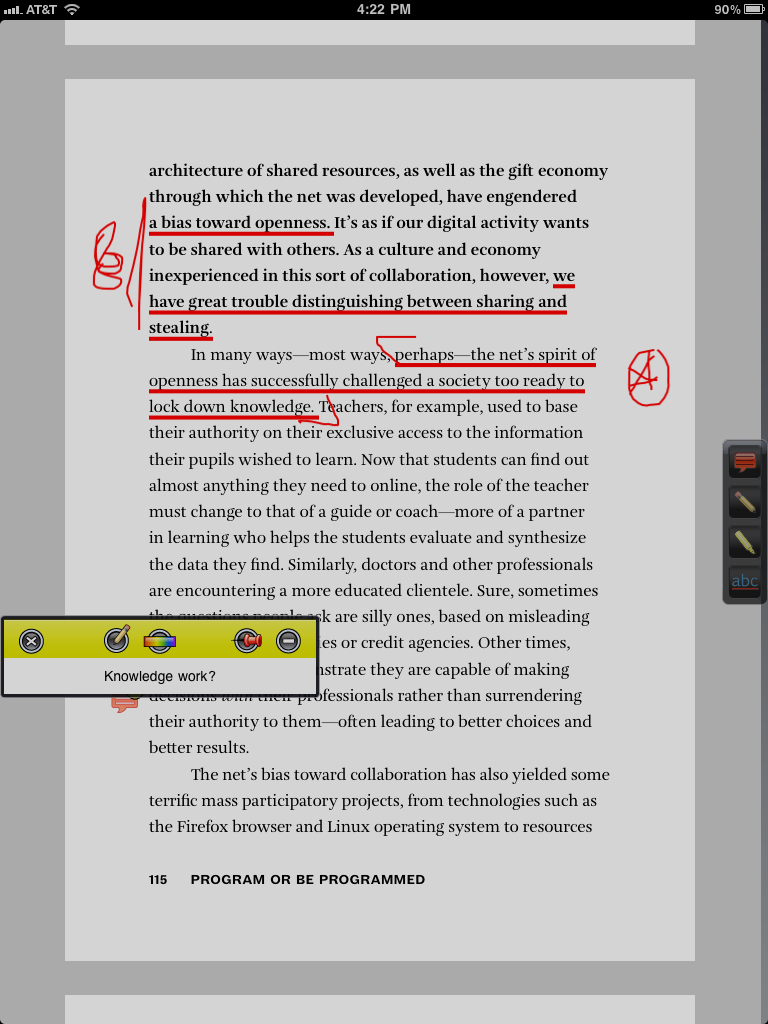
Because I read so much on my iPad, I use iAnnotate to read the books and articles I have in PDF. Here, for example, is a book that students in my Rhetoric, Writing, and Emerging Media course will read this semester, Program or Be Programmed:


With iAnnotate, I'm able to read in ways that are similar to (but still very different from!) the practices I use when reading an article or a book the old-fashioned way, pen in hand.

I can underline, star important points, and make comments in the margins. Because I type these comments instead of scrawling them in my horrible handwriting, I can actually read my notes later. Best of all, I can save the PDF as is, so that all of my edits and annotations are viewable (and shareable) elsewhere—in my DEVONthink database, for example (but that's fodder for another post...).

So, what am I reading?

Denise Schmandt-Besserat's How Writing Came About. A recent article by Clay Spinuzzi in Written Communication. Bill Moggridge's Designing Interactions. Howard Rheingold's Tools for Thought. A recent article about multimodal storytelling. Dave Winer's blog, Scripting News. The tweets of Jan Chipchase and Kevin Marks. Malcolm McCullough's Digital Ground. Mitchell Duneier's Sidewalk. And a whole host of other interesting articles in the "Read Later" archive of my Instapaper account...

11.10.2010

Exploring a Sustainable and Public Information Ecology

In September, I published a paper in the Proceedings of the ACM Special Interest Group for Design of Communication (SIGDOC); it has recently been published at the ACM site.

My paper details findings from a qualitative study of a professional conference, drawing from Nardi and O'Day's (1999) Information Ecologies and Activity Theory to explore the public writing activities that I observed and catalogued. I collected a few different kinds of data for the study—observations of planning meetings, observations of activities at the three-day conference, written public artifacts on the organization's blog and in the Twitter streams of conference participants, and interviews with several of the participants (and planners) themselves.

As I was coding data from the study, one of the key activities that I encountered again and again was something called tummeling. Tummeling can be seen as the intentional facilitation of conversation and engagement within online communities—often by someone who curates ideas and content while connecting previously unaffiliated individuals from overlapping social groups.

I am indebted to Kevin Marks for sharing this concept on Twitter and in Google Reader (he is, in fact, an active tummler). I think I would have struggled to characterize some of the key activities that emerged from the data had I not been made aware of this concept and its role in fostering online engagement.

Based upon the data, I argued that tummeling was a key factor in bolstering the sustainability of the online and physical community that I studied. Since I was privy to pre-conference planning meetings, I learned that the digital sustainability and visibility of the organization was a key goal heading into the conference.

Interestingly, I don't think most involved in those planning meetings envisioned phatic communication through an application like Twitter as being a large factor in fostering that sustainability.

The data says otherwise.

Tummeling activity and online phatic interaction clearly extended the organization's reach and visibility while promoting connections that were sustainable beyond the three-day conference. These activities were largely extraorganizational; in other words, they were driven from below—by attendees—rather than from above—by the organization itself.

The organizers, to their credit, realized that blogging and microblogging activities needed to be leveraged in some way. They were intent on trying new ways of extending the organization's reach.

Findings from this small-scale study indicate how organizations might better foster tummeling activities in support of visibility and sustainability efforts. Part of the challenge is met by simply promoting tools like Twitter—embracing and encouraging the tummlers who are in some way connected to (though not necessarily a part of) the organization.

You can get a pre-publication version of the full paper below, or the official version at the ACM Portal.


10.13.2010

Digital Publics and Participatory Education

Last week, an article that I worked on earlier this year saw publication with the open access journal Digital Culture and Education.

Back in January or thereabouts, Christa Teston and I were talking about different collaboration opportunities, and I suggested that we prepare a manuscript for a special issue of the journal. We put together a plan to explore the complex of blogging, backchannel communication, and Google Reader as a way to open up classrooms to broader public participation, drawing primarily from experiences in my Fall 2009 senior seminar at BSU.

Following Schön (1983), we took a reflective practice approach, inviting three participants as coauthors. Garrett Cox was an undergraduate in the model course, and he contributed a participatory perspective from inside the curriculum. Bolutife Olorunda was a student participant from the edges of the curriculum, and his perspective details his experience as a self-directed participant motivated by interests in the core subject matter. Finally, Noah Dunker, an Information Security professional from Kansas City, MO, contributed a participatory perspective from well outside the curriculum, as a public participant in the course, unaffiliated with BSU.

While the manuscript wasn't a good fit for the special issue, it was reviewed positively, and invited for inclusion in the next issue. In the article, we make an argument about operationalizing collaborative knowledge work within a specific curriculum and pedagogical approach—enacting a form of participatory education in digital publics.

In the process, we also detail a fairly novel approach to guided discovery (Clark & Mayer, 2003) and student blogging as a literate practice. Finally, we suggest practical methods of incorporating feeds—via Google Reader's "Bundle" feature—as a primary source within a given curriculum.

The abstract for the article is below, and the full piece can be found at Digital Culture and Education.


This article—a collaborative exploration between instructors, students, and members of the broader, digital classroom community—explores how the strategic incorporation of sociotechnical networks and digital technologies facilitates literate practices that extend the classroom in productive ways. The article builds toward coauthors’ reflective practices (Schön, 1983), or “participatory perspectives”, had during an undergraduate English Studies course at a mid-sized, public, American university. Specifically, participants argue that these literate practices afforded not just information sharing, but the opening up of a traditional classroom to include broader digital publics and collaborative knowledge work (Spinuzzi, 2006). Toward this end, we ground literate practice in scholarship that attends to public writing in online spaces, and theoretically frame our argument using Jenkins et al.’s (2006) principles of participatory education. We then detail the specific curricular approach deliberately designed to create digitally connected publics and end with generalizable significance of coauthors’ participatory perspectives.

10.12.2010

Spring 2011 Courses

A quick post—mainly for potential students (but possibly of interest to others)—with the brief course descriptions for my two Spring 2011 courses.

At the undergraduate level, I'll be teaching ENG 431 :: Rhetoric, Writing, and Emerging Media. This is a brand new course that I designed in conjunction with Ball State's new Minor in Professional Writing, and it is, in fact, the capstone experience for that program.

This course has as prerequisites our Introduction to Digital Literacies (ENG 213) and Professional Writing courses (ENG 231). It builds on the ideas introduced in those courses, including writing for the web and qualitative research practices introduced in 213 and 231, respectively. Since this is the first time running 431, however, it may be possible to take the course without having already taken 213 + 231—talk to your advisor (or me!).


At the graduate level, I'll be teaching ENG 692 :: Writing Technologies. I'm particularly excited for this course, since we'll be starting with Haas (1996) and moving through germinal work in Activity Theory and Professional/Technical Communication, leading toward small-scale qualitative studies of writing technologies.

If you have questions about either course, please feel free to ask away!


2.22.2010

:: Deliberative Ecologies :: Technologies, Practices, Actants

As a follow up to last week's collaboratively written post, On the Atomization of Rhetoric, Christa Teston and I have written a companion post: Deliberative Ecologies: Technologies, Practices, Actants, which is published on Christa's professional blog.

Please have a look at our post when you have a moment; it describes in more detail the messy complexity of our collaboration, and we take initial steps toward thinking through the notion of "deliberative ecologies" by attempting to surface our formative rhetorical knowledge work.

As always, we appreciate feedback--here, there, or on Blogora.

12.30.2009

On the "Death" of RSS...

A screencast showing a specific use case in favor of RSS within the context of the RSS vs. Twitter debate.

Here, we see how ineffectual Twitter search can be for finding older tweets, and how important a feed-reader can be for archiving and retrieving those same tweets...


11.07.2009

[ Locus Communis ] Twitter as Digital Commonplace

I gave a talk today at the International Digital Media and Arts Association annual conference. I almost always upload the slides for my talks, but because of the format for this conference--where presentations were limited to ten minutes--I decided to simply screencast the full talk and share it here.

I had a great time at the conference overall, and our panel fostered some excellent discussion. At just under ten minutes, the video takes some time to load; as always, I welcome feedback, questions, and discussion!


10.15.2009

Extending the Classroom: Conversations, Content, and Microblogging with Twitter

I had the opportunity to give a fun talk today about using Twitter in educational settings. I was able to present in the brand new Schwartz Digital Complex in Bracken Library, as part of Ball State's Tech4U series. I was also able to make use of an impressive visual display that allowed me to stream tweets in Seesmic, a hashtag search on FriendFeed, and my own slides simultaneously (I actually brought a class to the "learning pod" section of this fantastic facility on Tuesday and shot some video, which I'll upload soon).

The talk essentially mashed together ideas from some other research projects and presented some new material geared toward pedagogical approaches and student engagement.

This last bit was perhaps the most interesting, as it drew from the Ball State University Fall 2008 "Making Achievement Possible" survey of first-year students. The MAP Works survey indicates that 46% of first-year BSU students spend between 30 minutes and two hours on social networking websites each day. A full 40% of students spend 2 or more hours each day on such sites. My sense is that these numbers are underreported.

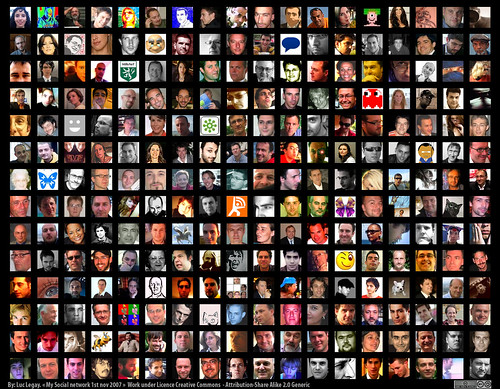
In other words, 86% of our first-year students, as of 2008, are spending time every single day with communities that look like this:

Creative Commons image by luc legay on Flickr.

I asked: as an educator, where are you in that picture? Where are the influential scholars and teachers in your field? Do we see their avatars represented in the social networks where our students are spending their time? Should they even be there in the first place?

I don't have any easy answers to those questions, but I did suggest some ways that faculty at Ball State can incorporate microblogging into their curricula and pedagogies. I've embedded the slides from today's talk below, and as always, I'm happy to provide a transcript as well. Tommy and Ben from the Center for Media Design were there shooting some video, and I assume it will eventually surface at some point; when it does, I'll link to it!

10.14.2009

Backchannel Persistence and Collaborative Meaning-Making

Last week I had the pleasure of delivering a paper relatively close to home, at the 27th ACM International Conference on Design of Communication (SIGDOC), at Indiana University in Bloomington. I was especially excited to be on a panel with Shaun Slattery of DePaul University, and Jason Swarts of North Carolina State University--two scholars that I hold in high esteem.

Our panel explored the traces of literate activity that are surfaced and archived in new media writing environments, and which lead to the construction of "fact" on Wikipedia, and the development of provisional knowledge in microblogging platforms. All three papers called on Actor Network Theory and/or Cultural Historical Activity Theory as a way to frame and trace computer supported collaborative work.

I added some theoretical frameworks that are likely too much for a 6,000 word manuscript. I like what I have here, but it's meant to be the start of something much more substantial. In short, my paper amounts to a longish position piece which aims to establish a theoretical framework for tracing meaning-making in persistent backchannel platforms (such as Twitter).

The official published version, should you be able to navigate behind the paywall, is available through the ACM portal. The full proceedings--which include excellent papers from Shaun, Jason, and a number of other fantastic researchers--can also be accessed through ACM. I've uploaded a pre-publication version of the paper to Scribd, and it's available below:


Finally, I've embedded the slides for my presentation as well. If you've seen me present in the past, you'll know that I take a minimalist approach to slidedecks, favoring images over alphabetic text. So, if you'd like the script that accompanies the slides, let me know!

10.02.2009

Twitter and Commonplace Books

Since 2006, I have been thinking through various iterations of a digital commonplace book. First, a little background on the traditional practice of commonplacing...

As early as the 14th Century in the west, literate populations began to cobble together bits of information--quotes, measures, thoughts, arguments, summaries, responses--on paper, an increasingly ubiquitous resource. These "note books" eventually came to be known as commonplace books, and they were a predicated upon tenets of classical rhetoric. George Eliot kept a commonplace book; so did Thoreau, Thomas Jefferson, and E.M Forster, among many, many others.

The Digital Commonplace

While people continue to keep journals--both offline and on--the online sourcing and collection of information and contemporary digital reading practices have provided different affordances for the same kinds of work accomplished in the traditional commonplace book. Delicious, Digg, Reader, FriendFeed--all of these tools enable knowledge curation practices which remediate the work of commonplacing to a certain extent. And the affordances are strikingly different: greater access to massive amounts of information, far flung, and harder to filter. If these affordances can be managed effectively, new communications tools can revive commonplacing in a significant way (in fact, if you're reading this, you are very likely already engaged in the kinds of digital commonplacing I am suggesting...).

As I mention above, I have been trying to develop the idea of digital commonplacing in concert with research on recursion in writing studies (and more recently, ambient research). For example, in 2006 my first-year writing students used a modified version of the WebCT discussions area to produce a (quasi) stream of short reading responses and thought pieces that eventually built from and played off of one another. Today, platforms like FriendFeed and Twitter afford commonplacing activities in ways that are persistent, searchable, copyable, and easily shareable.

A key, of course, is positioning the platform so that it can be effective for this kind of work.

I'm still thinking through these ideas, and I'll be discussing Twitter as digital commonplace book at the upcoming International Digital Media and Arts Association annual conference (iDMAa), held this year on my home campus of Ball State University. The abstract for that talk elaborates a bit on these ideas, and is embedded below. As always, I welcome feedback!