Showing posts with label technology. Show all posts

7.14.2013

Found Photo Fodder

Found Photo Fodder

I haven’t commented much on the death of Google Reader, and while this post is marginally about RSS (and, really, about tagging within RSS), I don’t really have much to say about Reader that adds anything meaningful to all of the excellent things that have already been written.

Instead, this post is about found photos, sources for those photos, and the use of such photos in professional presentations.

Over the last few years, I’ve received some minor kudos for developing conference presentations that are visually arresting and compelling. I’ve heard lots of good feedback from folks whose opinions I value about the effectiveness of my presentation style, which is heartening.

During the first couple of years that I worked on developing this ethos, I predominantly used striking images that I found on the web (hence my use of the term “found photos,” which, technically, is different from the actual definition of found photos or vernacular photography, but not unlike that definition either, but that’s for another post…). Indeed, when preparing a presentation, I would often begin with the images, mining Google Reader posts for visuals that evoked or supported ideas I was trying to convey verbally.

After giving a talk, folks would often ask: “Where do you find all those cool images?” In reply, I would usually joke that it was a “trade secret.” But really, it was just simple sifting and winnowing using RSS.

In Reader, I subscribed to several image-intensive feeds, many of which were from Tumblr. These feeds have always made my RSS experience a pleasure, for mixed in with discourse-heavy posts from fellow academics, tech blogs, and news sites were often incongruent and arresting photos. Over the years of using Reader, I probably looked at 100,000 or more photos.[1]

When I stumbled across an image that was striking for whatever reason—and I learned to develop a sense of what would make an interesting and effective slide-ready image—I would simply use Reader’s tagging function to label the post “photos.” That’s it. When it came time to prepare a talk, I’d open my list of posts tagged “photos” in Reader and simply j/k my way through, looking for visuals congruent with the scope of my presentation.

I had thousands of posts tagged “photos” in Reader,[2] which means that I had my own archive of visuals that might evoke the presentation ethos I’d developed over time.

However, over the last two years I’ve moved away from using such found photos in my presentations, preferring instead to use my own images to support my work for two main reasons. First, I’ve been developing approaches to using visual research methods in qualitative studies of writing, and consequently, many of my talks have covered this work. Second, and perhaps more importantly, I’ve been working hard on developing rhetorically engaging visuals of my own, honing a visual phronesis related my academic work alongside the verbal and written craft.

Regardless, when Reader died, so too did thousands of tags. This is but one example; I also used tags to code data in Reader, I used tags to mark items related to research reading, and I used tags for a variety of other things (one of my favorite tags was “holy shit,” reserved for a bevy of truly amazing and awe-inspiring posts).

I moved to Newsblur in mid-June, and I’ve been very happy with the service. No tags, though, and no import for the archive of tagged items from Reader users (there are some other options, I realize, but that’s not the point of this post).

And yet, I still have the desire to single out arresting images. In the old days of Reader, I would sometimes publicly share such images. Since Newsblur doesn’t support tagging but does offer some of the social sharing features that were once part of Reader, I’ve been using the “share” feature to collect interesting found images.

It’s not a workaround, but a totally different way of thinking about the images I find arresting. Since I’m sharing these publicly, I’m thinking more about why I find the images striking, whether others will find them similarly striking, and what my sharing them says about me and my visual ethos.

If you ever wanted to tap into the archive of images I used in presentations a few years ago, or if you simply would like another image-intensive feed in your own RSS reader, feel free to add my Blurblog, a feed of nothing but images that I once would have tagged “photos” in Reader.


  1. Who knows for sure? I’m basing this on the fact that a couple years ago Google released statistics for individual Reader users. When they did, I learned that I had already surpassed 300,000 total read items, the maximum count they’d render for a given user. Again, that was a couple years ago, at least. My feed list has always included a healthy amount of photoblogs, and “reading” posts from such feeds takes just a second, particularly if the image doesn’t immediately hold my attention. Could be I looked at 50,000 images, could be I looked at 300,000. Regardless, I explored (and continue to explore) a crap-ton of images as part of my everyday routine. I’ve thus honed certain visual sensibilities alongside my daily academic reading and writing.  ↩

  2. In actuality, I had more posts tagged “photos” than Reader could actually render, should I want to mine them to the earliest such tagged occurrence. Google’s API limits, even in the good old days, stopped me from seeing more than a few thousand.  ↩

6.19.2012

Annotations | Weinberger, 2011: Too Big to Know

Annotations | Weinberger, 2011

[ NB: “Annotations” are occasional posts that explore selections from my research reading—articles or books—in rhetoric, technical and professional communication, and related fields. ]

Weinberger, D. (2011). Too big to know: Rethinking knowledge now that the facts aren’t the facts, experts are everywhere, and the smartest person in the room is the room. New York: Basic Books.

This is a book that, like Clay Shirky’s work, is written for an educated lay audience, but that has tremendous influence for folks in both academe and industry. Unlike some books in this genre, Weinberger’s work carries a learned gravitas that others rarely approach.

I think that, for researchers in Rhetoric and Writing (and related fields), Too Big to Know is one of the most important popular books to emerge in the last decade, for reasons that I’ll explain in more detail below. But the upshot for scholars of writing is this: Weinberger reinforces many of the things that scholars in our field have been saying for years: writing is epistemic; there are multiple ontologies and epistemologies at work in the world; things are messy and complex and always already rhetorically fraught; writing is bigger than books, but written genres carry and instantiate what we call knowledge; knowledge and facts are spatially, temporally, historically, societally, and socially conditioned and thus provisional.

Weinberger’s argument, in a nutshell, is that “knowledge is becoming a property of the network, rather than of individuals who know things, of objects that contain knowledge, and of the traditional institutions that facilitate knowledge” (p. 182). From the Prologue forward, this argument is explored—sometimes tacitly, but often explicitly—through the tension between what can be committed to print, (cf. Updike’s paper trail, p. viii; “book-shaped thought,” p. 96–100) and what the affordances of networked knowledge mean for an exponential expansion of writing work (cf. Chapter 7’s discussion of Mendeley, Open Notebook Science, Eureqa, et al.).

In this post, I’ll hew mainly to Weinberger’s juxtaposition of print-based knowledge making and networked knowledge making.

One of the first moves that Weinberger makes is to question the role of expertise, the notion of accuracy, and the notion of credibility, among other ideas that have become entrenched in Western culture. He asks, “Does there turn out to be a benefit to letting events have blurry edges of ignorance?” (p. ix; cf. Spinuzzi, 2009). The focus on the instantiations of knowledge—primarily written instantiations—is clear from the start: “Transform the medium by which we develop, preserve, and communicate knowledge, and we transform knowledge” (p. ix).

In other words, change the shape and delivery of written communication and you change the shape and understanding of knowledge, facts, expertise, and a host of innumerable ontologies.

A central claim of Weinberger’s initial chapter is this: “Our most basic strategy for understanding a world that far outruns our brain’s capacity has been to filter, winnow, and otherwise reduce it something more manageable” (p. 4). We need to distill abundance and complexity so that we can wrap our arms around it.

The early information age facilitated the sifting and winnowing; our databases distilled essential information into categories and classifications: “our information systems worked only because they so rigorously excluded just about everything” (p. 4; cf. Bowker and Star, 1999). We’ve risen to prominence as a species, he argues, because our filtering systems work so well. But the devil is in the details here: “The real limitation isn’t the capacity of our individual brains but that of the media we have used to get past our brains’ limitations” (p. 5). The medium of knowledge for the last few hundred years or so has been print, and print is constraining in many ways.

A funny thing has happened, though. Despite alarm about information overload hearkening back to at least the 17th century, and despite the exponential overload afforded by the internet, “we have not proportionately suffered from information anxiety, information tremors, or information butterflies-in-the-stomach” (p. 9). Instead, we’ve developed cognitive tools to cope, both algorithmic and social (and usually a combination of the two).

So, he asks, “How has the new overload affected our basic strategy of knowing-by-reducing?” (p. 9). For one thing, filters no longer filter things out; now they filter things forward, which means that whatever is technically invisible due to a filter is still technically available, though it may be buried a few pages below (p. 11). There has always been too much to know, Weinberger argues, but now “we know there’s too much for us to know,” and there are consequences in having that understanding (p. 11).

There is lots of resonance with Bowker and Star (1999) early in the book, including the argument that filters—classification mechanics—are now “particularly crucial content” (p. 13; emphasis added). The implications of emergent forms and understandings of knowledge include a focus on width in addition to depth (“with a big enough population engaged, sufficient width can be its own type of depth”), boundary-free and populist contributions to public knowledge, extra-academic and extra-professional credentials, and unsettled, amorphous knowledge about many previously nailed down “facts” (p. 13–14).

Ultimately, the internet doesn’t have any discernible edges, which means that it doesn’t have a discernible shape; with no discernible shape, “networked knowledge lacks what we have so long taken to be essential to the structure of knowledge: a foundation” (p. 17).

In the past, we have been good at establishing “stopping points for knowledge” (p. 20); indeed, we still arbitrarily define such stopping points because there is simply too much to know (this is a continual problem in qualitative research: what things do we include and what gets left out? when do we stop observing? how do we know what may be essential and what’s not? cf. Spinuzzi, 2011). We’ve long seen knowledge as built upon firm foundations that allow us to add new pieces that extend the solid base. “But the idea that the house of knowledge is built on a foundation of facts is not itself a fact,” Weinberger argues (p. 23). Instead, “It’s an idea with a history that is now taking a sharp turn” (p. 23).

Networked facts are not the same as non-networked (or traditionally networked) facts: they “exist within a web of links that make them useful and understandable” (p. 39). A data table detailing a stratified sample of census data can link readers to the original dataset with virtually no expense in time or energy to either writer or reader. The new norm, therefore, is “If you’re going to cite the data, you might as well link to it” (p. 39).

But linking has an unintended consequence: it reveals the instability of facts that has always existed, but that has been literally papered over—a “continuos, multi-sided, linked contradiction of every fact changes the nature and role of facts for our culture” (p. 40).

These arguments lead Weinberger toward exploring the tyranny of print culture on our understanding of what constitutes facts and knowledge. The traditional view of facts

was based not in fact but in the paper medium that published facts. Because of the economics of paper, facts were relatively rare and gem-like because there wasn’t room for a whole lot of them. Because of the physics of paper, once a fact was printed, it stayed there on the page, uncontradicted, at least on that page. The limitations of paper made facts look far more manageable that they seem now that we see them linked into our unlimited network. (p. 40)

Ultimately, the role of facts doesn’t go away in our networked world; instead, the internet means that contradictions lurk around every corner, just a click away. For every fact a counter fact, linked symmetrically in dialectical tension.

The internet, Weinberger argues, is too wide open to simply create a body of knowledge by fiat. There is little of the permanence or stability (or “fealty”) that characterized traditional paradigms of print-based knowledge making. “The Internet is what you get when everyone is a curator and everything is linked” (p. 45). But “Traditional knowledge is what you get when paper is its medium” (p. 45). Weinberger explains:

There is nothing mystical about this. For example, if your medium doesn’t easily allow you to correct mistakes, knowledge will tend to be carefully vetted. If it’s expensive to publish, then you will create mechanisms that winnow out contenders. If you’re publishing on paper, you will create centralized locations where you amass books. The property of knowledge as a body of vetted works comes directly from the properties of paper. Traditional knowledge has been an accident of paper. (p. 45)

What happens when the body of knowledge and the mechanisms for knowledge-making are moved from books, brains, and bodies, to bodies, brains, and networks? The bulk of the book takes up the spirit of this question.

Weinberger explores at length our rapidly changing notions of expertise, noting the uncomfortable transition from “expertise modeled on books to expertise modeled on networks” (p. 67). We’re moving from “contained and knowable to linked and unmasterable” (p. 67).

Again, this seems relevant to writing researchers, since the fundamental point of this line of argument is that print culture instantiates a very specific kind of knowledge, and that this kind of knowledge is no longer tenable. This also means that writing, so often seen as contained and finite, bursts the bounds of print culture—spills out of the containers of print culture to many richer forms of work in the world, mediating a multitude of everyday knowledge making activities.

And so now we’re a bundle of contradictions, and these contradictions are a result of the internet’s bustling conflation of ideas, “forcing us to face a tension in our strategy of knowledge that the old medium of knowledge [literally] papered over. We thought that knowledge thrives in a lively ‘marketplace of ideas’ because the constraints of paper-based knowledge kept most of the competing ideas outside our local market” (p. 69). Of course, this is no longer the case, as the internet brings every conceivable contradictory perspective directly into view.

In Chapter 6: Long Form, Web Form we see perhaps the crux of Weinberger’s arguments about the impact of print culture on knowledge.

He begins by outlining Darwin’s masterwork, noting the brief asides and raised objections that characterize that work—imagined conversations with a objecting reader. Weinberger suggests that we engage in

this sort of play-acting not because that’s how thought should work but because books fix thought on paper. We’ve had to build a long sequence of thoughts, one leading to another, because books put one page after another. Long-form thinking looks the way it does because books shaped it that way. And because books have been knowledge’s medium, we have thought that that’s how knowledge should be shaped. (p. 95)

And we’re off and running!

He argues here that “physical books will no longer be the dominant cultural form of knowledge, if only because the physical book is such a bad fit for the structure of knowledge it’s intended to represent and enable” (p. 96). Parsing Nicholas Carr’s arguments in The Shallows, Weinberger contends that a central question is “how the nature of the book qua book affected the form of its content” (p. 98).

The fact that technology shapes content is not merely metaphorical—it has real, tangible affects, whether your perspective is like Carr’s (the internet is making is stupid) or like Weinberger’s (print culture shapes, instantiates, and naturalizes a specific cultural notion of knowledge that’s not immutable). He argues that “When you sit down to write a book, the bound pages—the boundness, the pageness—make demands of you” (p. 98). Books have beginning points because books have first pages; pages are bound and sequenced, which leads to arguments that are contained and sequenced (p. 98–99).

Weinberger continues:

The physical book’s demands have thus had you reinvent long-form writing. The book develops an idea from start to finish, across many—but not too many—pages. It also has to contain within its covers everything relevant to that idea because there is no easy way for the reader to access the rest of what she might need. You the author determine the sequence of ideas. The book’s physical finality encourages a finality of thought: You don’t finish writing it until you believe you have it done and right. (p. 99)

“The physical nature of books thereby enables and encourages long-form thought,” he argues (p. 99). In a masterful turn of phrase, Weinberger ends this section with the following: “To think that knowledge itself is shaped like books is to marvel that a rock fits so well in its hole in the ground” (p. 100).

And Weinberger is not done examining the relationship between print culture and “natural” understandings of knowledge; his next section is called “The Embarrassment of Books.” Weinberger suggests that the ways our culture often lionizes books “often sounds like the sublimation of an embarrassment about the sudden exposure of that old medium’s weaknesses” (p. 100).

“We have idealized books,” he argues, we have romanticized and even fetishized them (p. 102). The physical properties of books “squeeze ideas onto long, narrow paths that head the reader forward” (p. 103). The “physicality of books tends toward sequence, not divergence”; we’ve “elevated private thought because of the limitations of writing” (p. 103).

Here, I think Weinberger means the limitations of print, since writing unbound is what drives the new forms of knowledge on the web that he juxtaposes against the limitations of print. “The physics of books generally makes writing them a solo project” (p. 103).

Weinberger turns next to new forms of thinking in public, of writing within the context of broader social ecologies (I actually wrote a short article about this!). He uses Jay Rosen’s blog posts and the formidable cross-talk they engender as an example; but he also notes nine advantages to this kind of public writing and thinking:

  1. arguments are as long as they need to be
  2. arguments are responsive and malleable
  3. writing here reflects the actual mess of knowledge-making
  4. readers don’t have to deal with artificial objections or leave an argument early
  5. ideas reach the public, faster
  6. once public, ideas have escape velocity, “so that they can change the world” (p. 107)
  7. readers are potentially more involved
  8. “the author’s authority gets right-sized” (p. 108)
  9. connections, ripples, and traceable after-effects.

But there are disadvantages too, of which Weinberger enumerates five:

  1. readers may foster noise
  2. some arguments are more rhetorically effective when presented together (instead of as a string of blog posts)
  3. commercial opportunities may be diminished
  4. book = credibility, still
  5. a multiplicity of voices means it’s hard to know who to believe and trust.

He notes that one mode needn’t vanquish the other—there’s room for traditional long-form writing alongside emergent forms of networked knowledge making.

A key argument that Weinberger makes here is about how others use and misuse knowledge. He asserts that authors have always been “misquoted, degraded, enhanced, incorporated, passed around through a thousand degrees of misunderstanding” (p. 110). The crucial difference is that we can now see it as it happens, and that’s disturbing and potentially disruptive. It brings to the surface practices that were long invisibilized.

And still, we maintain a “picture of knowledge that lets objectivity make sense as a concept” (p. 111). “But objectivity,” he argues, “arose as a public value largely as a way of addressing a limitation of paper as a medium for knowledge” (p. 112).

Paper necessitates stopping points: “Paper is such an inconveniently disconnected medium that it’s important to include everything that the reader needs in order to understand a topic” (p. 113). “Paper-based citations,” therefore, “are like nails: If you wonder why the author made a particular claim, you can see that it’s nailed down by a footnote. Paper-based citations attempt to keep the reader within the article” (p. 113).

On the internet, “hyperlinks are less nails than invitations” (p. 113), leading a reader away from the article, “a visible manifestation of the author giving up any claim to completeness or even sufficiency” (p. 113). The messiness of the web, it’s intertwingularity, “should lead us to wonder if one of the problems with objectivity and long-form argument is that they aren’t a good match to structure the world” (p. 115).

But we still need stopping points, Weinberger argues, and we still need long-form writing; what we need is that long-form writing to be articulated with the web of ideas available on the internet, linked and traversable (p. 116). Trying to determine if the internet is good or bad for us is the wrong question to ask—the problem is far too nuanced and technology is not bound by finite outcomes: “now that ideas are freed of bound pages for their embodiment, it turns out that long-form works were never nearly long enough” (p. 118).

Weinberger’s exploration of emergent forms of science again views scientific knowledge making within the context and constraints of print culture: “In a phrase: Science had been a type of publishing and now it is becoming a network” (p. 152). The publishing model, he contends, has “silently shaped science” (p. 153), has given it a form that we assume to be natural and ordered, but this form is a response to the physics and sociocultural norms of print.

The scientific process, he argues, “could be said to include scientists, hypotheses, equipment, and publishers: Take away any one element, and science would not exist in recognizable form” (p. 153). These are wonderful arguments, and they resonate, I’m sure, with folks in our field who have read Bazerman and Latour, among others.

The system of publishing, then, “has marked the nature of science itself. Science aims at settling matters as far as possible—albeit with admirable humility—in part because it has relied on a medium that prints irrevocably on paper” (p. 154). Due to the physics of print, “science is generally accomplished in article-sized chunks that are relatively self-standing” (p. 154).

Scientific knowledge, therefore, has been “a type of publishing…broken off from its source because it was embodied in a physical thing with a life of its own,” as an article in Nature, for example, with stable boundaries and persistent characteristics (p. 155). But no longer. Today, “the final product of science is now neither final nor a product. It is the network itself,” an interwoven collection of scientists, datasets, methods and methodologies, theories and speculations, amateurs, citizens, publishers and open platforms (p. 156).

As Weinberger’s book comes to a close, he’s still positioning paper against the internet: “When knowledge was communicated and preserved on paper, it had to work around the fact that connected ideas were expressed in a disconnected medium” (p. 177). Authors became spokespeople for networks of knowledge that were tightly constrained by the physics of print.

Hyperlinks, however, “change the basic topology of knowledge” (p. 177). We can see ideas develop and shift on the web, in part because links expose knowledge-making—they surface and often make public conversations that were once invisibilized by the infrastructures of print.

Many of our modern notions of science, objectivity, and knowledge were predicated upon a priori understandings: “We had hoped that knowledge is independent of us. Now we know for sure it is not” (p. 180). This surely sounds familiar to rhetoricians. But before you say “duh! So and so has been saying that for years!” keep this in mind: Weinberger is talking to a popular audience comprised of folks who likely have never heard of our discipline.

He’s greasing the gears of postmodern knowledge-making—of epistemic rhetoric—for us, and he’s doing so masterfully. These arguments, old hat for us, are especially good news for us because of what they do in the world.

Weinberger ends with this salient insight: “We thought that knowledge was scarce, when in fact it was just that our shelves were small” (p. 196). Our new knowledge isn’t a canon, but an “infrastructure of connection” (p. 196).

2.11.2012

Technologies and Attachment

Technologies and Attachment

I love my 2009 MacBook Pro. This is a very silly thing to say, and an even sillier thing to publicly acknowledge. But in this post I want to explore how and why users may become attached to specific technologies (but not in an obsessive My Strange Addictions kind of way).

In my graduate class on activity theory this semester, I’m teaching a book that I first encountered as a graduate student myself, Nardi’s wonderful 1996 collection Context and Consciousness: Activity Theory and Human-Computer Interaction. One of the benefits of teaching, I’ve learned, is revisiting previous work with fresh eyes. In this case, Christiansen’s chapter helps shed new light on why I’ve become so attached to my MBP. She notes:

It is the relationship between artifact and user that creates a feeling inside the user, which in turn is projected to the artifact. The tool relationship becomes a kind of filter through which the user experiences the artifact. (p. 176)

Tools

To really unpack what Christiansen is saying here, we need to back up and explore her definition of the word tool, which is much richer than the typical understanding of “simple implement.” Christiansen’s use of the term tool designates “a computer artifact that has tamed someone so that she has come to care” (p. 175).[1]

This is very interesting, on several levels, especially since activity theory explicitly assumes an agentive asymmetry between people and things. In activity theory, human beings use artifacts in meaningful, intentional, and sociohistorically situated ways. Artifacts and people are not granted equal agency. So can an artifact tame a human being, or do human beings tame artifacts?

Christiansen is extending a metaphor here, one that originates in The Little Prince. The fox tells the little prince that “It is the time you have wasted on your rose that makes it so precious,” and Christiansen extends this line by noting that the prince’s effort and attention to the rose has “caused him to fall in love” with said rose (p. 175).

Intentional and sustained interactions with the rose, or with a computing technology, lead to feelings of attachment. But that’s still well short of the whole story. For example, my key ring is a technology, it’s with me constantly everyday, and I have almost no feelings of attachment to it; indeed, there’s another layer of interaction here…

Mediation

Christiansen extends the little prince metaphor to illustrate the much bigger issue of mediation. It is not the tool in and of itself—not the roseness of the rose or Appleness of my MBP— but the ways in which the artifact acts as a significant mediator in meaningful human activity that leads to the definition of tool noted above. Mediation, of course, necessitates a relationship of some kind.

But more importantly, mediation assumes motives and goals—mediated actions are enacted within and directed toward meaningful activities. Some mediation is fleeting or even invisible, therefore,[2] but other forms are deeply enmeshed in lived experience. And the tools mediating lived experience often involve lots of cultivation and nursing (to use Christiansen’s terms).

Mediation and Activity

The main reason that I love my MBP is its central role in mediating a variety of tremendously important (to me, anyway) activities.

Christiansen takes “activity as the term for the process through which a person creates meaning in her practice, a process we can neither see or fully recall but a process that is ongoing as part of the participation in a community of practice” (p. 177). Activities are complex, longer-term formations made up of chains of actions (Kuutti, 1996).

An example might be the longer-term project of ideating, researching, writing, submitting, and publishing an article. In this lengthy process, there are hundreds or thousands of culturally and historically situated actions that lead to the eventual outcome—publication. In my workflow, the vast majority of those actions are mediated by my relationship with my MBP…

And here’s another way of looking at this relationship. Earlier today, Courtney Danforth tweeted:

People, please stop asking what I do for fun. Don’t make me say that I don’t do anything for fun. You’re implying that what I do isn’t fun.

For me, going to work is fun. I get to read and write things that interest me and teach about what I read and write. Holy shit is my job fun! I love going to work, I love learning new things, I love working with research participants, I love publishing stuff, and I love seeing the consistently amazing things my students produce. And a ton of this love is mediated by the 2009 MacBook Pro (through which this very post is being written).

This is another way of saying that pretty much everything I do professionally—all of the many goal-directed activities relevant to my everyday lived experience—is filtered through this tool.

And as Kaptelinin (1996) points out:

Tool mediation is a way of transmitting cultural knowledge. Tools and culturally developed ways of using tools shape the external activity of individuals and through the process of internalization influence the nature of mental processes (internal activity). (p. 53)

It’s no wonder users become attached to technologies and practices that help mediate the most important activities of their lived experience.


  1. I should note here that Christiansen’s definition is focused on computing devices because the chapter itself explores “Computers as Tools in Human Activity.”  ↩

  2. My key ring agains serves as an apt illustration. The key ring becomes visible and consequential in the case of a breakdown or disruption—when I lose my keys, for example.  ↩

1.22.2012

Dirty Secret: I Don't Hate Blackboard

Dirty Secret: I Don't Hate Blackboard

It begins a few days before the start of each semester. Tweets of frustration. Tweets of anger. Tweets of stupefied ambivalence. Tweets of unfettered rage. Many of the educators that I follow on Twitter have serious problems with Blackboard or similar “learning management systems.”

I’m no fan either, and I never have been. My first peer-reviewed publication attempted to describe why learning management systems are especially stifling for instruction in writing and rhetoric. I’m also sure that I too have tweeted something to the effect of “Blackboard/WebCT is horridly horrible” in the past. But I feel as though I’ve been harboring a dirty secret, especially when I read those tweets tweets of frustration.

I don’t hate Blackboard.

Over that last couple of years I’ve really backed away from a militant anti-LMS perspective in everyday practice, in large part because it’s simply not conducive to getting things done with what we have.[1]

A rhetorician, after all, makes do with what’s available.[2]

Because of any number of limitations, many instructors simply find ways to play their hands with the cards that they’ve been dealt. For me, this means working within the constraints of the LMS in the most effective way possible, and with the least amount of time, energy, and headache. I wonder if much of the frustration that instructors feel is borne of simply trying to make the LMS do more than it is actually capable of accomplishing on a day-to-day basis.

In point of fact, Blackboard does few things well. Its constraints are massive. Once acknowledged, this perspective actually frees the instructor (and students) to make a deliberate move toward metis.

So, let me begin with some basic premises: first, a locked-down LMS is simply not designed to facilitate public or semi-public discourse; second, the usability of Blackboard and WebCT (the two learning management systems with which I have first-hand experience) is notoriously poor for all users—instructors and students alike; and third, with its profound ontological and epistemic limitations and soul-sucking user experience, it makes sense to spend as little time in the LMS as possible.

Given these premises, then, of what use is Blackboard? Well, there are a couple of areas where the university-sanctioned LMS actually excels: first, it’s great at storing stuff; and second, it’s intentionally designed to facilitate assessment.[3]

I don’t hate Blackboard because I recognize and accept that its limitations are enormous, and as such, I don’t try to make it do anything beyond its extremely limited capabilities. Blackboard, therefore, doesn’t frustrate me in the least.

Here’s a quick rundown of how I use Blackboard:

  • To store my syllabus (which includes lots of hyperlinks and can be viewed in-browser)
  • To store supplemental reading material (PDFs of articles and such)
  • To store assignment descriptions and rubrics
    • To store student deliverables in a knowledge work model, so that everyone in the class can see what everyone else did for a given deliverable
  • To privately message my students with feedback and assessments

That’s it. I use Blackboard to do basically the two things (only things?) that it does reasonably well: store stuff and provide private, individual feedback.

And because this is all I do with the LMS, usability improves by simple subtraction.[4] The homepage basically has nothing (I use none of Blackboard’s faux-clever mix and match modules for “assignments,” “announcements,” or anything else; I delete them all). I have a simple left-hand menu which lists:

  • Home
  • Syllabus
  • Supplemental Readings
  • Discussions
  • Messages

The Discussions area contains one forum, called “Deliverables.” Within this forum there are several threads, each of which corresponds to a given assignment (e.g., “Practicum 1”). The first post in a given thread is my assignment description and any attendant documents; when students have completed a deliverable, they simply reply to a message in the thread and upload their document (or hyperlink).

I use Messages to give my students feedback; they have a running tally of exactly where they stand at any point in the semester by simply consulting their private messages.

To reiterate: my Blackboard experience begins with deleting almost everything the LMS suggests I use; then I add only the things that the LMS can handle with reasonable efficiency. I store stuff there so it can be easily retrieved by students, and I provide feedback that can likewise be easily retrieved and maintained throughout a given semester.

This scenario leverages Blackboard’s few strengths. It means students can upload huge files (like PDFs with video and audio files related to their qualitative studies), that they can safely retrieve copyrighted work (such as articles provided as part of the course readings), and that they can safely maintain a record of their achievement in the course.

For everything else, there’s our face-to-face discussions and the interwebs, where they can have meaningful public and semi-public interactions with authentic audiences.[5]


  1. This is certainly not meant to shame anyone who tweets about the ontological frailties of Blackboard. I rather enjoy them, actually. Instead, I’ve chosen to take a more Stoic approach: some things are up to us, some things aren’t, and we would do well to focus on the things we can control, and those things alone. I don’t have the energy or influence to overturn my university’s LMS policy; I can offer my students interesting workarounds to the limitations of the LMS, however.  ↩

  2. I believe it was either Aristotle or Morrissey who argued that “Rhetoric may be defined as the faculty of observing in any given case the available means of persuasion.”  ↩

  3. I can hear you screaming at you screen: “It’s terrible at assessment!!1!” Stay with me here; I don’t use it for assessment in the ways that the designer intended…  ↩

  4. Figuring out Blackboard’s Messaging UI, however, remains a serious problem for first-time users. I’m not sure how one could design a poorer messaging workflow. Honestly.  ↩

  5. A final note. I have a colleague who grew up in Berkeley; I grew up in the East Bay as well. When I found out he was from Berkeley, I asked him if he hated Piedmont, an affluent enclave in the Berkeley hills that I resented when I was an angsty youngster. He replied, “No, I don’t hate Piedmont.” He understood why some folks did, but he didn’t see the point of hating something like an entire city. “What good could that possibly bring me?,” he wondered. Any residual disgust I harbored towards Piedmont disappeared on the spot.  ↩

1.14.2012

Idle Speculation

A few months ago, I think my mom must have googled me and spent some time going through my blog and website. She was reading up on my research and such, and then she sent along a couple of lengthy emails asking all sorts of questions about the future of communication technologies—questions I’m not qualified to answer, necessarily.

I told her I’d try and answer some of her questions, even though my responses would amount to little more than idle speculation. Then I thought it might be neat to simply publish her questions and my answers on the blog, and she was thrilled by the idea. So here goes…


Subject: “What do you think?”

Hi Son,

Hope that you and your family are doing well and all back at school with all the scheduling that involves. Enjoy your web/blog site and check frequently to see all the wonderful things you are doing. You know that I am so proud of you and all the hard work you have done has certainly paid off. I have a few theoretical questions for you…

Considering the almost universal usage of cell phone technology to tweet, “like” instantly send msg, pix and ideas as we have seen in the countries that have overthrown dictators, would you say that this will be the methodology for future history making/changing events? Do you think that the centuries old idea of “war” as we know it will change?

So, my mom starts off with a huge question, one that I feel woefully unprepared to answer. This is the kind of question that Clay Shirky routinely answers, and I’d consult some of his stuff for viable insights.

But just thinking through the question, I wouldn’t say that mobile technologies necessarily will be central to future “history-making/changing events.” Certainly, it seems inevitable from our current perspective, but who could have predicted 5 years ago the role that something like Twitter would play on a global scale?

So while all signs point to SMS and our current iterations of mobile communications playing a significant role in the coordination of human activity, there’s no telling what might be available to us in 5 or 10 years.

As for the notion of “war,” well, yes. I think our understanding of this construct is always in flux. Look at the role of drones in contemporary warfare, for example…

Now we have the ability to take a blood test from a sick child in Congo and send samples to laboratories in the USA or any where else. The samples are tested, the results emailed/tweeted back, best practice treatment is administered and the child is well. What do you see as the future of medical technology to help alleviate suffering utilizing this means of communication?

Again, I’m so unqualified to address this question that I hesitate to respond. One of my graduate school colleagues, Lucia Dura, is doing interesting and important work in areas like this, and one of my Ball State colleagues, Kerry Anne McGeary, is leading our new Global Health Institute in an effort to explore similar problems.

I also know that this question is related to the previous question in that SMS is increasingly used to facilitate health care decision-making in places where computing technologies are scarce, but mobile technologies are ubiquitous.

As for the political arena, now that everyone has access to modifying, altering and sending images, how will that effect the truth of what we see and believe?

There’s nothing new under the sun as far as this goes. Just differences of scale…

What do you think is the solution to cyber bullying and those who hide behind their keyboard/ texting to decimate the life of others?

This is an area where I haven’t done much thinking, but I know that folks like danah boyd are actively researching in this area, and the work that she and her colleagues are doing is helping to shape public policy…

Subject: “One more…”

Do you think that since tweeting has created a sort of new language to fit in 140 letters/symbols we will eventually evolve to a phonetic only language?

thx 4 yr insite, luv u, ma

Here’s one I can answer! I needn’t just provide my thoughts, since we know that the constraints of SMS—and by extension, Twitter—have resulted in many neologisms that have been adopted in more traditional communication genres.

The word “tweet” itself is a prime example. It’s now a verb that basically means “to broadcast a short, public message using the microblogging service Twitter.”

As for a “phonetic only language,” well, our language is already phonetic, but I think I see where she was going with that question… I think she was asking if written forms of our language will contract in some way, in order to better meet the constraints of SMS.

I’d say the answer is probably yes and no. In the short term, neologisms for shortening written forms of language will prosper. But again, we don’t know what our communications media will look like in 5 years. Even now, for example, Apple’s iMessages is pushing back against the constraints of SMS, affording text expansion within a given mobile message.

Who know’s what we’ll see in 5 years? A renaissance of epistolary communication is not out of the realm of possibility!

Subject: “Re: One more…”

Just thinking of the possibilities with these new methods of communications – visitors from another planet describing earthlings “2 feet, 2 legs, a torso topped by a head and 1 arm and an angular appendage on the other side of the torso that connects to the ear on the head. “ (cell phone user) Or –” 2 feet, 2 legs, torso, 2 arms, 1 head and talks to the air” (blue tooth user)

Medical issues – already seeing “text thumbitis” –(Will the thumb evolve to twice its present size and the other fingers shrink?), greater number of young people with major hearing issues (ear bud use with volume too high), neck cervical issues (always bent over keyboard of cell phone checking or sending text msg), major increase in stress levels and blood pressure due to the 24/7 involvement in constant communication, major increase in eye problems due to small print on text msg and/or computer social network connections, or the really tragic one “accident involving multiple cars due to driver texting while behind the wheel.” New law in CA has already been placed into effect – “no texting while driving – fine at least $350.00.”

Psychological changes – future generations unable to form deep friendships or other personal relationships. Every individual continually on blue tooth or texting while attempting to have conversations with companion, neighbor, friend, spouse etc, greater population of patients with major insecurities/depression and feeling disconnected from life due to loss of cell phone, spending time in “dead zones” etc.

Two really interesting popular audience articles come to mind when reading about changes to personal relationships. This first is Clive Thompson’s excellent, almost magisterial piece on “ambient awareness”.

The second is more recent, and explores the “Joy of Quiet”.

Both articles make compelling arguments, and both are substantially “right.” It’s not either/or, but both/and.

Future of communication? – cell phone type implants in the brain (sort of like a cochlear implant now in use for the deaf) so no actual cell phone or accessory needed? Also no battery needed as communication device powered by neuron synapses of the brain. The possibilities for future communication methods and effects on many areas of our lives are mindboggling ! Fun to speculate.

Definitely fun to speculate! Thanks for your contribution to the blog, mom, and thanks for making me think!

4.15.2011

GEMs


As we near the end of the Spring semester, the weather around Muncie has been steadily improving—the birds are out, singing their songs, the trees are budding, and flowers are blooming all over campus. This week, in both my grad and undergrad classes, we've spent some time outside, working on techniques for analyzing qualitative data.

In Writing Technologies, my grad class this semester, we're currently reading Spinuzzi's Tracing Genres Through Organizations along with Kaptelinin and Nardi's Acting with Technology. We're far enough along in Spinuzzi's book, with a solid enough grounding in Activity Theory, that creating Genre Ecology Models was a major goal for this week.

Spinuzzi notes that genre ecology diagrams "are drawn from data at all three levels [of research scope—macroscopic, mesoscopic, and microscopic] and portray how genres interact as they jointly mediate an activity" (p. 54). Spinuzzi also mentions that genre ecology diagrams "solely attempt to show direct mediational relationships among genres" (p. 54), where the lines between genres and implements are indicators of that mediation in dynamic systems (p. 120).

But this post is as much about the nice weather as it is genre ecologies. One of my students, Emily, indicated that she had sidewalk chalk in the event that we held even a part of class outside. I figured, why not draw genre ecology models in sidewalk chalk? The extra space alone would be worth the effort, as it would allow us to map more—and more complex—relationships...


So, I asked students, in two groups, to diagram the genre ecology of a typical FYC student tasked with completing their final, second semester research paper, from start to finish. They maybe included some things that are maybe more suited to activity diagrams than genre ecology models (like "embodied practices," for example), but check out what they came up with! These are the first GEMs I've seen that take on three-dimensional properties...


1.27.2011

What am I Reading?

[ NB: This post was written for the Ball State English Department Blog, and is mirrored here. ]

The more interesting question is "how am I reading?"

My workflow is constantly evolving, and right now, my reading is largely shaped by the combination of a few different mobile applications and devices.

I try to do 50 pages of research reading every day (more on that here). Consequently, most of the stuff I read is likely to be of little interest to all but the most intrepid grad students in Rhetoric and Writing. I'm assuming here that you don't enjoy research articles and technical reports about computer-supported cooperative work, distributed writing practices in the workplace, and the direction of ambient, networked writing activities. Like I do.

Some folks love to curl up with a good book of poems or short stories; I'd much rather read the methods section for a well-planned and executed qualitative study. So, I'll tell you what I'm reading, but I want to talk a bit about how I'm reading, since reading, writing, and publishing practices are currently in the midst of massive change.

Here's how much of my daily reading is likely to start. I open Google Reader and also browse links shared by folks I follow in Twitter. Thus begins the sifting and winnowing of information from the sources I've instructed to hail me each day. Clay Shirky says there's no such thing as information overload, just filter failure.

So my reading starts with filtering—selecting appropriate RSS feeds and Twitter accounts to deliver the things I need to do my job.


When something looks interesting, I'll click the link and navigate to the article. If it's more than two or three hundred words, and if it looks really interesting, then the magic starts. I use a bookmarklet that saves the article to Instapaper.

Instapaper is pure genius.

The application takes the article I'd like to save (let's say it's this 13,000 word gem of an interview with John McPhee in the Paris Review), strips away all of the banners, ads, and social networking detritus, and then serves up the written word in a clean, customizable interface on the device of my preference.

If something gets Instapapered by me, that means it's going to my iPad.


Reading on the iPad is amazing, but you know what Instapaper does that makes it even more useful? It downloads and stores every article I save so that I can read them no matter where I am, even if I'm offline (perish the thought!).


Because I don't want to keep hundreds of articles at all times in my Instapaper application on my iPad (I usually keep around 50 or so), and because I want to keep track of this river of reading for later reference, I made sure to link my Instapaper account with my bookmarking service, Pinboard. So, every time I save an article with Instapaper, that URL is archived for later retrieval on Pinboard.

Pinboard allows me to group items by using tags; here, for example, are all the items I've collected that might be used in ENG 213, our Intro to Digital Literacies course...

But I digress, this is about reading, yes?

So, let's get serious. Research articles, books, annotations of said items. Scholarly work. Instapaper usually isn't so good for those kinds of things (well, annotations, that is). That's where iAnnotate PDF and Dropbox come in to play.


If you don't have a Dropbox account, go get one immediately after finishing this post. Here's Dropbox in a nutshell: online backup of your files, synced among all of the computers and devices that you use. For free. Never lose a file again. Hard drive crashed? So what—files are in Dropbox. Elephant stepped on your Macbook? No worries—files are in Dropbox. Dog ate your homework? You get the picture. In fact, go sign up now. With this link, you'll get an extra 250 MB of space.

Many of the articles—and, increasingly, many of the books—that I read are available in PDF format. I upload those files to Dropbox, which means they're accessible from any internet-enabled device I might use to access them, which means I can choose from hundreds of articles or books to read pretty much anywhere.

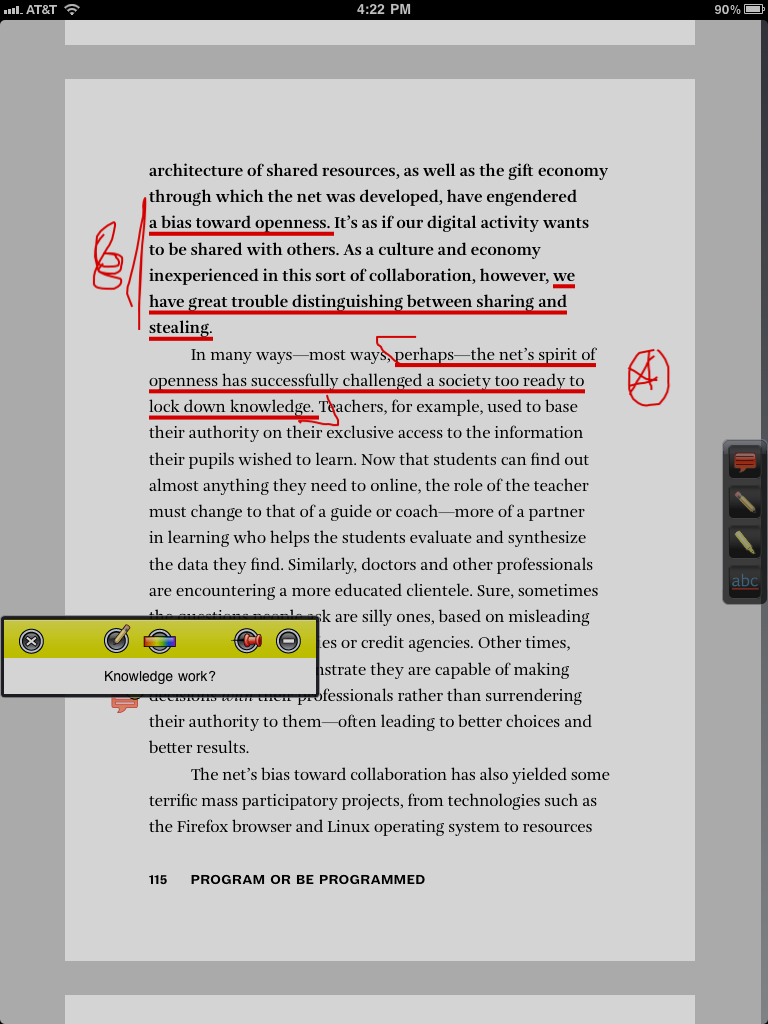
Because I read so much on my iPad, I use iAnnotate to read the books and articles I have in PDF. Here, for example, is a book that students in my Rhetoric, Writing, and Emerging Media course will read this semester, Program or Be Programmed:


With iAnnotate, I'm able to read in ways that are similar to (but still very different from!) the practices I use when reading an article or a book the old-fashioned way, pen in hand.

I can underline, star important points, and make comments in the margins. Because I type these comments instead of scrawling them in my horrible handwriting, I can actually read my notes later. Best of all, I can save the PDF as is, so that all of my edits and annotations are viewable (and shareable) elsewhere—in my DEVONthink database, for example (but that's fodder for another post...).

So, what am I reading?

Denise Schmandt-Besserat's How Writing Came About. A recent article by Clay Spinuzzi in Written Communication. Bill Moggridge's Designing Interactions. Howard Rheingold's Tools for Thought. A recent article about multimodal storytelling. Dave Winer's blog, Scripting News. The tweets of Jan Chipchase and Kevin Marks. Malcolm McCullough's Digital Ground. Mitchell Duneier's Sidewalk. And a whole host of other interesting articles in the "Read Later" archive of my Instapaper account...

3.12.2010

An Interlude on Writing and Technology

"As long as we think we do not have enough expertise to engage in substantive discussions about technology, we are effectively prevented from having an impact on the directions it may take. But there are opportunities for discussion and intervention in the process of technological growth and change, and it is important to take advantage of them. We believe that the lack of broad participation in conversations about technology seriously impoverishes the ways technologies are brought into our everyday lives. Our aim is to show how more people can be more fully engaged in important discussions and decisions about technology."

[. . .]

"We have noticed that people seem to distance themselves from critical evaluation of the technologies in their lives, as if these technologies were inevitable forces of nature rather than things we design and choose."

Nardi and O'Day, 1999, p. 13-14

Indeed, our expertise in engaging substantive discussions about technology is tied directly to rhetorical action in and through our literate practices. Our most pervasive technologies are "technolog[ies] of words" (Haas, 1996). Rhetorical action and technology are so tightly imbricated as to be nearly impossible to parse. Our literate practices, therefore, implicitly link us to our technologies.

"Technology and writing are not distinct phenomena; that is, writing has never been and cannot be separate from technology. ... To go further, writing is technology, for without the crayon or the stylus or the Powerbook, writing is simply not writing. Technology has always been implicated in writing: In a very real way, verbal behavior without technological tools is not, and cannot be, writing."

Haas, 1996, p. x-xi

Our expertise, therefore, is carried and enacted in large measure through rhetorical action, through literate practice.