In this post, I recap some of my research activity from the 2010–2011 academic year primarily as a way of sharing some of the things I've been working on, and how they lead into things that are coming up...
The last year was a busy one, no doubt. In addition to the usual stuff—teaching, grant writing, administrative and service work, etc.—I led and managed four different empirical studies that will be the focus of this post.
My ongoing study of Eucharistic Adoration practices continued into its second year of data collection (more about the methods and scope for this study can be found in screencasts of conference presentations here and here). After a bit of a lull in this project during the latter half of 2010, I've hit upon some especially intriguing ideas and participant practices in the last six months or so. I'm not quite prepared to publicly discuss even preliminary findings, but I will note that I'm seeing things that I intentionally wasn't looking for and didn't expect to find. Very exciting things that I think will make a real contribution to rhetorics of religion and spirituality.
This is a longitudinal, multi-sited ethnographic study, one that is currently planned to continue through April of 2012. I'll decide whether to continue data collection into 2013 sometime in early 2012. Right now, it looks like I'll do so, as my vision for the amount and types of data to collect is ambitious and still wanting. This is despite collecting a strong amount of data to this point. I'm currently considering strategic opportunities for dissemination—an edited collection or special issue, perhaps—where I could detail some early findings, but I have nothing planned as yet (which is probably for the best!).
I'm currently drafting the first of two planned manuscripts from a qualitative case study of transmedia storytelling that I conducted between December, 2010 and April, 2011. The impetus for this project was the work of my colleague and friend Brad King, a professor of journalism at Ball State and a leader in teaching digital and transmedia storytelling. In close collaboration with Nina Steiger of London's Soho Theatre, Brad led a transmedia summer school in 2010 that introduced playwrights to emergent digital story forms.
Preliminary findings indicate the importance of indexing practices for both teaching and carrying out transmedia stories. For my participants, indexing is most often realized as mundane, background, infrastructural writing work that supports narrative forms by organizing and linking multimodal (digital, print, material) assets. In this sense, indexing as a verb carries two concurrent meanings: the commonly assumed act of recording and organizing, and the less frequent usage (at least in writing studies) of tracing the value of assets (as in a stock index). I'm really excited about this project, and I'm indebted to the wonderful insights provided by Brad, Nina, and five of the ten playwrights who participated in both the summer school and my case study.
During the spring semester, 2011, I led an ethnographic study of the writing work supporting the collaboration of computer science undergraduates. My colleague and friend Paul Gestwicki was the instructor for the course that I studied, and a collaborator on the project (he wasn't involved during data collection but is now involved in analysis and dissemination, following our IRB protocol). Paul and two undergraduate honors fellows, Holden Hill and Phil Parli-Horne, developed a prototype application called Uatu that worked with Google Docs to visualize collaborative writing activity.
Our study, therefore, focused primarily on how students leveraged networked writing practices in conjunction with agile methods of software development. Our key research questions explored the role of networked writing in collaboration and learning, with participant use of Uatu providing us a way into secondary research questions concerning visualization and metacognition. We're still working through the data that we collected, but we already have a short piece out for review and plans for another manuscript later this summer. This was a really fun project, and my data collection was aided by a graduate assistant, Erika Johnson, who took a lot of field notes.
Finally, between July, 2010 and March, 2011 I conducted an ethnographic study of media researchers working on a large qualitative project of their own—from the earliest stages of planning and development all the way through execution of their study and public dissemination of their findings. I had collected rich, granular data in previous and concurrent studies, but nothing in my previous experience matches the amount of data that I collected for this project. This is due in large measure to the generous accommodation of my research participants, who provided me with tremendous access to their work.
Most of July and August will be spent working through the data, and I'm grateful to have a summer graduate assistant, Jenn Stewart, who has been tearing through the formidable pile of audio transcriptions while also offering insights by way of her own analytic memos.
I'm not entirely certain what kinds of outputs I plan to generate from this study, but I have a good idea of where I want to take this research. I've already discussed preliminary findings from one aspect of the study at ATTW 2011 (the screencast of the talk is here), and I'll publish more details from those findings at IPCC 2011 (discussed briefly here). I also have a short piece coming out soon that relies on one observed practice from this study. The majority of my work from this project is ahead, and I'm really looking forward to developing this work.
From these four 2010–2011 projects, only the first remains in a state of open data collection. This means I have a lot of writing to do!
I've already got firm plans for two more studies beginning in the fall, one of which extends my exploration of transmedia work by employing ethnographic methods. I'm also working on another smaller-scale case study (2–3 months of data collection) and have yet another ethnographic study tentatively planned for the spring of 2013.
I'm lucky to have some grant support for much of the work of analysis and dissemination during the summer and fall.
So there you go. Taking stock of my empirical research activity for the last academic year just reminds me of how much exciting work I have ahead of me!
Showing posts with label BSU. Show all posts
Showing posts with label BSU. Show all posts
7.12.2011
1.27.2011
What am I Reading?
[ NB: This post was written for the Ball State English Department Blog, and is mirrored here. ]
The more interesting question is "how am I reading?"
My workflow is constantly evolving, and right now, my reading is largely shaped by the combination of a few different mobile applications and devices.
I try to do 50 pages of research reading every day (more on that here). Consequently, most of the stuff I read is likely to be of little interest to all but the most intrepid grad students in Rhetoric and Writing. I'm assuming here that you don't enjoy research articles and technical reports about computer-supported cooperative work, distributed writing practices in the workplace, and the direction of ambient, networked writing activities. Like I do.
Some folks love to curl up with a good book of poems or short stories; I'd much rather read the methods section for a well-planned and executed qualitative study. So, I'll tell you what I'm reading, but I want to talk a bit about how I'm reading, since reading, writing, and publishing practices are currently in the midst of massive change.
Here's how much of my daily reading is likely to start. I open Google Reader and also browse links shared by folks I follow in Twitter. Thus begins the sifting and winnowing of information from the sources I've instructed to hail me each day. Clay Shirky says there's no such thing as information overload, just filter failure.
So my reading starts with filtering—selecting appropriate RSS feeds and Twitter accounts to deliver the things I need to do my job.

When something looks interesting, I'll click the link and navigate to the article. If it's more than two or three hundred words, and if it looks really interesting, then the magic starts. I use a bookmarklet that saves the article to Instapaper.
Instapaper is pure genius.
The application takes the article I'd like to save (let's say it's this 13,000 word gem of an interview with John McPhee in the Paris Review), strips away all of the banners, ads, and social networking detritus, and then serves up the written word in a clean, customizable interface on the device of my preference.
If something gets Instapapered by me, that means it's going to my iPad.

Reading on the iPad is amazing, but you know what Instapaper does that makes it even more useful? It downloads and stores every article I save so that I can read them no matter where I am, even if I'm offline (perish the thought!).
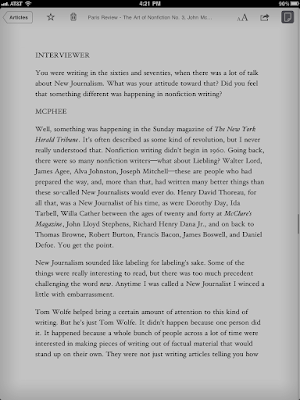
Because I don't want to keep hundreds of articles at all times in my Instapaper application on my iPad (I usually keep around 50 or so), and because I want to keep track of this river of reading for later reference, I made sure to link my Instapaper account with my bookmarking service, Pinboard. So, every time I save an article with Instapaper, that URL is archived for later retrieval on Pinboard.
Pinboard allows me to group items by using tags; here, for example, are all the items I've collected that might be used in ENG 213, our Intro to Digital Literacies course...
But I digress, this is about reading, yes?
So, let's get serious. Research articles, books, annotations of said items. Scholarly work. Instapaper usually isn't so good for those kinds of things (well, annotations, that is). That's where iAnnotate PDF and Dropbox come in to play.

If you don't have a Dropbox account, go get one immediately after finishing this post. Here's Dropbox in a nutshell: online backup of your files, synced among all of the computers and devices that you use. For free. Never lose a file again. Hard drive crashed? So what—files are in Dropbox. Elephant stepped on your Macbook? No worries—files are in Dropbox. Dog ate your homework? You get the picture. In fact, go sign up now. With this link, you'll get an extra 250 MB of space.
Many of the articles—and, increasingly, many of the books—that I read are available in PDF format. I upload those files to Dropbox, which means they're accessible from any internet-enabled device I might use to access them, which means I can choose from hundreds of articles or books to read pretty much anywhere.
Because I read so much on my iPad, I use iAnnotate to read the books and articles I have in PDF. Here, for example, is a book that students in my Rhetoric, Writing, and Emerging Media course will read this semester, Program or Be Programmed:
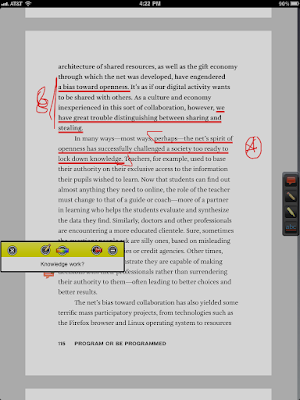
With iAnnotate, I'm able to read in ways that are similar to (but still very different from!) the practices I use when reading an article or a book the old-fashioned way, pen in hand.
I can underline, star important points, and make comments in the margins. Because I type these comments instead of scrawling them in my horrible handwriting, I can actually read my notes later. Best of all, I can save the PDF as is, so that all of my edits and annotations are viewable (and shareable) elsewhere—in my DEVONthink database, for example (but that's fodder for another post...).
So, what am I reading?
Denise Schmandt-Besserat's How Writing Came About. A recent article by Clay Spinuzzi in Written Communication. Bill Moggridge's Designing Interactions. Howard Rheingold's Tools for Thought. A recent article about multimodal storytelling. Dave Winer's blog, Scripting News. The tweets of Jan Chipchase and Kevin Marks. Malcolm McCullough's Digital Ground. Mitchell Duneier's Sidewalk. And a whole host of other interesting articles in the "Read Later" archive of my Instapaper account...
The more interesting question is "how am I reading?"
My workflow is constantly evolving, and right now, my reading is largely shaped by the combination of a few different mobile applications and devices.
I try to do 50 pages of research reading every day (more on that here). Consequently, most of the stuff I read is likely to be of little interest to all but the most intrepid grad students in Rhetoric and Writing. I'm assuming here that you don't enjoy research articles and technical reports about computer-supported cooperative work, distributed writing practices in the workplace, and the direction of ambient, networked writing activities. Like I do.
Some folks love to curl up with a good book of poems or short stories; I'd much rather read the methods section for a well-planned and executed qualitative study. So, I'll tell you what I'm reading, but I want to talk a bit about how I'm reading, since reading, writing, and publishing practices are currently in the midst of massive change.
Here's how much of my daily reading is likely to start. I open Google Reader and also browse links shared by folks I follow in Twitter. Thus begins the sifting and winnowing of information from the sources I've instructed to hail me each day. Clay Shirky says there's no such thing as information overload, just filter failure.
So my reading starts with filtering—selecting appropriate RSS feeds and Twitter accounts to deliver the things I need to do my job.

When something looks interesting, I'll click the link and navigate to the article. If it's more than two or three hundred words, and if it looks really interesting, then the magic starts. I use a bookmarklet that saves the article to Instapaper.
Instapaper is pure genius.
The application takes the article I'd like to save (let's say it's this 13,000 word gem of an interview with John McPhee in the Paris Review), strips away all of the banners, ads, and social networking detritus, and then serves up the written word in a clean, customizable interface on the device of my preference.
If something gets Instapapered by me, that means it's going to my iPad.

Reading on the iPad is amazing, but you know what Instapaper does that makes it even more useful? It downloads and stores every article I save so that I can read them no matter where I am, even if I'm offline (perish the thought!).

Because I don't want to keep hundreds of articles at all times in my Instapaper application on my iPad (I usually keep around 50 or so), and because I want to keep track of this river of reading for later reference, I made sure to link my Instapaper account with my bookmarking service, Pinboard. So, every time I save an article with Instapaper, that URL is archived for later retrieval on Pinboard.
Pinboard allows me to group items by using tags; here, for example, are all the items I've collected that might be used in ENG 213, our Intro to Digital Literacies course...
But I digress, this is about reading, yes?
So, let's get serious. Research articles, books, annotations of said items. Scholarly work. Instapaper usually isn't so good for those kinds of things (well, annotations, that is). That's where iAnnotate PDF and Dropbox come in to play.

If you don't have a Dropbox account, go get one immediately after finishing this post. Here's Dropbox in a nutshell: online backup of your files, synced among all of the computers and devices that you use. For free. Never lose a file again. Hard drive crashed? So what—files are in Dropbox. Elephant stepped on your Macbook? No worries—files are in Dropbox. Dog ate your homework? You get the picture. In fact, go sign up now. With this link, you'll get an extra 250 MB of space.
Many of the articles—and, increasingly, many of the books—that I read are available in PDF format. I upload those files to Dropbox, which means they're accessible from any internet-enabled device I might use to access them, which means I can choose from hundreds of articles or books to read pretty much anywhere.
Because I read so much on my iPad, I use iAnnotate to read the books and articles I have in PDF. Here, for example, is a book that students in my Rhetoric, Writing, and Emerging Media course will read this semester, Program or Be Programmed:
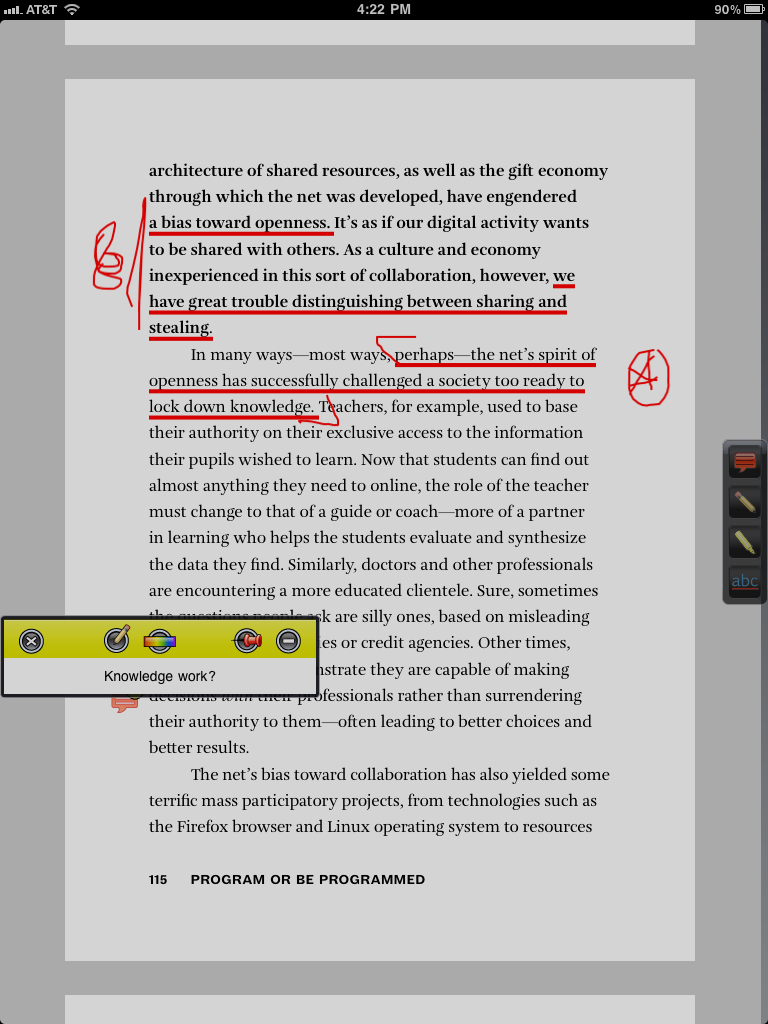
With iAnnotate, I'm able to read in ways that are similar to (but still very different from!) the practices I use when reading an article or a book the old-fashioned way, pen in hand.
I can underline, star important points, and make comments in the margins. Because I type these comments instead of scrawling them in my horrible handwriting, I can actually read my notes later. Best of all, I can save the PDF as is, so that all of my edits and annotations are viewable (and shareable) elsewhere—in my DEVONthink database, for example (but that's fodder for another post...).
So, what am I reading?
Denise Schmandt-Besserat's How Writing Came About. A recent article by Clay Spinuzzi in Written Communication. Bill Moggridge's Designing Interactions. Howard Rheingold's Tools for Thought. A recent article about multimodal storytelling. Dave Winer's blog, Scripting News. The tweets of Jan Chipchase and Kevin Marks. Malcolm McCullough's Digital Ground. Mitchell Duneier's Sidewalk. And a whole host of other interesting articles in the "Read Later" archive of my Instapaper account...
10.12.2010
Spring 2011 Courses
A quick post—mainly for potential students (but possibly of interest to others)—with the brief course descriptions for my two Spring 2011 courses.
At the undergraduate level, I'll be teaching ENG 431 :: Rhetoric, Writing, and Emerging Media. This is a brand new course that I designed in conjunction with Ball State's new Minor in Professional Writing, and it is, in fact, the capstone experience for that program.
This course has as prerequisites our Introduction to Digital Literacies (ENG 213) and Professional Writing courses (ENG 231). It builds on the ideas introduced in those courses, including writing for the web and qualitative research practices introduced in 213 and 231, respectively. Since this is the first time running 431, however, it may be possible to take the course without having already taken 213 + 231—talk to your advisor (or me!).
At the graduate level, I'll be teaching ENG 692 :: Writing Technologies. I'm particularly excited for this course, since we'll be starting with Haas (1996) and moving through germinal work in Activity Theory and Professional/Technical Communication, leading toward small-scale qualitative studies of writing technologies.
If you have questions about either course, please feel free to ask away!
3.31.2010
[ Finding Grooves ] Conversations + Spreadable Media
I gave a talk last week (3.26.10) at the Center for Media Design, responding to previous presentations about two of Ball State's most successful immersive learning programs, iMedia and SportsLink. This year, the CMD has sponsored research talks from Emerging Media Faculty Fellows, and more recently, presentations about our innovative immersive learning opportunities for undergraduates.
Brad King and I have been engaged in learning about both iMedia and SportsLink, and our backchannel conversations about opportunities for using social media platforms to extend SportsLink's brand resulted in an invitation for each of us to share those ideas with the university community last week.
I had a lot of fun with this talk, and worked from a looser script than I'm used to. Both talks fostered some great discussions, and I think we're all really invested in seeing these programs develop and prosper. Below is a screencast of my talk; as always, I welcome questions and feedback!
3.18.2010
[ Persistent Backchannels and Social Graphs ]
This a screencast of my brief roundtable talk for the 2010 Conference on College Composition and Communication in Louisville, Kentucky. I was thrilled to be a part of a panel called "(Almost) Live at the Cs: Re-visioning Conference Networks."
This screencast details my opening position statement; I argue that interstitial writing work is the sinew of persistent social graphs--the stuff that holds together and articulates (in the sense of "joining and mediating," following Hall, 1980 and Johnson-Eilola, 2005) complex sociotechnical networks. As always, I welcome feedback and conversation!
2.08.2010
Teaching in Public, Google Reader, and Self-Directed Learning
[ NB: this post was originally written for :: repurposed :: and is duplicated here because of clear overlapping concerns and dissemination for a different audience... ]

This is Bolutife (Bolu) Olorunda.
Bolu was a major contributor to my senior seminar for majors in English—Rhetorics, Places, and Publics, ENG 444—at Ball State University last semester. He's also an integral contributor to :: repurposed ::.
But Bolu is a Construction Management major. He doesn't really take any courses in English anymore. And he wasn't registered for my course at all.
Bolu's involvement in ENG 444 is absolutely fascinating to me.
I'm going to spend some time explaining why that is, and how opening our classrooms to broader publics through emerging media platforms can provide tremendous opportunities for self-directed, lifelong learning...
The start of fall term brought the usual documentation from the registrar's office—class lists, classroom locations, final exam schedules and the rest. As a faculty fellow with BSU's Emerging Media Initiative, I naively assumed that I'd be working in computer classrooms.
Naturally, I didn't actually check to see where my classrooms were located and what kinds of technologies were available in those rooms until a week before the semester started.
Of course, ENG 444 was not in a computer classroom. I needed it to be. So I requested a change.
Wish granted.
The new classroom location was in the Applied Technology building, in an open computer lab, in a room at least 15 degrees warmer than a room should be, regardless of changing weather conditions outside.
The new room was an unusually apt assignment for a course exploring rhetorics of space, place, and the built environment. We confronted issues of placement, location, and the malleability of the learning environment from day one. Early in the semester, when the weather was stunningly gorgeous, we often met outside, just to escape the heat of Applied Technology 208.
But perhaps the most curious affordance of the new classroom was the fact that it wasn't really a classroom at all. It's a computer lab, staffed full-time by a student employee. Every Thursday evening, when we met from 5 to 6:15, the student employee was Bolu...
A junior looking to graduate in 2011, Bolu is in many respects similar to thousands of other BSU students—he's bright, conscientious, responsible, and intellectually curious. Bolu's family is originally from Ibadan, Nigeria. His mother chose to pursue graduate studies at BSU (where she earned both an MA and PhD), and he moved to Muncie with his family when he was 14.
Bolu graduated from Muncie Central High School and enrolled at BSU. His father is an architect, and Bolu originally pursued architecture as his major. Though he is now studying Construction Management, he retains an interest in both architecture and engineering. He's started to think about his graduate school options in areas that may allow him to combine these interests.
Not surprisingly, the serendipity of Bolu's placement in an on-campus job in Applied Technology 208 each week, his interests in architecture and engineering, and the nature and tenor of our ongoing course on Rhetorics, Places, and Publics proved an important combination for his eventual involvement in 444.
For several class periods, our group of English majors (and contributors to :: repurposed ::) thought and talked through the politics and rhetorics of Muncie's “Village,” a shopping area just a couple of blocks away from campus. We used The Village to discuss Kevin Lynch's paths, edges, nodes, districts, and landmarks. We discussed how different groups cognitively mapped the area. We thought through what it might mean to redesign The Village, thinking about Setha Low's work on the social construction and the social production of public space.
Most of these discussions were student-led. I often provided the framework and the theoretical prompting from our readings, but the contributors to :: repurposed :: were always the contributors to our reimaginings of The Village. They did the work. And they mostly had fun with it, I think.
During a particularly lively full-group discussion one Thursday evening, while the others deliberated amongst themselves, I sat near the front of AT 208, across the desk from where Bolu patiently waited for the classroom to become a computer lab again. But this evening, about 5 or 6 weeks into the semester, Bolu asked, “is this an English class?”
“Yes,” I said. “The students are working on cognitive maps of The Village, thinking through one of our readings.”
“This isn't like any English class I've ever seen,” Bolu said.
“Oh? Why do you say that?”
“Well, the things you're talking about, the way you teach the course, the way they're discussing things. It's different,” Bolu said.
After class, I spent some more time talking to Bolu about the course. He was genuinely interested in the subject matter—in rhetoric—and in learning more about the work we were doing.
The next day, I added him to the Blackboard site for our course, so that he could access supplemental readings from Emig, Spinuzzi, Brummett, Porter et al, Diehl et al, Low, Soja, Sack, and Massey, among others. He started reading, on his own. He listened during class and took notes.
I asked Bolu to sign up for Google Reader, and had him subscribe to the Bundle that we used in conjunction with the course.
One Thursday evening after class, he told me that ENG 444 was the highlight of his day.
The week that we had this blog up and running, the week of October 19th, I formally introduced Bolu to the class, and I informed everyone that he'd be an important contributor to the blog.
And he was. And he still is.
At the end of finals week, Bolu came by my office so that I could ask him a little more about his involvement in the course. It was frankly thrilling for me to meet someone so interested in what we were doing, so invested in a course he wasn't even registered for, so intellectually curious.
I simply asked Bolu what interested him in 444, what made him participate in the ways that he did.
He told me that the course seemed informal and discussion-based—that there was room for participation from all who felt inclined to do so. As I mentioned above, the mere discussion of space, place, the built environment, and the use and theory of rhetoric was likewise interesting to him.
He told me again that he didn't think it was an English class.
For Bolu, the stereotypical English class involved students writing papers and reading things. But he felt like the 444 students were more than students. That they were doing things beyond simply writing papers. And they were interacting in class, in Reader, and on :: repurposed ::.
Bolu told me that he felt like a part of the class on those Thursday nights. He knew the others by name. He paid attention and took notes. He read many of the same things as those enrolled, and he followed along especially in our sharing of links and ideas on Google Reader.
Once :: repurposed :: was up and running, Bolu read every post. He told me that he was constantly refreshing the site, looking for new contributions.
Bolu is truly a self-directed learner. He's planning on graduate school after graduation, and eventually hopes to own his own business.
He doesn't want to work 9 to 5.
Knowing what I know about Bolu, I don't think that's going to be a problem.
I have more to say about how our group blog and emerging media tools like Google Reader can open up our classrooms to self-directed learners and to broader publics. The notion of making our classrooms more open, and of involving the public in our formative course work through tools like Reader has tremendous potential for immersive learning, in my opinion. But that's for another post...

This is Bolutife (Bolu) Olorunda.
Bolu was a major contributor to my senior seminar for majors in English—Rhetorics, Places, and Publics, ENG 444—at Ball State University last semester. He's also an integral contributor to :: repurposed ::.
But Bolu is a Construction Management major. He doesn't really take any courses in English anymore. And he wasn't registered for my course at all.
Bolu's involvement in ENG 444 is absolutely fascinating to me.
I'm going to spend some time explaining why that is, and how opening our classrooms to broader publics through emerging media platforms can provide tremendous opportunities for self-directed, lifelong learning...
-----
The start of fall term brought the usual documentation from the registrar's office—class lists, classroom locations, final exam schedules and the rest. As a faculty fellow with BSU's Emerging Media Initiative, I naively assumed that I'd be working in computer classrooms.
Naturally, I didn't actually check to see where my classrooms were located and what kinds of technologies were available in those rooms until a week before the semester started.
Of course, ENG 444 was not in a computer classroom. I needed it to be. So I requested a change.
Wish granted.
The new classroom location was in the Applied Technology building, in an open computer lab, in a room at least 15 degrees warmer than a room should be, regardless of changing weather conditions outside.
The new room was an unusually apt assignment for a course exploring rhetorics of space, place, and the built environment. We confronted issues of placement, location, and the malleability of the learning environment from day one. Early in the semester, when the weather was stunningly gorgeous, we often met outside, just to escape the heat of Applied Technology 208.
But perhaps the most curious affordance of the new classroom was the fact that it wasn't really a classroom at all. It's a computer lab, staffed full-time by a student employee. Every Thursday evening, when we met from 5 to 6:15, the student employee was Bolu...
-----
A junior looking to graduate in 2011, Bolu is in many respects similar to thousands of other BSU students—he's bright, conscientious, responsible, and intellectually curious. Bolu's family is originally from Ibadan, Nigeria. His mother chose to pursue graduate studies at BSU (where she earned both an MA and PhD), and he moved to Muncie with his family when he was 14.
Bolu graduated from Muncie Central High School and enrolled at BSU. His father is an architect, and Bolu originally pursued architecture as his major. Though he is now studying Construction Management, he retains an interest in both architecture and engineering. He's started to think about his graduate school options in areas that may allow him to combine these interests.
Not surprisingly, the serendipity of Bolu's placement in an on-campus job in Applied Technology 208 each week, his interests in architecture and engineering, and the nature and tenor of our ongoing course on Rhetorics, Places, and Publics proved an important combination for his eventual involvement in 444.
-----
For several class periods, our group of English majors (and contributors to :: repurposed ::) thought and talked through the politics and rhetorics of Muncie's “Village,” a shopping area just a couple of blocks away from campus. We used The Village to discuss Kevin Lynch's paths, edges, nodes, districts, and landmarks. We discussed how different groups cognitively mapped the area. We thought through what it might mean to redesign The Village, thinking about Setha Low's work on the social construction and the social production of public space.
Most of these discussions were student-led. I often provided the framework and the theoretical prompting from our readings, but the contributors to :: repurposed :: were always the contributors to our reimaginings of The Village. They did the work. And they mostly had fun with it, I think.
During a particularly lively full-group discussion one Thursday evening, while the others deliberated amongst themselves, I sat near the front of AT 208, across the desk from where Bolu patiently waited for the classroom to become a computer lab again. But this evening, about 5 or 6 weeks into the semester, Bolu asked, “is this an English class?”
“Yes,” I said. “The students are working on cognitive maps of The Village, thinking through one of our readings.”
“This isn't like any English class I've ever seen,” Bolu said.
“Oh? Why do you say that?”
“Well, the things you're talking about, the way you teach the course, the way they're discussing things. It's different,” Bolu said.
After class, I spent some more time talking to Bolu about the course. He was genuinely interested in the subject matter—in rhetoric—and in learning more about the work we were doing.
The next day, I added him to the Blackboard site for our course, so that he could access supplemental readings from Emig, Spinuzzi, Brummett, Porter et al, Diehl et al, Low, Soja, Sack, and Massey, among others. He started reading, on his own. He listened during class and took notes.
I asked Bolu to sign up for Google Reader, and had him subscribe to the Bundle that we used in conjunction with the course.
One Thursday evening after class, he told me that ENG 444 was the highlight of his day.
The week that we had this blog up and running, the week of October 19th, I formally introduced Bolu to the class, and I informed everyone that he'd be an important contributor to the blog.
And he was. And he still is.
-----
At the end of finals week, Bolu came by my office so that I could ask him a little more about his involvement in the course. It was frankly thrilling for me to meet someone so interested in what we were doing, so invested in a course he wasn't even registered for, so intellectually curious.
I simply asked Bolu what interested him in 444, what made him participate in the ways that he did.
He told me that the course seemed informal and discussion-based—that there was room for participation from all who felt inclined to do so. As I mentioned above, the mere discussion of space, place, the built environment, and the use and theory of rhetoric was likewise interesting to him.
He told me again that he didn't think it was an English class.
For Bolu, the stereotypical English class involved students writing papers and reading things. But he felt like the 444 students were more than students. That they were doing things beyond simply writing papers. And they were interacting in class, in Reader, and on :: repurposed ::.
Bolu told me that he felt like a part of the class on those Thursday nights. He knew the others by name. He paid attention and took notes. He read many of the same things as those enrolled, and he followed along especially in our sharing of links and ideas on Google Reader.
Once :: repurposed :: was up and running, Bolu read every post. He told me that he was constantly refreshing the site, looking for new contributions.
Bolu is truly a self-directed learner. He's planning on graduate school after graduation, and eventually hopes to own his own business.
He doesn't want to work 9 to 5.
Knowing what I know about Bolu, I don't think that's going to be a problem.
-----
I have more to say about how our group blog and emerging media tools like Google Reader can open up our classrooms to self-directed learners and to broader publics. The notion of making our classrooms more open, and of involving the public in our formative course work through tools like Reader has tremendous potential for immersive learning, in my opinion. But that's for another post...
12.30.2009
On the "Death" of RSS...
A screencast showing a specific use case in favor of RSS within the context of the RSS vs. Twitter debate.
Here, we see how ineffectual Twitter search can be for finding older tweets, and how important a feed-reader can be for archiving and retrieving those same tweets...
Here, we see how ineffectual Twitter search can be for finding older tweets, and how important a feed-reader can be for archiving and retrieving those same tweets...
11.07.2009
[ Locus Communis ] Twitter as Digital Commonplace
I gave a talk today at the International Digital Media and Arts Association annual conference. I almost always upload the slides for my talks, but because of the format for this conference--where presentations were limited to ten minutes--I decided to simply screencast the full talk and share it here.
I had a great time at the conference overall, and our panel fostered some excellent discussion. At just under ten minutes, the video takes some time to load; as always, I welcome feedback, questions, and discussion!
I had a great time at the conference overall, and our panel fostered some excellent discussion. At just under ten minutes, the video takes some time to load; as always, I welcome feedback, questions, and discussion!
CMD, RFID, QR, and Touch at iDMAa 2009
I spent some time over at the Center for Media Design during a break in the International Digital Media and Arts Association conference yesterday, and I had an opportunity to play around with the excellent integration of cross-platform media and information flow here at the conference. (If you have any interest, we've been blogging many of the conference sessions over at the iDMAa 2009 site).
Below are a couple of videos showing how iDMAa and the Center for Media Design have thoroughly integrated conference data (presenters, locations, abstracts) into the places, spaces, and ubiquitous devices that mediate our conference experience...
Below are a couple of videos showing how iDMAa and the Center for Media Design have thoroughly integrated conference data (presenters, locations, abstracts) into the places, spaces, and ubiquitous devices that mediate our conference experience...
8.26.2009
Fall Syllabi
It's that time of year once again, when the heat of summer dissipates into crisp fall evenings and the trees gain shape by losing shape, molting brilliantly colored leaves which fall into the paths of so many university students on so many campuses around the world. Marching bands will march, coffee will be consumed, and my students will scratch their heads for a few weeks...
In the time-honored tradition of my field, I make available to any and all the syllabi and course calendars from which my students will teach me and teach one another. There is some overlap, yes, but the two courses, despite the apparent similarity of the deliverables, will end up in very different places in just a few weeks. Comments and suggestions are warmly appreciated.
In the time-honored tradition of my field, I make available to any and all the syllabi and course calendars from which my students will teach me and teach one another. There is some overlap, yes, but the two courses, despite the apparent similarity of the deliverables, will end up in very different places in just a few weeks. Comments and suggestions are warmly appreciated.
Subscribe to:
Posts (Atom)
