Showing posts with label academe. Show all posts

10.24.2015

Visual Rhetorics, Visual Methods

Visual Rhetorics, Visual Methods

Just before the Fall, 2015 semester began, I tweeted a link to my Pinboard collection of articles and blog posts related to visual research methods. My message was simple: if you teach visual rhetorics or visual methods, here are hundreds of syllabus-worthy links in one handy place.

But even as I shared that collection of links, I worried about how colleagues in the field might interpret the collection, and whether they would even find use in them. This worry stems from the possible mismatch about what each of us considers to be representative of visual rhetoric. I don’t mean this in some strictly subjective sense, but in the broader sense in which our field’s view of visual rhetorics has congealed and become normative.

Even though I’ve written about the relationship between visual rhetorics and visual methods in various places, I’m aware that I’ve never made the connections, overlaps, and productive divergences particularly clear in spaces such as Twitter and here, on my blog. My fear is that teachers and scholars who are familiar with (and teach) mainstream approaches to visual rhetorics may be unclear as to how links such as this Slate post about Chinese, Taiwanese, and Japanese brooms—to take just one recent example—is useful for teaching and exploring visual rhetorics.

In this post, then, I’ll try to clearly and succinctly explain my perspective on the relationship between visual rhetorics and visual methods for teachers and scholars in rhetoric, writing studies, and related disciplines.

Historical interests in the visual, aural, multimodal, and multisensory aspects of persuasion and composition are by now well established. But our approaches to the visual, in particular, are predominantly reception-oriented. This is no critique, but a statement of fact regarding the scope and methodological focus of most of our field’s formative scholarship on the visual. Research in visual rhetorics overwhelmingly involves analysis of extant images (still and moving) and other extant visual phenomena. Those projects that use images in the processes of empirical research—for example, Cushman (2011) or Wickman (2010)—are outliers rather than evidence for prevalent or even emerging trends.

It may seem as if I am oversimplifying; I am not. The differences really are this simple.

But make no mistake: reception-oriented approaches to visual rhetorics are essential to our (and our students’) understanding of visual phenomena. My own arguments for using visuals in the processes of empirical research of writers and rhetors, I hope, draws from, complements, and extends reception-oriented approaches in different ways, toward different ends. Visual research methods, in other words, are closely parallel to the traditional analyses and subject matter of visual rhetorics.

The great majority of the links posted in my Pinboard collection are selected with my empirical, visuals-made-in-research approach. There are many, many posts highlighting what we might call documentary photography or photojournalism. There are very few posts featuring the work of anyone who might unambiguously be called researchers of writing or rhetoric.

So why did I argue that this collection is useful for teachers and researchers of visual methods and visual rhetorics?

For those interested in making images as part of research in rhetoric and writing (or teaching such approaches), there are hundreds of links that serve as inspiration, that feature compelling and often novel subject matter, that execute common visual methods (though for admittedly different purposes and audiences), and that present challenging or even orthogonal approaches that might help clarify and improve our work.

And for those interested in analyzing extant images from a variety of perspectives, the collection is a treasure trove of opportunity with a decidedly realist bent.

The post I linked to about brooms, for example, is more art photography than photojournalism, but it’s rich with implications for empirical visual researchers and visual rhetoricians.

For visual researchers, the project uses images to: (a) create a typology of like objects and thus a framework for comparison and analysis; (b) to celebrate beauty, craftsmanship, utility, place, and purpose in the everyday; and (c) to explore both situated and comparative experience. I’d be thrilled with any research design exploring writers and rhetors that would help me do so much.

For visual rhetoricians, the project uses images to: (a) foreground the compelling and varied visual aspects of mundane, ready-to-hand materials and objects; (b) to effect a visual typology that demonstrates similarity and difference in designed artifacts; and (c) to foreground work in visual rhetorics by one artist/photographer as a way of speculating on what such visuals do to and for particular audiences.

These analytic axes are off the top of my head, and as you’ll note, there is plenty of productive similarity across lists. Savvy teachers of visual rhetorics could come up with any number of alternative approaches to this example. Good examples, such as this one, will explore both visual methods and visual rhetorics in tandem.

In sum, visual rhetorics and visual methods are complementary approaches to our field’s study of visual composition and persuasion. Many of the links in my Pinboard collection may not appear to be firmly within the traditional realms of visual rhetoric, but I hope to have shown how nearly all of these examples could be productively examined from both perspectives.

10.18.2014

Picturing Writing with Visual Research Methods

Picturing Writing with Visual Research Methods

In Academic Writing as a Social Practice, Linda Brodkey (1987) argued that composition studies needed a new cultural conception of composing, one that reimagined the tired trope of the alienated and anguished writer who writes alone. In a chapter titled “Picturing Writing,” Brodkey relies heavily on visual metaphors; she passionately argued that we need new pictures of writers and composing practices in their rich, socially situated complexity. She asked readers to re-see writing, to consider alternative viewpoints, and in the process, to break away from popular perceptions of composing, particularly because such perceptions obviate new, different, or even challenging perspectives about writing (58).

More recently, Jody Shipka (2011) draws on Brodkey to suggest that one charge of contemporary composition research is to foreground and make more visible the circulatory processes of composing and textual distribution (38). In response to these and similar exigencies, I compose with photography as one way in which to see writing anew—a method for re-seeing the complexity of composing processes by literally and systematically picturing writers and writing.

As a qualitative researcher focused on the activities, objects, and environments of composing, I conduct ethnographies and case studies of writers in everyday life—from academe and industry to religious practice and social gaming. In these studies, I use traditional fieldwork methods such as semi-structured interviews, participant observation, and artifact collection and analysis. In my early fieldwork, I often used photography and videography as well, mainly as means of augmenting observational fieldnotes and capturing informal talk, gestures, and spatial and material arrangements.

A few years ago, however, I realized that my use of visual fieldwork methods, while beneficial, was also somewhat facile in its execution. I learned that over the last four decades, social scientists have explored the nuances of visual methods in studies of social life (see, for example, Pink, 2007; Spencer, 2011; and Pinney, 2011), of which writing is, of course, an inescapable mediator. The subfields of visual anthropology and visual sociology have enriched my understanding and use of visual methods in fieldwork. These approaches have developed in parallel to our own field’s explorations of visual rhetorics, resulting in complementary empirical perspectives on visuality and visibility.

Writing in the world: a tiny geocache container and scroll for logging visits.

More recently, therefore, I have adapted approaches from visual anthropology and visual sociology to the study of writers and their composing practices and environments. Doing so has resulted in many trials and errors, but the struggle has been rewarding: I have learned to use visual methods to explore, analyze, and present the rich materiality of everyday composing practices, and in the process, to formulate new pictures of writers and writing that may be generative for participants and composition researchers alike. More important, by using visual methods in field studies I have been able to create new forms of material engagement with participants about the role of composing in their learning, work, and play.

While critics such as Susan Sontag (1977) have suggested that photography results in the distancing of photographic subjects from photographers, I have found opposite to be true: Visual methods of fieldwork result in qualitatively different forms of intersubjective understanding between researchers and participants. Composing with photography throughout fieldwork can help researchers of writing move beyond mere tautological illustration; by using visual methods, researchers may document and engage simultaneously.

More important, participants may see their own composing environments, tools, and practices in new ways, from different perspectives. A technique known as photo-elicitation uses fieldwork photographs as pivots for better understanding participant practice. For example, by photographically demonstrating a writer’s well-maintained mise en place, the researcher may help make the familiar strange for a participant, and through discussion, develop new insights about their composing practices.

In a similar way, visual methods may result in presentations of experience that are more hyaline and evocative than traditional forms of reporting. Qualitative data is notoriously dense, and for readers, the mass of fieldwork supporting ethnographies and case studies is often opaque. In addition, traditional methods of collection and representation are necessarily sequential; observational fieldnotes, for example, may miss crucial details of actual practice—movements, tools, arrangements, or cross-talk that may meaningfully mediate composing.

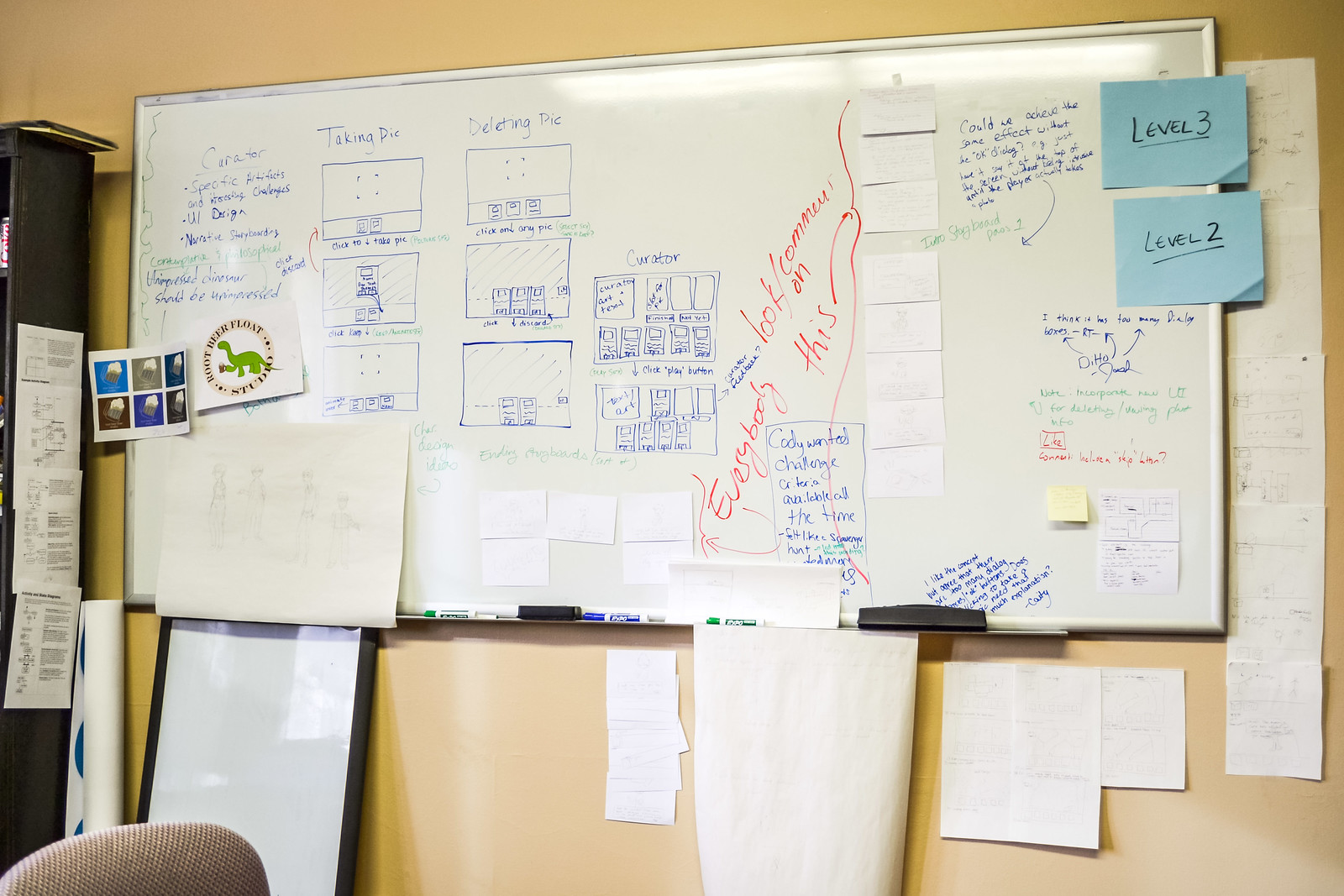
A software studio’s whiteboard is a collaborative space for composing and ideation.

Photographs offer simultaneous renderings of practice, what Flusser (2002) terms surfaces rather than lines. A traditional ethnographer detailing the complex, collaborative work pictured above must transform the simultaneously visible surface of a software studio’s whiteboard into a linear representation of activity. A visual ethnographer, however, can present that visible surface in its full complexity; when coupled with an analytic narrative that details punctuated development, a more hyaline rendering of complex composing practices emerges.

Qualitative research is characteristically ideographic; indeed, visual methods foreground the situated materiality of composing practices. This is a key strength of visual methods as I practice them in studies of writers and writing: the ability to document and collaboratively explore particular systemic contexts and the ways in which artifact assemblages participate in composing processes.

However, in developing new pictures of writers and writing, visual methods have the potential to be nomothetic in the aggregate. Because visual methods may be more hyaline—presenting richer data than traditional methods alone—they carry the potential for fruitful cross-case comparisons of composing practices. Imagine, for a moment, systematically composed and collected photographs of 20,000 first year writers’ typical composing environments and the resulting wealth of both particular (ideographic) and tendential (nomothetic) pictures of writing that might emerge from careful analysis.

Visual methods in empirical studies of writing carry the potential to further develop and realize Brodkey’s argument for re-seeing our object of study, and more important, the people who write. Barthes (1981) argued that “the camera can be an instrument of deep meaning, connecting the scene to the viewer and the viewer to existence” (131). With visual methods, writing researchers can reframe cultural conceptions of where, how, why, and with whom people write in their everyday lives.

4.05.2014

Gonzo Academicus

Gonzo Academicus

Justine Bateman—actress, entrepreneur, mother of two, and media consultant—enrolled as an undergraduate at UCLA in the fall of 2012, at the age of 46.

She maintains a Tumblr about the ups and downs of her experience called Get a College Life, and she has inspired many others who have enrolled in college at “nontraditional” ages. The blog is continually engaging, and I love when she posts the hand written cheat sheets created by her and her peers.

About a month ago, she posted about one of the most bewildering aspects of navigating a typical undergraduate curriculum: general education requirements. I vividly recall my confusion at the need to map compulsory subject areas to the many course options available when I was an undergrad at Oregon. And one of the compulsory general education courses over which students typically have little choice is first-year writing.

Bateman’s argument makes sense. She wrote:

“Also, just found out that I have to take these ridiculous GEs I was trying to get out of. I petitioned to substitute these very topic-similar upper division classes I’d already taken for these basic, lower division classes and they refused. I really don’t see the academic logic. If I’ve taken the more advanced versions of the classes they want me to take and I received A’s in those classes, doesn’t that give weight to the argument to use them as replacements?”

Many schools will substitute courses, but many schools also have a general education credit hour requirement that must be fulfilled in order to graduate (and the logics are often rooted in accreditation and administrative concerns). More important, where it might not matter if one took Anthropology 212 instead of Sociology 103 in order to check off the “social sciences” box of the general ed. curriculum, there’s typically little leeway when it comes to the writing requirement.

After a couple weeks, Bateman once again expressed her frustration with general ed, and with the writing requirement in particular:

“Already set for next quarter. Italian, Business Law, and Computer Organization (CS33 - Machine Language). (And a required english composition class they’re forcing me to take. Really?)”

I admit, I had three nearly simultaneous reactions when I read this post: (a) a defensive response rooted in my own attachment to writing as a worthwhile academic pursuit; (b) a sympathetic response rooted in my own desire to navigate both undergraduate and graduate curricula as quickly as possible while minimizing time and effort spent on subjects for which I had no investment; and (c) a thought experiment response rooted in a desire to push back against (a) and (b): what if taking the class improved one’s writing, regardless of their circumstances?

I’ve been thinking about this quite a lot in the last six months or so. Like many of my peers in academe, I’ve always been “good at” writing. But then again, I mostly write for academic audiences, and academic writing is regularly critiqued for being obtuse, jargon-filled, overly hedged, and generally esoteric.

Picture a continuum where, on one end is the argumentative acumen of a gifted third grader and on the other is Susan Sontag and John McPhee (or whomever you’d like to substitute for these masterful non-fiction writers). If I’m being honest, my prose is much, much closer to the gifted third grader than it is Sontag and McPhee.

The reality is that I still have so much to learn about writing, and about being a better writer. And I get paid to study writing. As I thought more about Bateman’s predicament within the context of my own ability as a writer, I started to think about my own need to continually learn and improve.

A few months ago I re-read Strunk and White’s The Elements of Style and realized that I’d gotten into lots of bad habits. I also read William Zinsser’s On Writing Well and Graff and Birkenstein’s They Say/I Say (a common FYC text). I learned much from all three books, but my overriding realization was that I still have a long way to go as a writer.

Let me put this another way: I am a writing professor, but I bet I’d learn quite a lot about writing if I enrolled in a first-year writing course with an open and earnest comportment to learn and improve.

Revisiting core concepts and diligently practicing my chops would surely contribute to my learning. But I’d argue that some of the most innovative teaching in our field occurs in the first year course, where bright graduate students and non-tenured faculty are continually reimagining what the course can and should do. As professors, we often learn from our graduate students in the seminars we lead; I bet we’d learn much from them as our teachers, too.

So I started to think about a kind of gonzo academicism (for lack of better term). What if we know-it-all types (the finger is squarely pointed at myself) took an FYC course?

Better yet, what if 10 writing professors at various stages in their careers and at various kinds of institutions enrolled in FYC courses for one semester at their schools and then contributed to a group blog about their experiences?

I can’t imagine that this would be a bad thing for our understanding of pedagogy and curricula in our respective institutions. And I’m willing to bet that our prose would improve. Wouldn’t we learn to be better writers, and to sympathize with our students and FYC instructors? How could we not?

A writing professor taking a first year writing course may well be different than an anthropology professor taking Anthro 101. I see this as a strength of our field. We can always improve our writing. We can learn from people along the continuum. We never stop learning how to write.

(Bateman, meanwhile, seems to be liking her writing instructor so far.)

7.14.2013

Found Photo Fodder

Found Photo Fodder

I haven’t commented much on the death of Google Reader, and while this post is marginally about RSS (and, really, about tagging within RSS), I don’t really have much to say about Reader that adds anything meaningful to all of the excellent things that have already been written.

Instead, this post is about found photos, sources for those photos, and the use of such photos in professional presentations.

Over the last few years, I’ve received some minor kudos for developing conference presentations that are visually arresting and compelling. I’ve heard lots of good feedback from folks whose opinions I value about the effectiveness of my presentation style, which is heartening.

During the first couple of years that I worked on developing this ethos, I predominantly used striking images that I found on the web (hence my use of the term “found photos,” which, technically, is different from the actual definition of found photos or vernacular photography, but not unlike that definition either, but that’s for another post…). Indeed, when preparing a presentation, I would often begin with the images, mining Google Reader posts for visuals that evoked or supported ideas I was trying to convey verbally.

After giving a talk, folks would often ask: “Where do you find all those cool images?” In reply, I would usually joke that it was a “trade secret.” But really, it was just simple sifting and winnowing using RSS.

In Reader, I subscribed to several image-intensive feeds, many of which were from Tumblr. These feeds have always made my RSS experience a pleasure, for mixed in with discourse-heavy posts from fellow academics, tech blogs, and news sites were often incongruent and arresting photos. Over the years of using Reader, I probably looked at 100,000 or more photos.[1]

When I stumbled across an image that was striking for whatever reason—and I learned to develop a sense of what would make an interesting and effective slide-ready image—I would simply use Reader’s tagging function to label the post “photos.” That’s it. When it came time to prepare a talk, I’d open my list of posts tagged “photos” in Reader and simply j/k my way through, looking for visuals congruent with the scope of my presentation.

I had thousands of posts tagged “photos” in Reader,[2] which means that I had my own archive of visuals that might evoke the presentation ethos I’d developed over time.

However, over the last two years I’ve moved away from using such found photos in my presentations, preferring instead to use my own images to support my work for two main reasons. First, I’ve been developing approaches to using visual research methods in qualitative studies of writing, and consequently, many of my talks have covered this work. Second, and perhaps more importantly, I’ve been working hard on developing rhetorically engaging visuals of my own, honing a visual phronesis related my academic work alongside the verbal and written craft.

Regardless, when Reader died, so too did thousands of tags. This is but one example; I also used tags to code data in Reader, I used tags to mark items related to research reading, and I used tags for a variety of other things (one of my favorite tags was “holy shit,” reserved for a bevy of truly amazing and awe-inspiring posts).

I moved to Newsblur in mid-June, and I’ve been very happy with the service. No tags, though, and no import for the archive of tagged items from Reader users (there are some other options, I realize, but that’s not the point of this post).

And yet, I still have the desire to single out arresting images. In the old days of Reader, I would sometimes publicly share such images. Since Newsblur doesn’t support tagging but does offer some of the social sharing features that were once part of Reader, I’ve been using the “share” feature to collect interesting found images.

It’s not a workaround, but a totally different way of thinking about the images I find arresting. Since I’m sharing these publicly, I’m thinking more about why I find the images striking, whether others will find them similarly striking, and what my sharing them says about me and my visual ethos.

If you ever wanted to tap into the archive of images I used in presentations a few years ago, or if you simply would like another image-intensive feed in your own RSS reader, feel free to add my Blurblog, a feed of nothing but images that I once would have tagged “photos” in Reader.


  1. Who knows for sure? I’m basing this on the fact that a couple years ago Google released statistics for individual Reader users. When they did, I learned that I had already surpassed 300,000 total read items, the maximum count they’d render for a given user. Again, that was a couple years ago, at least. My feed list has always included a healthy amount of photoblogs, and “reading” posts from such feeds takes just a second, particularly if the image doesn’t immediately hold my attention. Could be I looked at 50,000 images, could be I looked at 300,000. Regardless, I explored (and continue to explore) a crap-ton of images as part of my everyday routine. I’ve thus honed certain visual sensibilities alongside my daily academic reading and writing.  ↩

  2. In actuality, I had more posts tagged “photos” than Reader could actually render, should I want to mine them to the earliest such tagged occurrence. Google’s API limits, even in the good old days, stopped me from seeing more than a few thousand.  ↩

6.24.2013

Scaffolding

Scaffolding

Last week, I attended a one day forum exploring intercultural education.

Near the end of the forum, during an informal panel discussion, an audience member asked a question about scaffolding—how might we better scaffold intercultural learning experiences in order to effect outcomes?

As the panel member began his answer, my mind drifted…

Specifically, I began to think about this particular pedagogical metaphor—scaffolding. It’s something I first heard about in graduate school, and it’s actually something that became a part of my dissertation and eventual job talk (the first time I was on the market).

It’s a metaphor that’s commonsensical; teachers create scaffolds for student learning in a variety of ways, from the readings they choose through the pacing of lesson plans and the presentation/discussion of appropriate models. Scaffolding helps students reach higher (metaphorically) than they could without them.

I started to wonder—what if we approached the metaphor a little more literally?

Let’s say that I’m painting a two story house. I’ll definitely need scaffolding of some kind to help me reach second story eves and trim and walls.

Eventually.

My point is this: scaffolding is not necessarily where I’ll start. Indeed, I’ll probably jump in and start prepping the first story. I might power wash the exterior walls, scrape peeling paint, take a wire brush to window trim badly in need of a thorough cleaning.

And then the taping! So much taping is involved in this job. Much of this necessary (really, crucial) prep work will be done without scaffolding (but maybe a step ladder at times).

There’s something to be said for not having scaffolding—or not putting such an emphasis on scaffolding right away—but valuing some immersive work at the ground level. How much can we do without scaffolds?

It’s been a good six or seven years since I was introduced to the metaphor of scaffolding, and it has shaped (and even clouded) my pedagogical practices. It’s seems healthy to think through our dominant metaphors from time to time, even if only during a daydream.

11.03.2012

The Future 5000

The Future 5000

This post has one aim: to explore what I want to do with this blog, going forward.

This is a bit of metablogging, then—blogging about blogging. There’s a good chance none of this will interest you much; I won’t be offended if you click away…

I’ve used my blog to host a variety of different kinds of posts over the years, and I’ve never really limited the direction and scope, other than to say that this is my “research blog,” a way of differentiating what I post here from what I post (or might post) in other, especially shorter-form venues.

Two things have led to this particular post, however: 1. I haven’t blogged much this year, and 2. I haven’t been inspired to blog much this year.

Truth be told, I’ve been less inspired to publicly post much of anything, especially in the last few months. This may come as a shock to some who know me well, considering I have some 14,000 tweets, a few thousand Flickr photos (many of which are private, though), and I’m a fairly regular Instagram user/poster. But in reality, I tweet far less than I used to, I’ve never been on Facebook, I’ve essentially abandoned Pinterest, I never really got into Google+, Meme is dead, and Flickr is mostly for my family and very close friends.

For a while, I thought that I’d found a sweet spot with a shorter form blog, Notemaking, where I’d post more frequently about interesting current issues as a way of publicly thinking through items of potential research/practice interest. But really, that fell flat for two reasons: 1. I didn’t always feel like posting, especially when most of my time is far better spent working on (and writing for) my research program and working on teaching-related concerns; and 2. who the hell cares what I think about such things anyway? There are many awesome folks out there who maintain frequently updated short-form blogs; I’d rather read them than me, too.


One of the things I really admire about Clay Spinuzzi’s blog is the way that he shares his thoughts on scholarly research through his frequent reviews. I write annotations now (over 100 in the last year), and I’ve played around with formatting and posting some of them to the blog. But after writing many, many more annotations in DEVONthink than I actually posted to my blog, I realized that I likely read and annotate very differently than Clay, and so posting my annotations to my blog—even in revised form—just doesn’t accomplish the same thing that his excellent reviews do.

Moreover, my annotations are my annotations, and while I’ve long been a proponent of public sharing, my research notes don’t translate well to broader dissemination. I like keeping them in DEVONthink and using them the way that I do.

But this is all preamble to the aim I described above: what should this blog be, and how do I want to use it?


I’ve figured a lot of things out in the last couple of years. It took me a while to develop practices and routines that work for me as a professional academic. By no means do I have everything figured out, but I think I’ve got things pretty well sorted in terms of having a clearly articulated research program and well-defined practices for accomplishing things to push that program forward.

I certainly didn’t know what I was doing when I finished my PhD and took my first academic appointment in 2009. I didn’t really know what I was doing, actually, until sometime in 2011. Yes, I was still productive, and yes I did some things really well, but I didn’t have things really nailed down. There was a disconnect in many of the moving parts of my everyday practice.

Today, there are still a lot of moving parts in my everyday practice, but now I know how they are related; now I know what the effects are when I pull one string—how that act impacts the other strings to which it is connected. I come to work, and I know what the hell it is I’m doing. I don’t worry about what I should be doing, or what might happen in two months. I already know, because I’ve developed a research program rather than a research agenda; the program has tightly articulated, interrelated components rather than a series of projects that may or may not be related.


This is really important context for describing what I do with this blog, believe it or not.

You see, I’m not posting here much because this particular string is not really attached to the web of other things I’m working on. The future of the blog, therefore, will be literally and figuratively tied to the other strings in my professional web. And it will carry posts that are differentiated in important (and hopefully worthwhile) ways from the many excellent blogs run by my disciplinary colleagues.

I still reserve the right to post whatever I want here—I don’t want to limit this outlet and say “it’s only about x, y, and z.” However, I do envision a more coherent focus, for at least the medium term (let’s say 18–24 months—probably a bit longer, but we’ll go with that for now).

I’m not changing the title, I’m not developing some new, kitschy theme, and I’m not looking to carve out some niche. Hell, I don’t even care anymore about pageviews and such.

Instead, I’m going to post things here that relate more meaningfully to my research program—to current projects, to completed studies, to forthcoming work, to failed projects, to dreamed about projects, to the “b-sides” of published work.

Throughout my academic career, I’ve focused primarily on the everyday work, learning, and play of professionals and students. And beginning with my earliest published work, I’ve been a proponent of empirical visual research methods—even when I was too naive to know that this was a credible and well-established research methodology in the social sciences.

Many folks in my field work with, in, and through visual rhetorics. Comparatively few use empirical visual research methods (VRM) as a key form of inquiry. I do, and I’m working on new ways of tracing and studying writing and rhetorical work by using such strategies—visual ethnography in particular.

Going forward, my posts here will likely have more to do with VRM than other kinds of posts. That also means more visual content.

If you read this, thanks for thinking along with me!

2.20.2012

Annotations | Nardi, 1996: Studying Context

Annotations | Nardi, 1996: Studying Context

[ NB: “Annotations” are occasional posts that explore selections from my research reading—articles or books—in rhetoric, technical and professional communication, and related fields. ]

Nardi, B. (1996). Studying context: A comparison of activity theory, situated action models, and distributed cognition. In B. Nardi (Ed.), Context and Consciousness: Activity Theory and Human-Computer Interaction (69–102). Cambridge, MA: MIT Press.

In my last post, I considered how and why human beings become attached to particular artifacts and technologies. Trauman offered a compelling response in the comments area, and I thought I’d respond to at least part of his query here: how to get started with activity theory…

This semester, I’m teaching a special topics graduate seminar exploring activity theory and writing technologies. I’ve posted the syllabus for the course on Scribd, but the actual reading list is hardly innovative—it’s all the usual stuff to get one primed on the basics of AT and its application in rhetoric and writing studies. For deeper reading, have a look at Clay Spinuzzi’s list of activity theory sources on Mendeley.

But I thought I’d address some of the basics of activity theory by considering one of its primary applications: studying particularized contexts and situatedness by deploying a methodological framework (activity theory) that moves a given researcher beyond an overdetermined particularity. This is actually one of Nardi’s (1996) goals in her excellent chapter comparing activity theory to situated action models and distributed cognition.

I thought I’d kill two birds here by exploring some AT basics through an annotation of Nardi’s chapter.

This chapter of Context and Consciousness is, like the one before and the one that follows, essential reading for the budding activity theorist. Nardi explores the notion of context in a given research site by considering perspectives from three similar methodological/theoretical approaches: activity theory, situated action models, and distributed cognition. In this chapter, she asks:

  • What exactly is context?
  • What is the correct unit of analysis if the individual is no longer the primary locus?
  • What are the relations between artifacts, individuals, and social groups?

Nardi begins by making the argument (drawing on several other studies) that it is simply not possible to understand how people learn or work when the unit of analysis is “the unaided individual with no access to other people or to artifacts” (p. 69). In other words, artificial lab settings are no longer sufficient for truly approximating the complexity of human beings acting with technology. She also asks, crucially, how we might study complex, situated contexts while still producing research findings that are generalizable (p. 70).

Essentially, Nardi’s goal is to explore the three approaches noted above to see how each deals with the problem of research contexts, considering the benefits and drawbacks of each for studying HCI in particular.[1]

A situated action model, Nardi argues, “deemphasizes study of more durable, stable phenomena that persist across situations” (p. 72). Situated action models, therefore, are highly particularistic: “These analyses offer intricately detailed observations of the temporal sequencing of a particular train of events rather than being descriptive of enduring patterns of behavior across situations” (p. 72). She adds that situated action models suggests that the structuring of activity emanates from the immediacy of a given situation. This is extremely problematic, of course, because it essentially elides cultural-historical factors that surely impinge upon how a human being uses a particular artifact, for example.

Nardi moves next to a discussion of activity theory, where activity systems are the unit of analysis, comprised of “subject, object, actions, and operations,” and where the object held by any one subject “motivates activity” and gives it shape and direction (p. 73).[2] “Actions are goal-directed processes that must be undertaken to fulfill the object,” she states. Actions are conscious, and different actions may be linked in the service of the same goal. Chains of actions work in support of the more complex activity.

Objects, Nardi notes, are not immutable structures, but they also don’t change on a moment-by-moment basis, thus offering some stability (p. 74). Actions also have operational aspects—routinized, unconscious operations (such as accelerating and breaking while driving a car). Nardi points out that “Activity theory holds that the constituents of activity are not fixed but can dynamically change as conditions change. All levels can move both up and down” (p. 75).

Nardi then describes mediation as a key notion in activity theory approaches. “Artifacts carry with them a particular culture and history,” she argues, drawing on Kuutti (1991), and they are “persistent structures that stretch across activities through time and space” (p. 75). Activity theory, she argues, has a very strong notion of context: “the activity itself is the context. What takes place in an activity system composed of object, actions, and operation, is the context” (p. 76, emphasis in original). Moreover, “People consciously and deliberately generate contexts (activities) in part through their own objects; hence context is not just ‘out there’” (p. 76).

Nardi takes us next through the particulars of the distributed cognition approach, where the representation of knowledge is both in the head and in the world, that is, in and between individuals and artifacts (p. 76–77). For distributed cognition, “we cannot understand how a system achieves its goal by understanding ‘the properties of individual agents alone’” (p. 77). Distributed cognition “moves the unit of analysis to the system and finds its center of gravity in the functioning of the system” (p. 77).

In this chapter, we can see that Nardi establishes a continuum, with the constrained particularity of situated action models at one end, and the systems level approach of distributed cognition at the other. Activity theory, with its recognition of both individual particularity and collective sociocultural histories within a given context, sits somewhere in the middle of this continuum.

Nardi moves next to exploring the key differences between these frameworks, starting with how each structures or models human activity. In an activity theory approach, “activity is shaped first and foremost by an object held by the subject” (p. 79). Activity theory, therefore, emphasizes motivation and intentionality of the human or collective. This differs markedly from the situated action approach, where plans, and presumably intentions, are “retrospective reconstructions” (p. 79) that somehow justify an individual’s response to a given situation.

Nardi’s chapter is as much about research methods as it is exploring the three frameworks noted above. For example, she notes that interviewing is a way of bringing operations to a research participant’s “conscious awareness,” and that doing so can empirically demonstrate “the dynamism of the levels of activity as posited by activity theory” (p. 82). In a situated action model, Nardi argues, “what constitutes a situation is defined by the researcher; there is no definitive concept such as object that marks a situation” (p. 82). This is extremely important, methodologically: in activity theory, “the structuring of activity is determined in part, and in important ways, by human intentionality before the unfolding in a particular situation” (p. 82). So, for a researcher to identify an activity system, she can simply start with the object defined by a given research participant rather than imposing her own view (p. 82–83).

Nardi’s next section explores the important role of persistent structures. She notes that understanding the role played by persistent structures—“artifacts, institutions, and cultural values” (p. 83)—in the structuring and shaping of activity is crucial. Drawing on Leont’ev (1974), she illustrates how activity theory is “concerned with the historical development of activity and the mediating role of artifacts” (p. 83). Nardi then explores the ways in which each approach considers the mediating role of artifacts, suggesting that distributed cognition “has taken most seriously the study of persistent structures” (p. 85). In activity theory approaches, things like artifacts or the work practices in a given community are important “precisely because they span particular situations” (p. 86). In other words, the activity theorist looks for patterns that stretch across individual situations, since those patterns are indicative of larger contexts comprised of genres and norms (Engeström’s “rules”), collaborations and interactions (Engeström’s “division of labor”).

Despite the focus on artifacts, for activity theory, unlike actor network theory, “people and things are unambiguously asymmetrical” (p. 86). Nardi argues that, compared to distributed cognition’s tendency to overdetermine the cognitive properties of artifacts, “The activity theory notion of artifacts as mediators of cognition seems a more reasonable way to discuss relations between artifacts and people” (p. 87). “Activity theory says, in essence, that we are what we do,” she argues (p. 88).

One of the most important contributions of this chapter is Nardi’s argument that activity theory gives researchers a shared vocabulary and outlook on a given research site, and that this shared vocabulary and approach allows us to generalize qualitative research. She gives a compelling example of the three different walkers in a forest near the end of this chapter, and in so doing she provides an application of an activity theoretical lens—one that helps researchers see how situatedness constrains human beings, but doesn’t determine their agency.

Of activity theory, Nardi argues:

Aiming for a broader, deeper account of what people are up to as activity unfolds over time and reaching for a way to incorporate subjective accounts of why people do what they do and how prior knowledge shapes the experience of a given situation is the more satisfying path in the long run. (p. 94)

Activity theory, therefore, comes with the following methodological implications:

  1. It requires “A research time frame long enough to understand users’ objects”
  2. It requires “Attention to broad patterns of activity rather than narrow episodic fragments”
  3. It suggests “The use of a varied set of data collection techniques, including interviews, observations, video, and historical materials” (without an over-reliance on any one method)
  4. It suggests “A commitment to understanding things from users’ points of view” (p. 95)

Nardi concludes with the argument that “Activity theory seems the richest framework for studies of context in its comprehensiveness and engagement with difficult issues of consciousness, intentionality, and history” (p. 96). I would add, following Kaptelinin (1996) and Engeström (1999), the centrality of mediation (which is especially important for writing researchers), and following Tolman (1999), I would further stress the “societal nature of the human individual” (p. 71).

  1. I’m making the tacit assumption that we have much to apply from this approach to studying writing, especially as it largely occurs today, as technologically mediated human-computer interaction…  ↩

  2. If you are new to activity theory, the nomenclature can be a bit disorienting at first. “Object,” for example, refers not to an artifact, but is more akin to objective. The object is the thing motivating activity…  ↩

2.11.2012

Technologies and Attachment

Technologies and Attachment

I love my 2009 MacBook Pro. This is a very silly thing to say, and an even sillier thing to publicly acknowledge. But in this post I want to explore how and why users may become attached to specific technologies (but not in an obsessive My Strange Addictions kind of way).

In my graduate class on activity theory this semester, I’m teaching a book that I first encountered as a graduate student myself, Nardi’s wonderful 1996 collection Context and Consciousness: Activity Theory and Human-Computer Interaction. One of the benefits of teaching, I’ve learned, is revisiting previous work with fresh eyes. In this case, Christiansen’s chapter helps shed new light on why I’ve become so attached to my MBP. She notes:

It is the relationship between artifact and user that creates a feeling inside the user, which in turn is projected to the artifact. The tool relationship becomes a kind of filter through which the user experiences the artifact. (p. 176)

Tools

To really unpack what Christiansen is saying here, we need to back up and explore her definition of the word tool, which is much richer than the typical understanding of “simple implement.” Christiansen’s use of the term tool designates “a computer artifact that has tamed someone so that she has come to care” (p. 175).[1]

This is very interesting, on several levels, especially since activity theory explicitly assumes an agentive asymmetry between people and things. In activity theory, human beings use artifacts in meaningful, intentional, and sociohistorically situated ways. Artifacts and people are not granted equal agency. So can an artifact tame a human being, or do human beings tame artifacts?

Christiansen is extending a metaphor here, one that originates in The Little Prince. The fox tells the little prince that “It is the time you have wasted on your rose that makes it so precious,” and Christiansen extends this line by noting that the prince’s effort and attention to the rose has “caused him to fall in love” with said rose (p. 175).

Intentional and sustained interactions with the rose, or with a computing technology, lead to feelings of attachment. But that’s still well short of the whole story. For example, my key ring is a technology, it’s with me constantly everyday, and I have almost no feelings of attachment to it; indeed, there’s another layer of interaction here…

Mediation

Christiansen extends the little prince metaphor to illustrate the much bigger issue of mediation. It is not the tool in and of itself—not the roseness of the rose or Appleness of my MBP— but the ways in which the artifact acts as a significant mediator in meaningful human activity that leads to the definition of tool noted above. Mediation, of course, necessitates a relationship of some kind.

But more importantly, mediation assumes motives and goals—mediated actions are enacted within and directed toward meaningful activities. Some mediation is fleeting or even invisible, therefore,[2] but other forms are deeply enmeshed in lived experience. And the tools mediating lived experience often involve lots of cultivation and nursing (to use Christiansen’s terms).

Mediation and Activity

The main reason that I love my MBP is its central role in mediating a variety of tremendously important (to me, anyway) activities.

Christiansen takes “activity as the term for the process through which a person creates meaning in her practice, a process we can neither see or fully recall but a process that is ongoing as part of the participation in a community of practice” (p. 177). Activities are complex, longer-term formations made up of chains of actions (Kuutti, 1996).

An example might be the longer-term project of ideating, researching, writing, submitting, and publishing an article. In this lengthy process, there are hundreds or thousands of culturally and historically situated actions that lead to the eventual outcome—publication. In my workflow, the vast majority of those actions are mediated by my relationship with my MBP…

And here’s another way of looking at this relationship. Earlier today, Courtney Danforth tweeted:

People, please stop asking what I do for fun. Don’t make me say that I don’t do anything for fun. You’re implying that what I do isn’t fun.

For me, going to work is fun. I get to read and write things that interest me and teach about what I read and write. Holy shit is my job fun! I love going to work, I love learning new things, I love working with research participants, I love publishing stuff, and I love seeing the consistently amazing things my students produce. And a ton of this love is mediated by the 2009 MacBook Pro (through which this very post is being written).

This is another way of saying that pretty much everything I do professionally—all of the many goal-directed activities relevant to my everyday lived experience—is filtered through this tool.

And as Kaptelinin (1996) points out:

Tool mediation is a way of transmitting cultural knowledge. Tools and culturally developed ways of using tools shape the external activity of individuals and through the process of internalization influence the nature of mental processes (internal activity). (p. 53)

It’s no wonder users become attached to technologies and practices that help mediate the most important activities of their lived experience.


  1. I should note here that Christiansen’s definition is focused on computing devices because the chapter itself explores “Computers as Tools in Human Activity.”  ↩

  2. My key ring agains serves as an apt illustration. The key ring becomes visible and consequential in the case of a breakdown or disruption—when I lose my keys, for example.  ↩

1.20.2012

Annotations | "What Does the Transactions Publish?"

Annotations | "What Does the Transactions Publish?"

[ NB: “Annotations” are occasional posts that explore selections from my research reading—articles or books—in rhetoric, technical and professional communication, and related fields. ]

Carliner, S., Coppola, N., Grady, H., & Hayhoe, G. (2011). What does the Transactions publish? What do readers want to read? IEEE Transactions on Professional Communication 54(4), 341–359.

As I mentioned in my previous Annotations post, I’m a big fan of meta-analyses and systematic lit reviews. This recent piece by Carliner et al. isn’t exactly a meta-analysis, but it’s in the same ballpark,[1] and their analysis of what major journals in technical and professional communication have published in the last 5 years is really interesting to me (and, I hope, to you as well).

In addition to exploring the major genres and methods comprising the sample of articles they selected, Carliner et al. report findings from a survey of Transactions on Professional Communication (TPC) readers in order to determine what kinds of congruencies and gaps exist between what the TPC publishes and what TPC readers would like to read. One of the most interesting gaps they established was a desire among readers for more case studies, lit reviews, and tutorials; this is is especially surprising, since the TPC primarily publishes experimental and survey-based studies.

The impetus for the study[2] was a change in TPC editorship, and Carliner et al. “sought empirical evidence on which to base decisions about the future direction of the journal” (p. 341–42). In order to do so, the authors placed findings from the readership survey in conversation with their analysis of 5 years’ worth of peer-reviewed scholarship from: the TPC, Journal of Business and Technical Communication, Technical Communication, and Technical Communication Quarterly.

One handy subsection of this article is the lit review, which amounts to a review of previously published systematic lit reviews and meta-analyses. If I was wanting to know more about this methodology, the brief lit review provided here would get me off to a strong start.

As Carliner et al. note near the end of their lit review, the study actually contrasts “the content published by one peer-reviewed journal [the TPC] and other journals in the discipline with the preferences of readers” (p. 343, emphasis added). I think the italicized bit is key; if you’re an academic researcher in technical and professional communication, this article provides a very useful snapshot of the major journals in the field, the kinds of articles they publish, and the relationship among them.

Also useful, if you have an interest in conducting or evaluating systematic lit reviews, is the methodology section. I think the decision to adopt STC’s technical communication Body of Knowledge classification scheme is sound, and the authors provide a clear description of where and why they amended the scheme. They contend that the “full disclosure of the methodology and the dual coding[3] of each article ensures the trustworthiness of the data” (p. 345).

The authors provide findings for each journal, and then detail (in both table and narrative forms) findings across the journals—“the three topics that received the most coverage were: (1) Information Design and Development, (2) Deliverables, and (3) Academic Programs” (p. 347). “The three most common categories of research methods” across the articles in their sample were: “(1) Critical—Document Review, (2) Experience Report, and (3) Quantitative—Survey” (p. 347). The “critical document review” category, it should be noted, uses critical methods to explore texts without disclosing a sampling method or systematic methodology. My assumption is that most of the articles in this category were rhetorical analyses of one form or another.

The discussion of what readers of the TPC want was less interesting overall, but contains some very surprising tidbits. For one, though the sample was small (n=88, a 9.4% response rate), it was professionally diverse. Only 33%, for example, were academics, while 56% work in industry (p. 349). The survey used the classification scheme described above and asked respondents to rank the three topics of most interest and the three of least interest (p. 351). They did the same with research methods.[4]

As I mentioned briefly above, of most interest to readers were case studies and lit reviews, while survey-based studies and document analyses were of least interest. TPC rarely publishes case studies, and they publish a lot of survey-based work.

The authors note that the finding is somewhat problematic, as the term “case study” is broadly interpreted across journals. Personally, I follow MacNealy (1999) here, and see case studies as both systematic and rigorous, otherwise we’re not talking about a case study but a case history or experience report. I realize that I’m probably in the minority, though, and it’s a good idea if you’re conducting and writing about systematic qualitative case studies to clearly explain how your work is systematic, well-triangulated, and rigorous, so as to avoid the sometimes pejorative perception. But I digress…

Carliner et al. suggest that the survey findings indicate a “strong interest in research on communication in engineering workplaces,” and that “readers have a preference for applied research rather than the basic research that the Transactions has emphasized in recent years,” hence the preference for more in-depth (dare I say?) qualitative work (p. 352).

Overall, this was a fun read. The article provides a really nice snapshot of where we are in terms of current scholarship in technical and professional communication. And to me, it suggests a lot of opportunity for new kinds of work.


  1. Carliner et al. include a detailed reporting of their methods, which means that their study is replicable, or better yet, extensible (by covering a decade’s worth of articles from these and related journals, for example).  ↩

  2. Really, Carliner et al. conducted two different studies and compared them in this article; for the sake of clarity, I’m referring to the article itself as a “study.”  ↩

  3. Two of the authors coded each article by first conducting a series of “norming sessions” where they jointly coded two full issues of each publication under scrutiny. Because of this approach, the authors didn’t provide any measures of inter-coder reliability.  ↩

  4. Interestingly, they did not include ethnography, usability testing, and experience reports in the survey…  ↩

1.10.2012

Annotations | "Innovation in qualitative research methods"

[ NB: "Annotations" are occasional posts that explore selections from my research reading—articles or books—in rhetoric, technical and professional communication, and related fields. ]

Wiles, R., Crow, G., & Pain, H. (2011). Innovation in qualitative research methods: A narrative review. Qualitative Research 11(5), 587–604.

There's a particular genre of academic article that I highly value, and Wiles et al. have produced a good example in this form. This article, a "narrative review," is similar to what MacNealy (1999) describes as meta analysis, a literature review "that is conducted empirically and analyzed statistically" (p. 109). While MacNealy's discussion of meta analysis largely relies on statistical measures of a group of previous experimental studies, the methodologically rigorous manner in which a meta analysis is carried out can provide researchers in a variety of fields with a very useful approach to exploring an existing body of research literature.

In short, the meta analysis or systematic literature review provides a valuable service to scholars in a given area; such articles are difficult to do well, and are fairly infrequent (Carliner, et al., 2011, have recently published a similar piece in the IEEE Transactions on Professional Communication, and I'll review that soon...). At the most basic level, the feature that distinguishes a meta analysis or systematic literature review from a bibliographic essay, annotated bibliography, or conceptual literature review is the systematicity involved in sampling and analysis. In any of these genres, a purposeful sample must be identified from the broader range of available articles in a given subject area.

Exactly how a researcher moves from the total population to this purposeful sample is explicitly articulated in a meta analysis or systematic lit review; this is important because such transparency means that the analysis is replicable. A solid meta analysis clearly defines the total population and criteria for inclusion, describes how and why articles were selected or excluded, and proceeds along a clearly defined schema for analysis. Performing this kind of rigorous, systematic review of literature in a given area can be tremendously useful for other researchers; this is the primary reason I appreciate a strong meta analysis or systematic lit review.

Wiles et al. (2011) provide qualitative researchers with a narrative review—a systematic literature review—of 57 articles published between 2000 and 2009 that make claims of innovation in qualitative research methods. Overall, this article is useful for two important reasons: first, it acts as a good model of how a researcher might conduct a systematic literature review—an approach that differs from MacNealy's (1999) meta analysis in that it relies on a qualitative coding schema rather than statistical measures as the primary method of analysis; and second, the article explores how and why researchers make claims to methodological innovation and explore the implications for doing so.

"A claim to innovation," they argue, "should be rooted in genuine attempts to improve some aspect of the research process" (p. 588). But in order to explore a given researcher's claims to methodological innovation, the authors first set out to define what constitutes such innovations (p. 588). Ultimately, the authors seek evidence for "Travers' (2009) assertion that there is an increasing tendency for authors to claim innovation, that such claims are exaggerated and that they are detrimental to qualitative social science" (p. 589). Wiles et al. list five research questions that act as an analytic schema for exploring the articles included in their sample.

Wiles et al. describe how their project "used traditional methods of qualitative systematic review for summarizing data as well as qualitative analysis of text to explore the narratives of the claims being made" (p. 589). They next describe their sampling procedures, moving through a systematic search of the all the articles published in 22 relevant journals during the 2000s. Wiles et al. provide a table of the journals where relevant papers were identified (based on their sampling criteria); more importantly, they have published a full list of these papers as an annotated bibliography at the National Center for Research Methods, so that other researchers can see which papers were identified from the population but excluded from the sample.

The article also explores "sites for innovation," the actual research sites where innovation claims were carried out. This is important, as new media environments were related to innovation claims, often because a researcher was adapting or extending methods intended for traditional (that is, non-digital) sites. Of the 57 papers in the sample, "The majority of innovations claimed were at the level of methods, techniques, or tools with only a minority (10 papers) focusing on methodology" (p. 592). Wiles et al. then describe six different categories of innovation claimed in the sample: creative methods, narrative methods (including autoethnography), mixed methods, online methods, software tools, and focus group methodology (p. 592).

After establishing their procedures and sample and identifying major categories of innovation claims, Wiles et al. define three analytic categories to understand innovations that emerged from their analysis of the articles in the sample; they suggested that innovations could be categorized at the level of inception, adaptation, or adoption. They note that "None of the authors defined innovation when they used the term," and that overall, "much innovation in social science research methods involves adapting established methods rather than inventing completely new methods" (p. 593). Claims at the inception level, then, "are those in which the authors claim to be using a new method, approach, or tool" (p. 593). Claims at the level of adaptation "are when an author claims an established method has been adapted or changed in order to improve the method or to meet specific needs within the research context" (p. 593). Finally, claims at the level of adoption "are when an author claims they are taking an established method, relatively unchanged, and applying it into a new discipline or sphere of study" (p. 594). Given these categories, Wiles et al. note that "the majority of papers appeared to claim innovation at the inception level (32 papers)" (p. 594).

In their next section, Wiles et al. explore why authors make claims to innovation, identifying three key reasons: theoretical, moral/ethical, and practical. These reasons were distributed in fairly uniform ways across the sample. Finally, the authors look at the uptake of innovations—are other scholars citing and deploying the innovations claimed by the researchers in the sample? A little more than half of the papers had between 0–3 citations in Google Scholar; however, nine papers had 12 or more citations (p. 599). It is interesting to note that "there was a markedly higher citation rate of papers on online software innovations" (p. 599).

In their discussion section, Wiles et al. argue that "This study indicates the majority of innovation or novelty claims in these papers might more appropriately be called developments in that they involve adapting methods either to meet the needs of a particular project or to meet some moral, ethical or theoretical standpoint" (p. 600). Most of the papers, therefore, draw from and adapt existing methods, and "there is little evidence of paradigmatic shifts in qualitative research methods within these 'innovations'" (p. 600). Wiles et al. suggest that "many of the 'innovations' identified in these papers are little more than the day-to-day adaptation that researchers have always, rightly, undertaken in applying methods to a specific research context" (p. 600). Trends toward over-claiming innovation, therefore, can be "potentially detrimental to qualitative social science" (p. 601).

Too many claims of innovation may dilute the appreciation and understanding of the ways in which contemporary researchers adopt and adapt well-established methods and methodologies.

1.04.2012

Annotations | Marino, "Critical Code Studies"

[ NB: "Annotations" are occasional posts that explore selections from my research reading—articles or books—in rhetoric, technical and professional communication, and related fields. ]

Marino, M. (2006). Critical code studies. Electronic Book Review.

This piece is a hallmark of the critical code studies movement; I believe that I first heard of this article at the CCCC conference in 2011, and I've finally taken some time to give the piece a read. It is important to note that Marino calls this a "proposal" in the penultimate section of the article, so I think it's fair to allow two caveats: first, since this was early days for critical code studies, it's important to keep in mind that some of these ideas needed room to develop (in other words, I don't want to blithely assume that this iteration of CCS is in any way equivalent to today's iteration of CCS; at the same time, this iteration is often seen as foundational); and second, Marino is clearly writing from the disciplinary perspective of literary studies, while I am responding to this work from outside that perspective.

Marino's brief introduction raises some thoughtful questions about an ontology of code and our relationship to programming languages as something more than executable files. Indeed, he notes that to "critique code merely for its functionality or aesthetics is to approach code with only a small portion of our analytic tools" (para. 4). His final question (and final sentence) of his introduction asks: "What would happen if we began to interpret the meaning of the code?" (para. 4).

In the section that follows, "Making the Code the Text," I become disheartened by what seems to be Marino's invocation of the standard literary paradigm for textualizing and then interpreting a given artifact, in this case code. However, my mind is open to the CCS approach, and this section is largely given over to reviewing previous work by individuals who have taken an academic or critical interest in programming languages and executables—Raley (2007), Cayley (2002), Cramer (2005), et al. Marino unpacks Cramer's (2005) expansive definition of software, a definition I resist since it seems to be formulated by a literary critic as opposed to a software engineer—a definition, perhaps, that allows said literary critic the latitude to fold an array of technical artifacts under the rubric of hermeneutics. Marino rejects Cramer's definition, suggesting that it "directs the discussion away from the direct analysis of specific source code" (para. 14).

Marino then argues that scholars eschew code as metaphorical text and instead suggests that "we begin to analyze and explicate code as a text, as a sign system with its own rhetoric, as verbal communication that possesses significance in excess of its functional utility" (para. 15). The last clause in that sentence prefigures the nugget of the article: a code artifact, however it's designed and whatever it actually does in the world, has some symbolic significance beyond its function. This seems very similar to a standard move in rhetorical criticism, where an artifact such as the Bill of Rights—a legal document with functional utility—is analyzed in a manner similar to what one might do with an exemplary text, such as an epic poem. At root, the artifact is abstracted in some important way from its actual context ("its functional utility") and seen as worthy of study as a stand alone object. From here, the rhetorical critic can apply all manner of clever analytic permutations that largely serve the rhetorical critic. But I'm probably cynical.

In a follow-on sentence, Marino suggests the potential value that humanities scholars might bring to computer science, but his piece seems to rest on the following argument: "I am proposing that we can read and explicate code the way we might explicate a work of literature in a new field of inquiry that I call Critical Code Studies (CCS)" (para. 15). That's precisely what I was afraid of when I first caught wind of critical code studies. Marino goes on to argue that "code itself is a cultural text worthy of analysis and rich with possibilities for interpretation" (para 16). I certainly don't disagree, but since I haven't seen any discussion of methods or methodology, I'm very skeptical that this is simply literary studies' next foray into appropriating and textualizing things for which they can be arbiters of cultural normativity. I also wonder at this point how many computer scientists have read this piece, and what they think.

In his next major section, Marino introduces the reader to CCS and maps out its import and relevance. This section is broken into several subsections, which include headers such as "What Can Be Interpreted?," "Why Study the Paint?," and "Code (most of it) Is Not Poetry." In the first sentence of this section, my growing trepidation is all but confirmed: "Critical Code Studies (CCS) is an approach that applies critical hermeneutics to the interpretation of computer code, program architecture, and documentation within a sociohistorical context" (para. 18). As I read these lines, my mind conjures a vision of early anthropologists visiting "savage" peoples—"we're here to examine your culture and tell the world what it means!" Marino, drawing an analogy to the framework of critical legal studies, claims that CCS will help "explicate meaning in excess of the document's functionality, critiquing more than merely aesthetics and efficiency" (para. 18). Yet we're still left with no discussion of methods or methodology, other than the vaguely hermeneutic methods implied in the phrase "critical hermeneutics," which I resist the urge to simplify as "literary interpretation."

And yet a couple paragraphs later, Marino likens CCS to literary analysis, "an interpretive process rather than an instrumentally proscriptive or solely descriptive process" (para. 20). Basically, in Marino's lit review on code as metaphorical text he distances himself from previous instantiations of code that is written as literature (e.g., Perl Poetry) and instead argues that we take extant code, produced by programmers, and analyze it as text, with a careful understanding of the professional nomenclature of software development (see para. 23, for example). We should, therefore, interpret code because "it is a form of symbolic expression and interaction" (para. 23). A couple paragraphs down, Marino hits on some of the most intriguing aspects of studying programming—the complex sociohistorical infrastructures at work in the everyday production of a given program or project. But rather than prying apart these infrastructures by actually studying how they're held together and enacted (as an ethnographer might), it seems that Marino is interested only in post hoc artifactual interpretation, and that's a methodology that seems to be tightly congruent with literary criticism; same approach, different texts.

In describing what can be interpreted in a CCS framework, Marino argues that "The goal need not be code analysis for code's sake, but analyzing code to better understand programs and the networks of other programs and humans they interact with, organize, represent, manipulate, transform, and otherwise engage" (para. 27). Again, this is a promising site of potential research for scholars in rhetoric and writing studies; one could take an empirical approach to studying these very things! But I fear that instead, CCS will foment new spins on things like intertextuality. Indeed, throughout the article so far, I don't recall that Marino has referred to programming as writing in any meaningful way (he does state that it has its own grammar and rhetoric). For Marino, quite simply, "code is not merely a means or a procedure, it is a text" (para. 33). In the work I've done with software engineers (both novice and expert), I've never once heard a participant refer to his, her, or their collaborative code as a "text," though my participants frequently (and sometimes reverentially) refer to programming as a kind of writing work.

As Marino moves to the next major section of his article, "Current Practitioners of Critical Code Studies," I'm still deeply troubled by the utter lack of discussion regarding methodology and methods. The methodology, it seems, is simply critical hermeneutics. This must be well known to literary scholars, but the methods of effecting critical hermeneutics are nebulous (or simply unspoken) in this piece. We've been given a definition of CCS, and a rationale for the approach. We've been given sample objects of study, and Marino has even provided a brief but nuanced treatment of the complex sociocultural infrastructures within which code may be produced. But how will the CCS researcher actually study code? In this section, Marino notes that "notable readings of code have" already been conducted (para. 41), and it seems that in this statement I am given an answer to the methods question: the CCS researcher learns the nomenclature of the programming he or she wishes to study, performs a close reading of a code artifact, and then tells us what it means (see para. 41; this is not an exaggeration).

Finally, in paragraph 42, we get an oblique reference to programming as writing, as Marino reviews the work of Cayley and Glazier (who cite Hayles). But this is short lived. In his penultimate section, "Cautionary Comments," Marino is right to point out the futility of exploring code without closely attending to "historical, material, [and] social context[s]" (para. 54). Yet his corrective is hollow: he recommends more close readings of artifacts related to coding contexts. In other words, keep doing literary analysis of the things near the thing you want to analyze, but make sure not to get your hands dirty by actually deploying a social scientific methodology to see how people actually act with programming technologies (see Kaptelinin and Nardi, 2006). I see no mention here of an obvious approach: working collaboratively with programmers to better understand their code.

It occured to me this morning that this is a prime example of the hammer/nail paradigm. If you wield a big hammer, everything starts to look like a nail. His final sentence says as much: "Let us make the code the text" (para. 57). This is an approach that's perhaps congruent with mainstays of rhetorical criticism, but few empirical (associational or sociocultural, for example) approaches to rhetoric and writing studies. In short, I don't see what this piece has to offer to researchers in technical and professional communication and writing studies, though I suppose the piece might be attractive to folks doing traditional rhetorical criticism.

Studying the work of software development is exciting and rewarding. In the studies that I've conducted, programming is a fascinating, rich, and extraordinarily complex professional activity. As I've written previously, collaborative work is tremendously important to programming, and writing code is knowledge work. Studying programming as knowledge work is incredibly complex—there's much writing and communicative work that never becomes manifest in either code or documentation, and yet these forms of collaboration would be near impossible to trace by simply performing a "close reading" of "code as text." Take a look at Alistair Cockburn's advice for describing methodologies, for example. This is crucial writing work that supports the production of code, and it's something that will likely only be uncovered by an ethnographer who spends lots and lots of time observing and working with a team of developers. This is where common methods in technical and professional communication shine, but I have serious doubts about a critical code studies approach after reading Marino's article.

11.29.2011

Informal Communication, Sustainability, and the Public Writing Work of Organizations

My most recent paper, "Informal Communication, Sustainability, and the Public Writing Work of Organizations," was recently published on IEEE Xplore. This piece offers findings from two different qualitative studies of social software use within professional organizations.

Because the paper will not be accessible to folks without an individual or institutional subscription to IEEE, I have provided a pre-publication version below. As always, I welcome your thoughts on this work!

4.15.2011

GEMs


As we near the end of the Spring semester, the weather around Muncie has been steadily improving—the birds are out, singing their songs, the trees are budding, and flowers are blooming all over campus. This week, in both my grad and undergrad classes, we've spent some time outside, working on techniques for analyzing qualitative data.

In Writing Technologies, my grad class this semester, we're currently reading Spinuzzi's Tracing Genres Through Organizations along with Kaptelinin and Nardi's Acting with Technology. We're far enough along in Spinuzzi's book, with a solid enough grounding in Activity Theory, that creating Genre Ecology Models was a major goal for this week.

Spinuzzi notes that genre ecology diagrams "are drawn from data at all three levels [of research scope—macroscopic, mesoscopic, and microscopic] and portray how genres interact as they jointly mediate an activity" (p. 54). Spinuzzi also mentions that genre ecology diagrams "solely attempt to show direct mediational relationships among genres" (p. 54), where the lines between genres and implements are indicators of that mediation in dynamic systems (p. 120).

But this post is as much about the nice weather as it is genre ecologies. One of my students, Emily, indicated that she had sidewalk chalk in the event that we held even a part of class outside. I figured, why not draw genre ecology models in sidewalk chalk? The extra space alone would be worth the effort, as it would allow us to map more—and more complex—relationships...


So, I asked students, in two groups, to diagram the genre ecology of a typical FYC student tasked with completing their final, second semester research paper, from start to finish. They maybe included some things that are maybe more suited to activity diagrams than genre ecology models (like "embodied practices," for example), but check out what they came up with! These are the first GEMs I've seen that take on three-dimensional properties...