Showing posts with label empirical. Show all posts

10.18.2014

Picturing Writing with Visual Research Methods

Picturing Writing with Visual Research Methods

In Academic Writing as a Social Practice, Linda Brodkey (1987) argued that composition studies needed a new cultural conception of composing, one that reimagined the tired trope of the alienated and anguished writer who writes alone. In a chapter titled “Picturing Writing,” Brodkey relies heavily on visual metaphors; she passionately argued that we need new pictures of writers and composing practices in their rich, socially situated complexity. She asked readers to re-see writing, to consider alternative viewpoints, and in the process, to break away from popular perceptions of composing, particularly because such perceptions obviate new, different, or even challenging perspectives about writing (58).

More recently, Jody Shipka (2011) draws on Brodkey to suggest that one charge of contemporary composition research is to foreground and make more visible the circulatory processes of composing and textual distribution (38). In response to these and similar exigencies, I compose with photography as one way in which to see writing anew—a method for re-seeing the complexity of composing processes by literally and systematically picturing writers and writing.

As a qualitative researcher focused on the activities, objects, and environments of composing, I conduct ethnographies and case studies of writers in everyday life—from academe and industry to religious practice and social gaming. In these studies, I use traditional fieldwork methods such as semi-structured interviews, participant observation, and artifact collection and analysis. In my early fieldwork, I often used photography and videography as well, mainly as means of augmenting observational fieldnotes and capturing informal talk, gestures, and spatial and material arrangements.

A few years ago, however, I realized that my use of visual fieldwork methods, while beneficial, was also somewhat facile in its execution. I learned that over the last four decades, social scientists have explored the nuances of visual methods in studies of social life (see, for example, Pink, 2007; Spencer, 2011; and Pinney, 2011), of which writing is, of course, an inescapable mediator. The subfields of visual anthropology and visual sociology have enriched my understanding and use of visual methods in fieldwork. These approaches have developed in parallel to our own field’s explorations of visual rhetorics, resulting in complementary empirical perspectives on visuality and visibility.
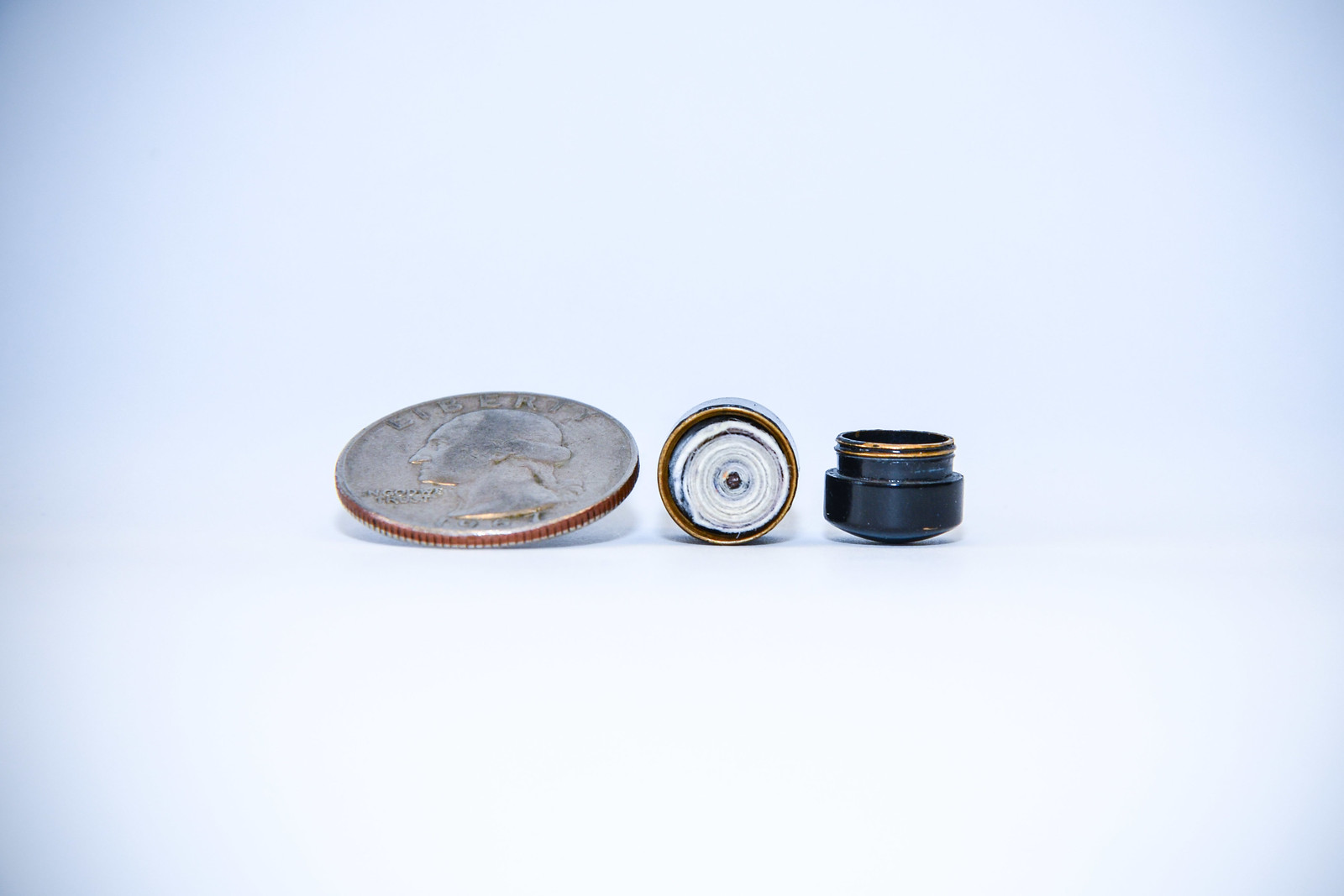
Writing in the world: a tiny geocache container and scroll for logging visits.

More recently, therefore, I have adapted approaches from visual anthropology and visual sociology to the study of writers and their composing practices and environments. Doing so has resulted in many trials and errors, but the struggle has been rewarding: I have learned to use visual methods to explore, analyze, and present the rich materiality of everyday composing practices, and in the process, to formulate new pictures of writers and writing that may be generative for participants and composition researchers alike. More important, by using visual methods in field studies I have been able to create new forms of material engagement with participants about the role of composing in their learning, work, and play.

While critics such as Susan Sontag (1977) have suggested that photography results in the distancing of photographic subjects from photographers, I have found opposite to be true: Visual methods of fieldwork result in qualitatively different forms of intersubjective understanding between researchers and participants. Composing with photography throughout fieldwork can help researchers of writing move beyond mere tautological illustration; by using visual methods, researchers may document and engage simultaneously.

More important, participants may see their own composing environments, tools, and practices in new ways, from different perspectives. A technique known as photo-elicitation uses fieldwork photographs as pivots for better understanding participant practice. For example, by photographically demonstrating a writer’s well-maintained mise en place, the researcher may help make the familiar strange for a participant, and through discussion, develop new insights about their composing practices.

In a similar way, visual methods may result in presentations of experience that are more hyaline and evocative than traditional forms of reporting. Qualitative data is notoriously dense, and for readers, the mass of fieldwork supporting ethnographies and case studies is often opaque. In addition, traditional methods of collection and representation are necessarily sequential; observational fieldnotes, for example, may miss crucial details of actual practice—movements, tools, arrangements, or cross-talk that may meaningfully mediate composing.
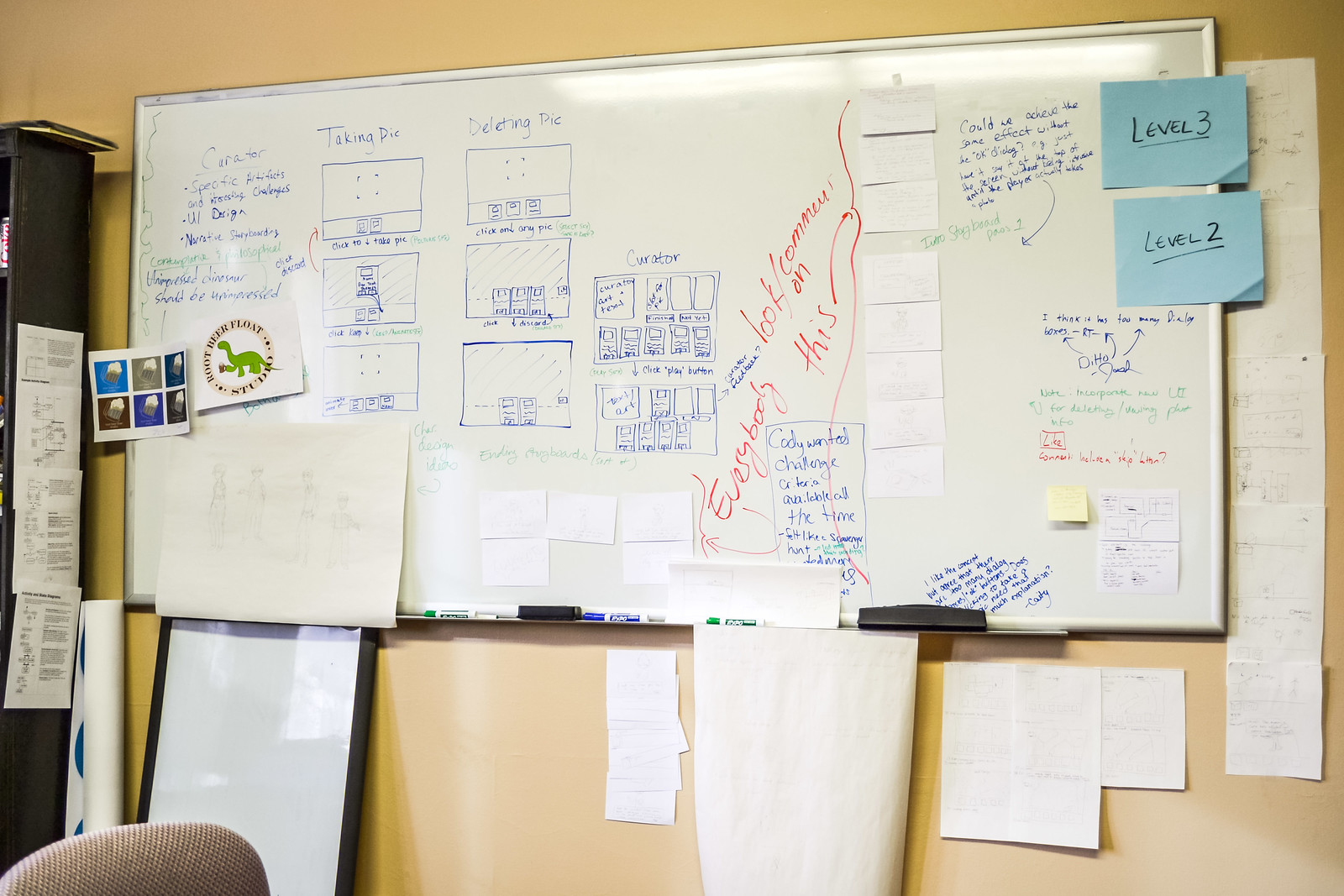
A software studio’s whiteboard is a collaborative space for composing and ideation.

Photographs offer simultaneous renderings of practice, what Flusser (2002) terms surfaces rather than lines. A traditional ethnographer detailing the complex, collaborative work pictured above must transform the simultaneously visible surface of a software studio’s whiteboard into a linear representation of activity. A visual ethnographer, however, can present that visible surface in its full complexity; when coupled with an analytic narrative that details punctuated development, a more hyaline rendering of complex composing practices emerges.

Qualitative research is characteristically ideographic; indeed, visual methods foreground the situated materiality of composing practices. This is a key strength of visual methods as I practice them in studies of writers and writing: the ability to document and collaboratively explore particular systemic contexts and the ways in which artifact assemblages participate in composing processes.

However, in developing new pictures of writers and writing, visual methods have the potential to be nomothetic in the aggregate. Because visual methods may be more hyaline—presenting richer data than traditional methods alone—they carry the potential for fruitful cross-case comparisons of composing practices. Imagine, for a moment, systematically composed and collected photographs of 20,000 first year writers’ typical composing environments and the resulting wealth of both particular (ideographic) and tendential (nomothetic) pictures of writing that might emerge from careful analysis.

Visual methods in empirical studies of writing carry the potential to further develop and realize Brodkey’s argument for re-seeing our object of study, and more important, the people who write. Barthes (1981) argued that “the camera can be an instrument of deep meaning, connecting the scene to the viewer and the viewer to existence” (131). With visual methods, writing researchers can reframe cultural conceptions of where, how, why, and with whom people write in their everyday lives.

1.20.2012

Annotations | "What Does the Transactions Publish?"

Annotations | "What Does the Transactions Publish?"

[ NB: “Annotations” are occasional posts that explore selections from my research reading—articles or books—in rhetoric, technical and professional communication, and related fields. ]

Carliner, S., Coppola, N., Grady, H., & Hayhoe, G. (2011). What does the Transactions publish? What do readers want to read? IEEE Transactions on Professional Communication 54(4), 341–359.

As I mentioned in my previous Annotations post, I’m a big fan of meta-analyses and systematic lit reviews. This recent piece by Carliner et al. isn’t exactly a meta-analysis, but it’s in the same ballpark,[1] and their analysis of what major journals in technical and professional communication have published in the last 5 years is really interesting to me (and, I hope, to you as well).

In addition to exploring the major genres and methods comprising the sample of articles they selected, Carliner et al. report findings from a survey of Transactions on Professional Communication (TPC) readers in order to determine what kinds of congruencies and gaps exist between what the TPC publishes and what TPC readers would like to read. One of the most interesting gaps they established was a desire among readers for more case studies, lit reviews, and tutorials; this is is especially surprising, since the TPC primarily publishes experimental and survey-based studies.

The impetus for the study[2] was a change in TPC editorship, and Carliner et al. “sought empirical evidence on which to base decisions about the future direction of the journal” (p. 341–42). In order to do so, the authors placed findings from the readership survey in conversation with their analysis of 5 years’ worth of peer-reviewed scholarship from: the TPC, Journal of Business and Technical Communication, Technical Communication, and Technical Communication Quarterly.

One handy subsection of this article is the lit review, which amounts to a review of previously published systematic lit reviews and meta-analyses. If I was wanting to know more about this methodology, the brief lit review provided here would get me off to a strong start.

As Carliner et al. note near the end of their lit review, the study actually contrasts “the content published by one peer-reviewed journal [the TPC] and other journals in the discipline with the preferences of readers” (p. 343, emphasis added). I think the italicized bit is key; if you’re an academic researcher in technical and professional communication, this article provides a very useful snapshot of the major journals in the field, the kinds of articles they publish, and the relationship among them.

Also useful, if you have an interest in conducting or evaluating systematic lit reviews, is the methodology section. I think the decision to adopt STC’s technical communication Body of Knowledge classification scheme is sound, and the authors provide a clear description of where and why they amended the scheme. They contend that the “full disclosure of the methodology and the dual coding[3] of each article ensures the trustworthiness of the data” (p. 345).

The authors provide findings for each journal, and then detail (in both table and narrative forms) findings across the journals—“the three topics that received the most coverage were: (1) Information Design and Development, (2) Deliverables, and (3) Academic Programs” (p. 347). “The three most common categories of research methods” across the articles in their sample were: “(1) Critical—Document Review, (2) Experience Report, and (3) Quantitative—Survey” (p. 347). The “critical document review” category, it should be noted, uses critical methods to explore texts without disclosing a sampling method or systematic methodology. My assumption is that most of the articles in this category were rhetorical analyses of one form or another.

The discussion of what readers of the TPC want was less interesting overall, but contains some very surprising tidbits. For one, though the sample was small (n=88, a 9.4% response rate), it was professionally diverse. Only 33%, for example, were academics, while 56% work in industry (p. 349). The survey used the classification scheme described above and asked respondents to rank the three topics of most interest and the three of least interest (p. 351). They did the same with research methods.[4]

As I mentioned briefly above, of most interest to readers were case studies and lit reviews, while survey-based studies and document analyses were of least interest. TPC rarely publishes case studies, and they publish a lot of survey-based work.

The authors note that the finding is somewhat problematic, as the term “case study” is broadly interpreted across journals. Personally, I follow MacNealy (1999) here, and see case studies as both systematic and rigorous, otherwise we’re not talking about a case study but a case history or experience report. I realize that I’m probably in the minority, though, and it’s a good idea if you’re conducting and writing about systematic qualitative case studies to clearly explain how your work is systematic, well-triangulated, and rigorous, so as to avoid the sometimes pejorative perception. But I digress…

Carliner et al. suggest that the survey findings indicate a “strong interest in research on communication in engineering workplaces,” and that “readers have a preference for applied research rather than the basic research that the Transactions has emphasized in recent years,” hence the preference for more in-depth (dare I say?) qualitative work (p. 352).

Overall, this was a fun read. The article provides a really nice snapshot of where we are in terms of current scholarship in technical and professional communication. And to me, it suggests a lot of opportunity for new kinds of work.


  1. Carliner et al. include a detailed reporting of their methods, which means that their study is replicable, or better yet, extensible (by covering a decade’s worth of articles from these and related journals, for example).  ↩

  2. Really, Carliner et al. conducted two different studies and compared them in this article; for the sake of clarity, I’m referring to the article itself as a “study.”  ↩

  3. Two of the authors coded each article by first conducting a series of “norming sessions” where they jointly coded two full issues of each publication under scrutiny. Because of this approach, the authors didn’t provide any measures of inter-coder reliability.  ↩

  4. Interestingly, they did not include ethnography, usability testing, and experience reports in the survey…  ↩

11.29.2011

Informal Communication, Sustainability, and the Public Writing Work of Organizations

My most recent paper, "Informal Communication, Sustainability, and the Public Writing Work of Organizations," was recently published on IEEE Xplore. This piece offers findings from two different qualitative studies of social software use within professional organizations.

Because the paper will not be accessible to folks without an individual or institutional subscription to IEEE, I have provided a pre-publication version below. As always, I welcome your thoughts on this work!

7.12.2011

Taking Stock: AY 2010–2011

In this post, I recap some of my research activity from the 2010–2011 academic year primarily as a way of sharing some of the things I've been working on, and how they lead into things that are coming up...

The last year was a busy one, no doubt. In addition to the usual stuff—teaching, grant writing, administrative and service work, etc.—I led and managed four different empirical studies that will be the focus of this post.

My ongoing study of Eucharistic Adoration practices continued into its second year of data collection (more about the methods and scope for this study can be found in screencasts of conference presentations here and here). After a bit of a lull in this project during the latter half of 2010, I've hit upon some especially intriguing ideas and participant practices in the last six months or so. I'm not quite prepared to publicly discuss even preliminary findings, but I will note that I'm seeing things that I intentionally wasn't looking for and didn't expect to find. Very exciting things that I think will make a real contribution to rhetorics of religion and spirituality.

This is a longitudinal, multi-sited ethnographic study, one that is currently planned to continue through April of 2012. I'll decide whether to continue data collection into 2013 sometime in early 2012. Right now, it looks like I'll do so, as my vision for the amount and types of data to collect is ambitious and still wanting. This is despite collecting a strong amount of data to this point. I'm currently considering strategic opportunities for dissemination—an edited collection or special issue, perhaps—where I could detail some early findings, but I have nothing planned as yet (which is probably for the best!).

I'm currently drafting the first of two planned manuscripts from a qualitative case study of transmedia storytelling that I conducted between December, 2010 and April, 2011. The impetus for this project was the work of my colleague and friend Brad King, a professor of journalism at Ball State and a leader in teaching digital and transmedia storytelling. In close collaboration with Nina Steiger of London's Soho Theatre, Brad led a transmedia summer school in 2010 that introduced playwrights to emergent digital story forms.

Preliminary findings indicate the importance of indexing practices for both teaching and carrying out transmedia stories. For my participants, indexing is most often realized as mundane, background, infrastructural writing work that supports narrative forms by organizing and linking multimodal (digital, print, material) assets. In this sense, indexing as a verb carries two concurrent meanings: the commonly assumed act of recording and organizing, and the less frequent usage (at least in writing studies) of tracing the value of assets (as in a stock index). I'm really excited about this project, and I'm indebted to the wonderful insights provided by Brad, Nina, and five of the ten playwrights who participated in both the summer school and my case study.

During the spring semester, 2011, I led an ethnographic study of the writing work supporting the collaboration of computer science undergraduates. My colleague and friend Paul Gestwicki was the instructor for the course that I studied, and a collaborator on the project (he wasn't involved during data collection but is now involved in analysis and dissemination, following our IRB protocol). Paul and two undergraduate honors fellows, Holden Hill and Phil Parli-Horne, developed a prototype application called Uatu that worked with Google Docs to visualize collaborative writing activity.

Our study, therefore, focused primarily on how students leveraged networked writing practices in conjunction with agile methods of software development. Our key research questions explored the role of networked writing in collaboration and learning, with participant use of Uatu providing us a way into secondary research questions concerning visualization and metacognition. We're still working through the data that we collected, but we already have a short piece out for review and plans for another manuscript later this summer. This was a really fun project, and my data collection was aided by a graduate assistant, Erika Johnson, who took a lot of field notes.

Finally, between July, 2010 and March, 2011 I conducted an ethnographic study of media researchers working on a large qualitative project of their own—from the earliest stages of planning and development all the way through execution of their study and public dissemination of their findings. I had collected rich, granular data in previous and concurrent studies, but nothing in my previous experience matches the amount of data that I collected for this project. This is due in large measure to the generous accommodation of my research participants, who provided me with tremendous access to their work.

Most of July and August will be spent working through the data, and I'm grateful to have a summer graduate assistant, Jenn Stewart, who has been tearing through the formidable pile of audio transcriptions while also offering insights by way of her own analytic memos.

I'm not entirely certain what kinds of outputs I plan to generate from this study, but I have a good idea of where I want to take this research. I've already discussed preliminary findings from one aspect of the study at ATTW 2011 (the screencast of the talk is here), and I'll publish more details from those findings at IPCC 2011 (discussed briefly here). I also have a short piece coming out soon that relies on one observed practice from this study. The majority of my work from this project is ahead, and I'm really looking forward to developing this work.

From these four 2010–2011 projects, only the first remains in a state of open data collection. This means I have a lot of writing to do!

I've already got firm plans for two more studies beginning in the fall, one of which extends my exploration of transmedia work by employing ethnographic methods. I'm also working on another smaller-scale case study (2–3 months of data collection) and have yet another ethnographic study tentatively planned for the spring of 2013.

I'm lucky to have some grant support for much of the work of analysis and dissemination during the summer and fall.

So there you go. Taking stock of my empirical research activity for the last academic year just reminds me of how much exciting work I have ahead of me!