Showing posts with label twitter. Show all posts

3.02.2013

Craft Tweets

Craft Tweets

What would craft tweets look like?

I’m thinking here of an (admittedly poor) analogy between craft tweets and craft beer…


I created an experimental Twitter account a few weeks ago. Called @the_smudges, this account builds from an idea I first started floating during formal talks I gave in the fall of 2011, when I was on the job market (at some point, I’d like to give a more meaningful, public version of this talk).

The idea behind the talks, and behind @the_smudges, is fairly simple: in the course of our everyday, we leave traces—like smudges on countertops, light switches, and alley walls, or through our generation of digital ephemera. The smudges of everyday life are thus traces of human (and nonhuman) behaviors and entanglements. And we might think about what those smudges mean as we look for and describe them.

From this basic idea I built an argument about tracing and exploring digital smudges in practice, and I drew from one of my ethnographic studies to ground my argument.

I’m fascinated by everydayness. I’ve been practicing my attention to smudges for a few years now. And I envision @the_smudges as a place where, in one carefully crafted post each day, I might practice the craft of writing rich ethnographic observations that meaningfully evoke ordinary affects (Stewart, 2007)—actions, experiences, potentials, trajectories, intensities, and sediments.

I suppose the audience I have in mind are folks similarly interested in ethnographic observation, everydayness, and broader meanings invoked/evoked by smudges, folds, interstices.

These tweets aren’t meant to be anything more than viable, meaningful ethnographic observations. I’m not trying to write poetry.

I am interested in slowing the pace of flow-based media, of working at and through writing carefully, well. In contrast to my normal tweets, these are much more intentional, slow, meditative. I hope.


So that’s all preamble to the primary purpose of this post: exploring the notion of craft tweets.

Yesterday morning, I hiked to the Kentucky River overlook at Raven Run. On the return portion of the loop, I stopped for a few moments, struck by the nearly fluorescent green moss covering a hundred and more stones on either side of the wooded trail.

The lighting conditions were ideal: a slate gray sky, sun not yet overhead, a damp forest floor, and a winter-driven paucity of vegetation.

Here’s the tweet that I wrote for yesterday:

As best as I can recall, here’s the process of writing the tweet:

  • First, keep in mind that I don’t carry my phone into the woods; I started thinking about how to represent in writing this moment of ordinary affect as I stood there on the trail in the morning quiet...
  • I was still about 2 miles from my car. I thought about the moment as I hiked.
  • I thought about elements of experience—sky, colors, sounds?, stones or rocks?, is the light snow important or not?
  • I started drafting, in my head.
  • I traded words for other words—fluorescent? luminescent? incandescent? glowing?
  • As I hiked on, I thought about craft; what if I could workshop this one tweet? How might I slow it down, think it through, iterate?
  • I drafted some more, continued to take in my surroundings, avoided slipping in the mud, dreamed of a private wiki for workshopping craft tweets with other folks.
  • I thought about craft beer, about my colleagues Jenny Rice (say yes to the text) and Jeff Rice (what is the nature of obsession? the relationship to craft?).
  • At the parking lot, I opened the car door, found my phone, typed a draft.
  • I put my phone on the passenger seat.
  • I slapped my muddy shoes on the pavement, put on clean socks and shoes, unrolled my pants, thought.
  • I picked up my phone and changed a word or two. Drove the 15 minutes home.
  • I exchanged the car for my bike. Rode to work. Revised in my head.
  • At my office, I revised again, materially. Eventually hit send. Unsatisfied.
  • I thought of many other things along the way, interwoven with this little task.

All told, my guess is that I took around two hours to compose this tweet. I suppose that’s slow, but my overriding sense was that this writing work should have been much, much slower.

Mostly, I thought of the lower division undergraduate creative writing workshops I attended so many years ago. I thought about how nice it would be to share my draft with peers, to be questioned by them, maybe to get a little defensive even, to work through that defensiveness, to improve.

And then I thought about parking craft tweets for a bit. Using digital workshops. A fermentation process. Add hops (always, always add hops). Think through drafts with others, problematize them, consider pressure points, potential trajectories, affects.


Is this somewhat antithetical to the medium?

Not to me, for Twitter, while certainly carrying some popular genred norms, is nearly as protean as any other genre of written communication and its concomitant constraints.

In other words, this isn’t an argument for what Twitter should be or how others should tweet; just some musing on craft that could apply to any genre. I happen to be thinking about it relative to Twitter because it’s manageable for me.

11.29.2011

Informal Communication, Sustainability, and the Public Writing Work of Organizations

My most recent paper, "Informal Communication, Sustainability, and the Public Writing Work of Organizations," was recently published on IEEE Xplore. This piece offers findings from two different qualitative studies of social software use within professional organizations.

Because the paper will not be accessible to folks without an individual or institutional subscription to IEEE, I have provided a pre-publication version below. As always, I welcome your thoughts on this work!

9.04.2011

Twitter and RSS

Over the last year or so, there's been a lot of talk about how Twitter killed its RSS feeds. What Twitter killed, in actuality, was the button that made subscribing to Twitter feeds (from users or search terms) simple.

As Dave Winer notes: "If you have a Twitter account you have a feed." Where people sometimes run into problems is simply finding those feeds—in particular, it can be difficult to find a user's ID number.

Luckily, Matt Matteson built a handy little tool that queries the Twitter API for the ID of any public user: idfromuser.com. Once you have the ID number for the feed you'd like, simply plug the ID into this URL:

http://twitter.com/statuses/user_timeline/[useridnumber].rss

Then, just grab the URL and drop it in Reader (or your preferred RSS reader). That's it.

Update: well, since I started writing this post a couple days ago, I noticed a problem with the "idfromuser" site—it doesn't seem to be returning IDs for some reason. So, I made a quick screencast showing a workaround in case the "idfromuser" site isn't working for you:


Update #2: Tommy, a former colleague at the Center for Media Design here at Ball State, created an elegant little bookmarklet that does all of the above in a fraction of the time! It quickly retrieves the user ID for any individual Twitter user, then returns the RSS feed for that user. Grab the bookmarklet here! Below is a quick screencast of the bookmarklet in action:


Follow Tommy on Twitter. He's awesome!

Now, If you'd like the feed for a specific hashtag, simply use the following URL:

http://search.twitter.com/search.atom?q=%23[hashtag (without pound sign)]

Take the new URL and drop into Reader. Piece o' cake.

How is any of this useful?

Well, since I'm a qualitative researcher who studies writing, I often try to document—as much as possible—the places where my research participants write. That sometimes means tracking their tweets.

In previous and current studies, a particular hashtag has been important for exploring collective writing work. Since I'm not dealing with huge numbers of tweets—I'll typically collect anywhere from a few hundred to a few thousand for a given study—RSS makes sense for a few different reasons...

First, I drop feeds into my database application, DEVONthink, for archiving. I then mirror those same feeds in Reader as a backup. If I happen to have a list of start codes or a pretty well-defined coding schema, I can use the tagging feature in either DEVONthink or Reader to code data as it comes in. This is tremendously useful during data analysis, but it also allows me to detect trends as I conduct a study, giving me opportunities to shape interview questions or fieldwork while it's happening.

8.11.2011

Sociotechnical Notemaking: Short-form to Long-form Writing Practices

I've just published a piece in the journal Present Tense that attempts to bring research from my discipline (Rhetoric and Writing) to a public debate about networked writing practices (especially via social software), while simultaneously bringing that public debate to the attention of scholars in my field.

In this sense, the article is less "academic" than other stuff I write because I'm explicitly trying to reach a public audience and show them that, hey, we've been researching this stuff for years, and it is meaningful ("it" being short-form writing). That said, it's still pretty academic in tone...

Sociotechnical Notemaking: Short-form to Long-form Writing Practices

On a related note, I wanted to mention how great it was to interact with Present Tense through the review process. I submitted my manuscript on May 4th and had a decision on May 26th. You read that right. The piece was reviewed by two referees (who provided excellent feedback) and returned with editor's comments in the space of 3 weeks!

If you're an academic, you know that this approaches the speed of light for peer-reviewing scholarship. Granted, part of the reason that Present Tense can turn manuscripts around so quickly is the brevity of the articles it publishes—2,000 to 2,500 words. In fact, part of the lag between the decision and today's publication was my need to trim my 3,100 word submission down to about 2,500 words.

I also really like that Present Tense publishes articles when they're ready rather than waiting to cobble together 6 or 8 articles before releasing a full issue. They still publish issues (my article is in Vol 2 Number 1), but they publish finished articles directly to the site when they're ready to go, which also decreases the overall turnaround time dramatically and gets ideas out into the public domain in a timely manner. Finally, they have fantastic Review and Advisory Boards, their editors were wonderful throughout the process, and articles are fully open access and published with a Creative Commons license.

If you have a shorter article or an idea for a more concise article (for example, I wrote my piece specifically for the journal), I'd highly recommend Present Tense.

5.24.2011

Blogging: Links in Chains of Literate Action

The 2011 Computers and Writing Conference has been widely lauded in recent days as one of the best iterations in the conference's history. I echo those sentiments: the venue was spectacular, the people—as always—were wonderful and supportive, and Ann Arbor is a lovely city.

I participated on a roundtable exploring the following: Is Blogging Dead? Yes, No, Other. With eight participants, we limited our talks to three minutes, leaving lots of time for audience interaction. The panel was organized by Steve Krause, and one of my fellow presenters, Bradley Dilger has done a fine job of corralling some of the discussion before, during, and after the roundtable.

The general feeling was that our session engaged the backchannel in a way that few others did at this year's conference, and part of that is attributable to: 1. the nature of our topic, and 2. the format, which explicitly took emphasis away from individual presenters and attempted to foster what Scott (1967) calls "collaborative critical inquiry."

Put another way: it was a lot of fun to deliver a 3 minute talk, and then sit back and listen to the thoughts of my fellow panelists and audience participants (those co-located and distributed). Basically, I spoke for 3 minutes, then didn't say anything until the last 10 minutes or so of the session. And I learned a lot more that way.

My talk is below. I encourage you to have a look at Bradley's post—he's updating periodically to capture some of the post-roundtable reaction, including a Storify perspective on the session.

11.10.2010

Exploring a Sustainable and Public Information Ecology

In September, I published a paper in the Proceedings of the ACM Special Interest Group for Design of Communication (SIGDOC); it has recently been published at the ACM site.

My paper details findings from a qualitative study of a professional conference, drawing from Nardi and O'Day's (1999) Information Ecologies and Activity Theory to explore the public writing activities that I observed and catalogued. I collected a few different kinds of data for the study—observations of planning meetings, observations of activities at the three-day conference, written public artifacts on the organization's blog and in the Twitter streams of conference participants, and interviews with several of the participants (and planners) themselves.

As I was coding data from the study, one of the key activities that I encountered again and again was something called tummeling. Tummeling can be seen as the intentional facilitation of conversation and engagement within online communities—often by someone who curates ideas and content while connecting previously unaffiliated individuals from overlapping social groups.

I am indebted to Kevin Marks for sharing this concept on Twitter and in Google Reader (he is, in fact, an active tummler). I think I would have struggled to characterize some of the key activities that emerged from the data had I not been made aware of this concept and its role in fostering online engagement.

Based upon the data, I argued that tummeling was a key factor in bolstering the sustainability of the online and physical community that I studied. Since I was privy to pre-conference planning meetings, I learned that the digital sustainability and visibility of the organization was a key goal heading into the conference.

Interestingly, I don't think most involved in those planning meetings envisioned phatic communication through an application like Twitter as being a large factor in fostering that sustainability.

The data says otherwise.

Tummeling activity and online phatic interaction clearly extended the organization's reach and visibility while promoting connections that were sustainable beyond the three-day conference. These activities were largely extraorganizational; in other words, they were driven from below—by attendees—rather than from above—by the organization itself.

The organizers, to their credit, realized that blogging and microblogging activities needed to be leveraged in some way. They were intent on trying new ways of extending the organization's reach.

Findings from this small-scale study indicate how organizations might better foster tummeling activities in support of visibility and sustainability efforts. Part of the challenge is met by simply promoting tools like Twitter—embracing and encouraging the tummlers who are in some way connected to (though not necessarily a part of) the organization.

You can get a pre-publication version of the full paper below, or the official version at the ACM Portal.


10.13.2010

Digital Publics and Participatory Education

Last week, an article that I worked on earlier this year saw publication with the open access journal Digital Culture and Education.

Back in January or thereabouts, Christa Teston and I were talking about different collaboration opportunities, and I suggested that we prepare a manuscript for a special issue of the journal. We put together a plan to explore the complex of blogging, backchannel communication, and Google Reader as a way to open up classrooms to broader public participation, drawing primarily from experiences in my Fall 2009 senior seminar at BSU.

Following Schön (1983), we took a reflective practice approach, inviting three participants as coauthors. Garrett Cox was an undergraduate in the model course, and he contributed a participatory perspective from inside the curriculum. Bolutife Olorunda was a student participant from the edges of the curriculum, and his perspective details his experience as a self-directed participant motivated by interests in the core subject matter. Finally, Noah Dunker, an Information Security professional from Kansas City, MO, contributed a participatory perspective from well outside the curriculum, as a public participant in the course, unaffiliated with BSU.

While the manuscript wasn't a good fit for the special issue, it was reviewed positively, and invited for inclusion in the next issue. In the article, we make an argument about operationalizing collaborative knowledge work within a specific curriculum and pedagogical approach—enacting a form of participatory education in digital publics.

In the process, we also detail a fairly novel approach to guided discovery (Clark & Mayer, 2003) and student blogging as a literate practice. Finally, we suggest practical methods of incorporating feeds—via Google Reader's "Bundle" feature—as a primary source within a given curriculum.

The abstract for the article is below, and the full piece can be found at Digital Culture and Education.


This article—a collaborative exploration between instructors, students, and members of the broader, digital classroom community—explores how the strategic incorporation of sociotechnical networks and digital technologies facilitates literate practices that extend the classroom in productive ways. The article builds toward coauthors’ reflective practices (Schön, 1983), or “participatory perspectives”, had during an undergraduate English Studies course at a mid-sized, public, American university. Specifically, participants argue that these literate practices afforded not just information sharing, but the opening up of a traditional classroom to include broader digital publics and collaborative knowledge work (Spinuzzi, 2006). Toward this end, we ground literate practice in scholarship that attends to public writing in online spaces, and theoretically frame our argument using Jenkins et al.’s (2006) principles of participatory education. We then detail the specific curricular approach deliberately designed to create digitally connected publics and end with generalizable significance of coauthors’ participatory perspectives.

3.31.2010

[ Finding Grooves ] Conversations + Spreadable Media

I gave a talk last week (3.26.10) at the Center for Media Design, responding to previous presentations about two of Ball State's most successful immersive learning programs, iMedia and SportsLink. This year, the CMD has sponsored research talks from Emerging Media Faculty Fellows, and more recently, presentations about our innovative immersive learning opportunities for undergraduates.

Brad King and I have been engaged in learning about both iMedia and SportsLink, and our backchannel conversations about opportunities for using social media platforms to extend SportsLink's brand resulted in an invitation for each of us to share those ideas with the university community last week.

I had a lot of fun with this talk, and worked from a looser script than I'm used to. Both talks fostered some great discussions, and I think we're all really invested in seeing these programs develop and prosper. Below is a screencast of my talk; as always, I welcome questions and feedback!

3.23.2010

6,000

Whoa. 6,000 tweets. That's a lot of writing. At around 12 words a tweet, that's ~72,000 words. Hmmm...

3.18.2010

[ Persistent Backchannels and Social Graphs ]

This a screencast of my brief roundtable talk for the 2010 Conference on College Composition and Communication in Louisville, Kentucky. I was thrilled to be a part of a panel called "(Almost) Live at the Cs: Re-visioning Conference Networks."

This screencast details my opening position statement; I argue that interstitial writing work is the sinew of persistent social graphs--the stuff that holds together and articulates (in the sense of "joining and mediating," following Hall, 1980 and Johnson-Eilola, 2005) complex sociotechnical networks. As always, I welcome feedback and conversation!

2.22.2010

:: Deliberative Ecologies :: Technologies, Practices, Actants

As a follow up to last week's collaboratively written post, On the Atomization of Rhetoric, Christa Teston and I have written a companion post: Deliberative Ecologies: Technologies, Practices, Actants, which is published on Christa's professional blog.

Please have a look at our post when you have a moment; it describes in more detail the messy complexity of our collaboration, and we take initial steps toward thinking through the notion of "deliberative ecologies" by attempting to surface our formative rhetorical knowledge work.

As always, we appreciate feedback--here, there, or on Blogora.

12.30.2009

On the "Death" of RSS...

A screencast showing a specific use case in favor of RSS within the context of the RSS vs. Twitter debate.

Here, we see how ineffectual Twitter search can be for finding older tweets, and how important a feed-reader can be for archiving and retrieving those same tweets...


11.07.2009

[ Locus Communis ] Twitter as Digital Commonplace

I gave a talk today at the International Digital Media and Arts Association annual conference. I almost always upload the slides for my talks, but because of the format for this conference--where presentations were limited to ten minutes--I decided to simply screencast the full talk and share it here.

I had a great time at the conference overall, and our panel fostered some excellent discussion. At just under ten minutes, the video takes some time to load; as always, I welcome feedback, questions, and discussion!


10.15.2009

Extending the Classroom: Conversations, Content, and Microblogging with Twitter

I had the opportunity to give a fun talk today about using Twitter in educational settings. I was able to present in the brand new Schwartz Digital Complex in Bracken Library, as part of Ball State's Tech4U series. I was also able to make use of an impressive visual display that allowed me to stream tweets in Seesmic, a hashtag search on FriendFeed, and my own slides simultaneously (I actually brought a class to the "learning pod" section of this fantastic facility on Tuesday and shot some video, which I'll upload soon).

The talk essentially mashed together ideas from some other research projects and presented some new material geared toward pedagogical approaches and student engagement.

This last bit was perhaps the most interesting, as it drew from the Ball State University Fall 2008 "Making Achievement Possible" survey of first-year students. The MAP Works survey indicates that 46% of first-year BSU students spend between 30 minutes and two hours on social networking websites each day. A full 40% of students spend 2 or more hours each day on such sites. My sense is that these numbers are underreported.

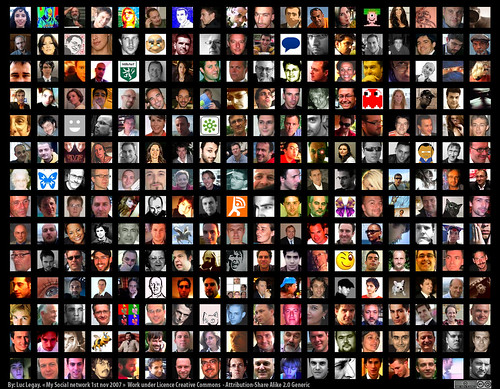
In other words, 86% of our first-year students, as of 2008, are spending time every single day with communities that look like this:

Creative Commons image by luc legay on Flickr.

I asked: as an educator, where are you in that picture? Where are the influential scholars and teachers in your field? Do we see their avatars represented in the social networks where our students are spending their time? Should they even be there in the first place?

I don't have any easy answers to those questions, but I did suggest some ways that faculty at Ball State can incorporate microblogging into their curricula and pedagogies. I've embedded the slides from today's talk below, and as always, I'm happy to provide a transcript as well. Tommy and Ben from the Center for Media Design were there shooting some video, and I assume it will eventually surface at some point; when it does, I'll link to it!

10.14.2009

Backchannel Persistence and Collaborative Meaning-Making

Last week I had the pleasure of delivering a paper relatively close to home, at the 27th ACM International Conference on Design of Communication (SIGDOC), at Indiana University in Bloomington. I was especially excited to be on a panel with Shaun Slattery of DePaul University, and Jason Swarts of North Carolina State University--two scholars that I hold in high esteem.

Our panel explored the traces of literate activity that are surfaced and archived in new media writing environments, and which lead to the construction of "fact" on Wikipedia, and the development of provisional knowledge in microblogging platforms. All three papers called on Actor Network Theory and/or Cultural Historical Activity Theory as a way to frame and trace computer supported collaborative work.

I added some theoretical frameworks that are likely too much for a 6,000 word manuscript. I like what I have here, but it's meant to be the start of something much more substantial. In short, my paper amounts to a longish position piece which aims to establish a theoretical framework for tracing meaning-making in persistent backchannel platforms (such as Twitter).

The official published version, should you be able to navigate behind the paywall, is available through the ACM portal. The full proceedings--which include excellent papers from Shaun, Jason, and a number of other fantastic researchers--can also be accessed through ACM. I've uploaded a pre-publication version of the paper to Scribd, and it's available below:


Finally, I've embedded the slides for my presentation as well. If you've seen me present in the past, you'll know that I take a minimalist approach to slidedecks, favoring images over alphabetic text. So, if you'd like the script that accompanies the slides, let me know!

10.02.2009

Twitter and Commonplace Books

Since 2006, I have been thinking through various iterations of a digital commonplace book. First, a little background on the traditional practice of commonplacing...

As early as the 14th Century in the west, literate populations began to cobble together bits of information--quotes, measures, thoughts, arguments, summaries, responses--on paper, an increasingly ubiquitous resource. These "note books" eventually came to be known as commonplace books, and they were a predicated upon tenets of classical rhetoric. George Eliot kept a commonplace book; so did Thoreau, Thomas Jefferson, and E.M Forster, among many, many others.

The Digital Commonplace

While people continue to keep journals--both offline and on--the online sourcing and collection of information and contemporary digital reading practices have provided different affordances for the same kinds of work accomplished in the traditional commonplace book. Delicious, Digg, Reader, FriendFeed--all of these tools enable knowledge curation practices which remediate the work of commonplacing to a certain extent. And the affordances are strikingly different: greater access to massive amounts of information, far flung, and harder to filter. If these affordances can be managed effectively, new communications tools can revive commonplacing in a significant way (in fact, if you're reading this, you are very likely already engaged in the kinds of digital commonplacing I am suggesting...).

As I mention above, I have been trying to develop the idea of digital commonplacing in concert with research on recursion in writing studies (and more recently, ambient research). For example, in 2006 my first-year writing students used a modified version of the WebCT discussions area to produce a (quasi) stream of short reading responses and thought pieces that eventually built from and played off of one another. Today, platforms like FriendFeed and Twitter afford commonplacing activities in ways that are persistent, searchable, copyable, and easily shareable.

A key, of course, is positioning the platform so that it can be effective for this kind of work.

I'm still thinking through these ideas, and I'll be discussing Twitter as digital commonplace book at the upcoming International Digital Media and Arts Association annual conference (iDMAa), held this year on my home campus of Ball State University. The abstract for that talk elaborates a bit on these ideas, and is embedded below. As always, I welcome feedback!

9.12.2009

A Look at Yahoo! Meme

Yahoo's recent struggles to remain relevant have been well documented, from upheaval in executive management to the significant search deal with Microsoft's Bing. As a long-time Flickr user, I've never been particularly happy with Yahoo. Under Yahoo! ownership, Flickr has arguably regressed as social networks have burgeoned all around them.

Earlier this year, Yahoo! rolled out a new service called Meme in a Portuguese-only version, a move described at the time as akin to a Twitter 'Clone'. I recently received an invite for the service's English-language rollout. Early impressions? It's very cool--lighter than Tumblr, more functional than Twitter. I've created a screencast with some initial thoughts, comparisons, and a brief demo...

7.17.2009

The @Reply Experiment: Phatic Communication in Digital Publics

Beginning on the morning of July 5th and concluding in the afternoon of July 12th, I updated Twitter 81 times, and each update was an @reply to another Twitter user. In other words, I made no updates that were not directly in reference to--and addressed to--another user (most of whom I already followed, but some of whom I didn't).

This experiment started simply as an attempt to curtail my own usage; at times, I feel like I might be spamming those who follow my updates, and I never want folks to feel like I'm overdoing it, that I'm posting too much. But more importantly, this was an exercise in concerted listening, in using the digital publics of Twitter to read, respond, and hopefully add to the conversations of others.

Here are a few (purely anecdotal) observations:

Listening Practices


Because I often feel like I'm simply posting things that are interesting to me and my research communities--things which surely are *not* interesting to all of those who follow my updates--my initial observation is that the @reply experiment forced me to listen to others in a very concerted way.

I've mentioned previously on Twitter that I read almost every update of every person that I follow. The main way that I'm able to do this is by enabling device updates for a large majority of the folks that I follow (granted, compared to others, I follow a relatively small number of people). So, even if someone is posting from a radically different time zone--and I miss those tweets in realtime--I catch up with them eventually via my mobile. In short, I'm already a pretty good Twitter listener, I think.

But active listening and purposeful responding are something else; these are the activities that were more strongly engaged during the @reply experiment. Not only did I actively read nearly every tweet, but I was more strongly aligned in a sense of addressivity--responding and reacting, and hopefully fostering conversation. Of course, this didn't always play out in practice (read on).

The Digital Phatic


It's certainly nothing new to assert that social network sites like Twitter, MySpace, and Facebook foster phatic communication online. But I want to suggest that the digital phatic is something much more purposeful (and thus rhetorically significant) than the commonplace gloss of phatic interaction as "small-talk." At the same time (because "small-talk" is itself rhetorically significant in many contexts), I don't want to suggest that this notion of the phatic--the "small talk" understanding--isn't a very valid descriptor of much interaction on social network sites (lol, lmao, ttyl).

For me, the @reply experiment suggests that the digital phatic is both/and. In support of a more purposeful and rhetorically significant understanding of the digital phatic, I simply offer the cost associated with a thoughtful @reply. Valdis Krebs, for example, is among the most careful re-tweeters and responders I know on Twitter. He'll often publish and rewrite a short response to another's post two or three times, until he feels that it's presumably acceptable for public consumption. How do I know this? Because I receive his updates on my mobile, and each update, even those deleted, (usually) show up on mobile devices once they're posted.

My point is this: many of my own @replies during this experiment were ostensibly phatic, but they also attempted to convey amplifying information or to engage conversation in ways more meaningful than the common sense of "small talk." Yes, writing under 140 characters, many will point out, carries little cost or effort. And yes, writing under 140 characters, many will point out, requires a good deal of skill and effort. Doing so while explicitly responding to/and or engaging others can enact both senses of the phatic simultaneously, thus calling for research on the potentiality of the digital phatic.

I Cheated


For the first few days of the experiment, I had zero issues with using Twitter as a reply platform only. I was quite happy, in fact, responding to the things that others found interesting or were discussing.

However, I came across a tremendously fascinating item in my feed reader 4 days in, a lengthy interview in The Paris Review with Gay Talese. This was something that I felt absolutely compelled to share with my Twitter community for two reasons: first, it's simply a brilliant interview that I think a lot of people would find interesting. But secondly, and more importantly, it's the type of sketch that's fascinating to writing researchers like myself for what it says about the writing practices of an expert. What to do? What to do?

I tweeted it. As an @reply. I cheated. Kind of.

As I sat there with this wonderful item to share, I thought about how I could maintain fidelity to my experiment while still sharing said item. I would @reply it to someone whom I felt would appreciate it, and possibly discuss or share with others. Who to send it to?

For some reason, Collin Brooke was the first person I thought of, and I just felt he'd appreciate the interview (for the record, while I met Collin briefly at last year's Watson conference, I certainly don't know him well; most of my interaction with him is through his scholarship and on Twitter. We seem to have similar interests, and that's perhaps why I thought of him with respect to the Talese interview). This exercise revealed a potential problem with using an @reply to initiate conversation/sharing: he never said a peep.

This is certainly not Collin's fault, and here's what I'm getting at: when someone updates Twitter, and one responds within a reasonable time frame via @reply, there's an expectation that the latter message is received. When one uses an @reply to initiate a conversation or to explicitly share something with another user, the expectation becomes something different.

For all I know, Collin was simply busy and didn't have a chance to read the interview. He might not have even seen it. He might have taken a look and decided it wasn't for him. The point is, I cheated and used an @reply as a means for publicly sharing on Twitter, and it didn't really work well, it seems. So, using @replies for responsive addressivity = win, while using @replies for initiative addressivity = fail in my limited and purely anecdotal sample.

Habits


Since the end of my @reply experiment on July 12th, I've posted an additional 50 updates. Interestingly, 32 of those were @replies. I've actually grown very fond of using the @reply to track and engage the posts of others rather than using Twitter as a platform for simply broadcasting things. I did some of the latter, to be sure, but I really like the idea of actively *looking* for conversations to join in digital publics, even if my contributions are rebuffed or ignored.

I think my ratio of public updates to @replies will remain relatively similar.

What's been your experience with @replies on Twitter, or addressivity in other digital publics? What am I missing here? Is this worthy of more in-depth and rigorous study?

6.16.2009

Tweet Research: Computers and Writing 2009

I'll be presenting at the 2009 Computers and Writing Conference at UC Davis this week, and I've included the slides for my presentation below. If you would like a transcript of the talk, please let me know--I'm happy to provide it.

One of the most rewarding aspects of preparing this presentation was my interaction with Peter West, a management consultant and principle of Continuous Innovation in London, Ontario. Peter is one of my most important Twitter contacts, and he was gracious enough to grant me an interview which detailed how he uses Twitter within a broader suite of knowledge management tools and ecologies. My work with Peter is so interesting that I hope to work with him on a more substantial project in the very near future, as much of the information that he provided must necessarily be truncated for a short conference presentation.

Regardless, I wanted to provide a preview of Peter's workflow now, in anticipation of a more detailed discussion on Friday:

Peter has developed what he calls an “environmental scanning system” predicated upon a complex ecology of information sources ranging from RSS feeds of peer-reviewed journals to tools such as Twitter. He also relies heavily on both Google and Windows Desktops. He says that “each day, I manually scan the new citation releases from over 10,000 journals. Experience has proven that this is the most effective way to get a general sense of the literature that is being produced and to comprehensively capture relevant material.”

To get a better sense of what this type of knowledge work entails, Peter graciously tracked his activity during the month of May, yielding some tremendous insights into how he scans and disseminates research:

He processed 23,970 total citations, and spent 89.1 total hours doing so.

The highest number of citations processed in one day was 1,630 and the longest one-day processing time was 6.42 hours. Alternatively, the lowest number of citations processed in one day was 108, and the shortest single-day processing time was 1.1 hours.

He averaged 773 citations per day for an average processing time of 2.87 hours.

The Total number of journals included in these statistics was 4,298, however, he scanned another 5,834 journals during the period whose articles were not posted in Twitter, primarily because they do not provide open access.

Peter began sharing citations publicly via a blog called “SynapShots” back in 2002. One of his objectives was to foster reciprocity and conversation, an ethos achieved more readily through Twitter.
Regardless of your perspective on Twitter, it's clear that Peter is a very unique user and participant in this evolving social space. For my own work, his diligence is invaluable. I'm very much looking forward to talking more about Twitter at #CW09!


The University of Texas at El Paso approval for this study is filed under IRB protocol ID #117301-1--"Tweet Research: Aggregating and Disseminating Organizational Knowledge Work through Twitter"

6.03.2009

Twitter, Mobile Devices, and User Retention

As I've argued on this blog and elsewhere, the mobile component of Twitter is essential to a rich user experience. Having SMS updates enabled or using a mobile client such as Tweetie or Twitterific is a key factor in getting the most out of Twitter as a robust communications platform and as a framework for ambient research. While I've maintained this position over the last few months, I recently had the misfortune/opportunity to experience Twitter sans mobility, and I didn't like it much.

As you may know, one of my primary areas of research is the study of writing and rhetorics on ubiquitous and mobile small-screen devices. In fact, my impending move to Ball State University includes support for a new, more robust mobile device and data plan, as well as affiliation with the Center for Media Design, where I hope to procure funding and develop empirical studies of mobile media consumption and ambient communication.

The long and the short of the story is that my phone broke last week. More specifically, my phone's screen functioned intermittently and not very well, mostly not at all (though banging it on my desk seemed to help at times). There was no disruption is service or functionality--messages and calls still came through just fine--but I couldn't read those messages or determine who might be calling. As you might imagine, this presented some problems. I'm the type of person who will go on using something until it just won't work anymore (I still have--and use--a Palm Vx, for Pete's sake!), but this was something different.

My first order of business was to remove device updates from Twitter. That "solved" some of the problem, but I was still faced with incoming calls that I couldn't see, and additional text messages from others that I couldn't read. Moreover, my engagement with Twitter was rather poor. I figured it would be easier to elaborate on some of this via video:

So, certainly my experience here is purely anecdotal, but I am left wondering how mobile adoption might enrich one's experience of using Twitter, how it might make it easier for a new user to engage in conversation and to feel as though they are part of a larger community, and how their reading and writing practices travel with them. My unintended experiment in reverse-engineering the mobile UX of Twitter gave me a very different, rather underwhelming perspective on the service. In explaining Twitter going forward, I know that I'll be emphasizing mobile usage even more.