My most recent paper, "Informal Communication, Sustainability, and the Public Writing Work of Organizations," was recently published on IEEE Xplore. This piece offers findings from two different qualitative studies of social software use within professional organizations.
Because the paper will not be accessible to folks without an individual or institutional subscription to IEEE, I have provided a pre-publication version below. As always, I welcome your thoughts on this work!
Showing posts with label microblogging. Show all posts
Showing posts with label microblogging. Show all posts
11.29.2011
1.27.2011
What am I Reading?
[ NB: This post was written for the Ball State English Department Blog, and is mirrored here. ]
The more interesting question is "how am I reading?"
My workflow is constantly evolving, and right now, my reading is largely shaped by the combination of a few different mobile applications and devices.
I try to do 50 pages of research reading every day (more on that here). Consequently, most of the stuff I read is likely to be of little interest to all but the most intrepid grad students in Rhetoric and Writing. I'm assuming here that you don't enjoy research articles and technical reports about computer-supported cooperative work, distributed writing practices in the workplace, and the direction of ambient, networked writing activities. Like I do.
Some folks love to curl up with a good book of poems or short stories; I'd much rather read the methods section for a well-planned and executed qualitative study. So, I'll tell you what I'm reading, but I want to talk a bit about how I'm reading, since reading, writing, and publishing practices are currently in the midst of massive change.
Here's how much of my daily reading is likely to start. I open Google Reader and also browse links shared by folks I follow in Twitter. Thus begins the sifting and winnowing of information from the sources I've instructed to hail me each day. Clay Shirky says there's no such thing as information overload, just filter failure.
So my reading starts with filtering—selecting appropriate RSS feeds and Twitter accounts to deliver the things I need to do my job.

When something looks interesting, I'll click the link and navigate to the article. If it's more than two or three hundred words, and if it looks really interesting, then the magic starts. I use a bookmarklet that saves the article to Instapaper.
Instapaper is pure genius.
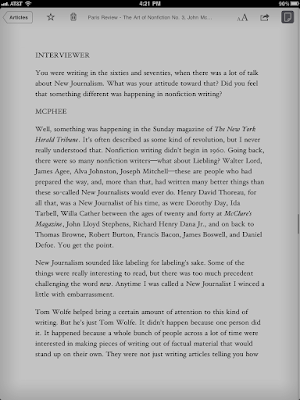
The application takes the article I'd like to save (let's say it's this 13,000 word gem of an interview with John McPhee in the Paris Review), strips away all of the banners, ads, and social networking detritus, and then serves up the written word in a clean, customizable interface on the device of my preference.
If something gets Instapapered by me, that means it's going to my iPad.

Reading on the iPad is amazing, but you know what Instapaper does that makes it even more useful? It downloads and stores every article I save so that I can read them no matter where I am, even if I'm offline (perish the thought!).
Because I don't want to keep hundreds of articles at all times in my Instapaper application on my iPad (I usually keep around 50 or so), and because I want to keep track of this river of reading for later reference, I made sure to link my Instapaper account with my bookmarking service, Pinboard. So, every time I save an article with Instapaper, that URL is archived for later retrieval on Pinboard.
Pinboard allows me to group items by using tags; here, for example, are all the items I've collected that might be used in ENG 213, our Intro to Digital Literacies course...
But I digress, this is about reading, yes?
So, let's get serious. Research articles, books, annotations of said items. Scholarly work. Instapaper usually isn't so good for those kinds of things (well, annotations, that is). That's where iAnnotate PDF and Dropbox come in to play.

If you don't have a Dropbox account, go get one immediately after finishing this post. Here's Dropbox in a nutshell: online backup of your files, synced among all of the computers and devices that you use. For free. Never lose a file again. Hard drive crashed? So what—files are in Dropbox. Elephant stepped on your Macbook? No worries—files are in Dropbox. Dog ate your homework? You get the picture. In fact, go sign up now. With this link, you'll get an extra 250 MB of space.
Many of the articles—and, increasingly, many of the books—that I read are available in PDF format. I upload those files to Dropbox, which means they're accessible from any internet-enabled device I might use to access them, which means I can choose from hundreds of articles or books to read pretty much anywhere.
Because I read so much on my iPad, I use iAnnotate to read the books and articles I have in PDF. Here, for example, is a book that students in my Rhetoric, Writing, and Emerging Media course will read this semester, Program or Be Programmed:
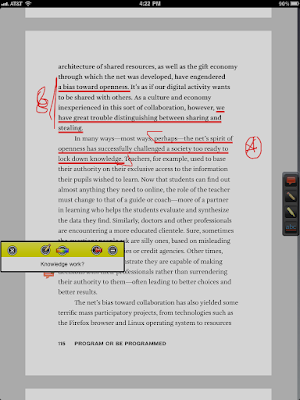
With iAnnotate, I'm able to read in ways that are similar to (but still very different from!) the practices I use when reading an article or a book the old-fashioned way, pen in hand.
I can underline, star important points, and make comments in the margins. Because I type these comments instead of scrawling them in my horrible handwriting, I can actually read my notes later. Best of all, I can save the PDF as is, so that all of my edits and annotations are viewable (and shareable) elsewhere—in my DEVONthink database, for example (but that's fodder for another post...).
So, what am I reading?
Denise Schmandt-Besserat's How Writing Came About. A recent article by Clay Spinuzzi in Written Communication. Bill Moggridge's Designing Interactions. Howard Rheingold's Tools for Thought. A recent article about multimodal storytelling. Dave Winer's blog, Scripting News. The tweets of Jan Chipchase and Kevin Marks. Malcolm McCullough's Digital Ground. Mitchell Duneier's Sidewalk. And a whole host of other interesting articles in the "Read Later" archive of my Instapaper account...
The more interesting question is "how am I reading?"
My workflow is constantly evolving, and right now, my reading is largely shaped by the combination of a few different mobile applications and devices.
I try to do 50 pages of research reading every day (more on that here). Consequently, most of the stuff I read is likely to be of little interest to all but the most intrepid grad students in Rhetoric and Writing. I'm assuming here that you don't enjoy research articles and technical reports about computer-supported cooperative work, distributed writing practices in the workplace, and the direction of ambient, networked writing activities. Like I do.
Some folks love to curl up with a good book of poems or short stories; I'd much rather read the methods section for a well-planned and executed qualitative study. So, I'll tell you what I'm reading, but I want to talk a bit about how I'm reading, since reading, writing, and publishing practices are currently in the midst of massive change.
Here's how much of my daily reading is likely to start. I open Google Reader and also browse links shared by folks I follow in Twitter. Thus begins the sifting and winnowing of information from the sources I've instructed to hail me each day. Clay Shirky says there's no such thing as information overload, just filter failure.
So my reading starts with filtering—selecting appropriate RSS feeds and Twitter accounts to deliver the things I need to do my job.

When something looks interesting, I'll click the link and navigate to the article. If it's more than two or three hundred words, and if it looks really interesting, then the magic starts. I use a bookmarklet that saves the article to Instapaper.
Instapaper is pure genius.
The application takes the article I'd like to save (let's say it's this 13,000 word gem of an interview with John McPhee in the Paris Review), strips away all of the banners, ads, and social networking detritus, and then serves up the written word in a clean, customizable interface on the device of my preference.
If something gets Instapapered by me, that means it's going to my iPad.

Reading on the iPad is amazing, but you know what Instapaper does that makes it even more useful? It downloads and stores every article I save so that I can read them no matter where I am, even if I'm offline (perish the thought!).

Because I don't want to keep hundreds of articles at all times in my Instapaper application on my iPad (I usually keep around 50 or so), and because I want to keep track of this river of reading for later reference, I made sure to link my Instapaper account with my bookmarking service, Pinboard. So, every time I save an article with Instapaper, that URL is archived for later retrieval on Pinboard.
Pinboard allows me to group items by using tags; here, for example, are all the items I've collected that might be used in ENG 213, our Intro to Digital Literacies course...
But I digress, this is about reading, yes?
So, let's get serious. Research articles, books, annotations of said items. Scholarly work. Instapaper usually isn't so good for those kinds of things (well, annotations, that is). That's where iAnnotate PDF and Dropbox come in to play.

If you don't have a Dropbox account, go get one immediately after finishing this post. Here's Dropbox in a nutshell: online backup of your files, synced among all of the computers and devices that you use. For free. Never lose a file again. Hard drive crashed? So what—files are in Dropbox. Elephant stepped on your Macbook? No worries—files are in Dropbox. Dog ate your homework? You get the picture. In fact, go sign up now. With this link, you'll get an extra 250 MB of space.
Many of the articles—and, increasingly, many of the books—that I read are available in PDF format. I upload those files to Dropbox, which means they're accessible from any internet-enabled device I might use to access them, which means I can choose from hundreds of articles or books to read pretty much anywhere.
Because I read so much on my iPad, I use iAnnotate to read the books and articles I have in PDF. Here, for example, is a book that students in my Rhetoric, Writing, and Emerging Media course will read this semester, Program or Be Programmed:
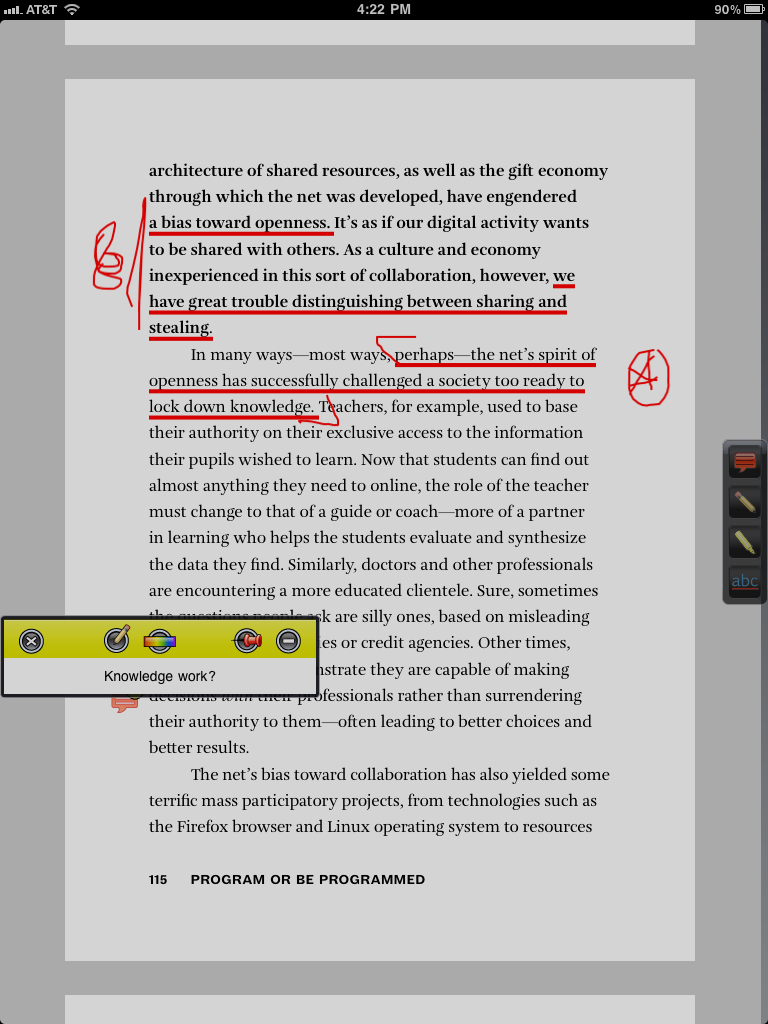
With iAnnotate, I'm able to read in ways that are similar to (but still very different from!) the practices I use when reading an article or a book the old-fashioned way, pen in hand.
I can underline, star important points, and make comments in the margins. Because I type these comments instead of scrawling them in my horrible handwriting, I can actually read my notes later. Best of all, I can save the PDF as is, so that all of my edits and annotations are viewable (and shareable) elsewhere—in my DEVONthink database, for example (but that's fodder for another post...).
So, what am I reading?
Denise Schmandt-Besserat's How Writing Came About. A recent article by Clay Spinuzzi in Written Communication. Bill Moggridge's Designing Interactions. Howard Rheingold's Tools for Thought. A recent article about multimodal storytelling. Dave Winer's blog, Scripting News. The tweets of Jan Chipchase and Kevin Marks. Malcolm McCullough's Digital Ground. Mitchell Duneier's Sidewalk. And a whole host of other interesting articles in the "Read Later" archive of my Instapaper account...
11.10.2010
Exploring a Sustainable and Public Information Ecology
In September, I published a paper in the Proceedings of the ACM Special Interest Group for Design of Communication (SIGDOC); it has recently been published at the ACM site.
My paper details findings from a qualitative study of a professional conference, drawing from Nardi and O'Day's (1999) Information Ecologies and Activity Theory to explore the public writing activities that I observed and catalogued. I collected a few different kinds of data for the study—observations of planning meetings, observations of activities at the three-day conference, written public artifacts on the organization's blog and in the Twitter streams of conference participants, and interviews with several of the participants (and planners) themselves.
As I was coding data from the study, one of the key activities that I encountered again and again was something called tummeling. Tummeling can be seen as the intentional facilitation of conversation and engagement within online communities—often by someone who curates ideas and content while connecting previously unaffiliated individuals from overlapping social groups.
I am indebted to Kevin Marks for sharing this concept on Twitter and in Google Reader (he is, in fact, an active tummler). I think I would have struggled to characterize some of the key activities that emerged from the data had I not been made aware of this concept and its role in fostering online engagement.
Based upon the data, I argued that tummeling was a key factor in bolstering the sustainability of the online and physical community that I studied. Since I was privy to pre-conference planning meetings, I learned that the digital sustainability and visibility of the organization was a key goal heading into the conference.
Interestingly, I don't think most involved in those planning meetings envisioned phatic communication through an application like Twitter as being a large factor in fostering that sustainability.
The data says otherwise.
Tummeling activity and online phatic interaction clearly extended the organization's reach and visibility while promoting connections that were sustainable beyond the three-day conference. These activities were largely extraorganizational; in other words, they were driven from below—by attendees—rather than from above—by the organization itself.
The organizers, to their credit, realized that blogging and microblogging activities needed to be leveraged in some way. They were intent on trying new ways of extending the organization's reach.
Findings from this small-scale study indicate how organizations might better foster tummeling activities in support of visibility and sustainability efforts. Part of the challenge is met by simply promoting tools like Twitter—embracing and encouraging the tummlers who are in some way connected to (though not necessarily a part of) the organization.
You can get a pre-publication version of the full paper below, or the official version at the ACM Portal.
11.07.2009
[ Locus Communis ] Twitter as Digital Commonplace
I gave a talk today at the International Digital Media and Arts Association annual conference. I almost always upload the slides for my talks, but because of the format for this conference--where presentations were limited to ten minutes--I decided to simply screencast the full talk and share it here.
I had a great time at the conference overall, and our panel fostered some excellent discussion. At just under ten minutes, the video takes some time to load; as always, I welcome feedback, questions, and discussion!
I had a great time at the conference overall, and our panel fostered some excellent discussion. At just under ten minutes, the video takes some time to load; as always, I welcome feedback, questions, and discussion!
10.15.2009
Extending the Classroom: Conversations, Content, and Microblogging with Twitter
I had the opportunity to give a fun talk today about using Twitter in educational settings. I was able to present in the brand new Schwartz Digital Complex in Bracken Library, as part of Ball State's Tech4U series. I was also able to make use of an impressive visual display that allowed me to stream tweets in Seesmic, a hashtag search on FriendFeed, and my own slides simultaneously (I actually brought a class to the "learning pod" section of this fantastic facility on Tuesday and shot some video, which I'll upload soon).
The talk essentially mashed together ideas from some other research projects and presented some new material geared toward pedagogical approaches and student engagement.
This last bit was perhaps the most interesting, as it drew from the Ball State University Fall 2008 "Making Achievement Possible" survey of first-year students. The MAP Works survey indicates that 46% of first-year BSU students spend between 30 minutes and two hours on social networking websites each day. A full 40% of students spend 2 or more hours each day on such sites. My sense is that these numbers are underreported.
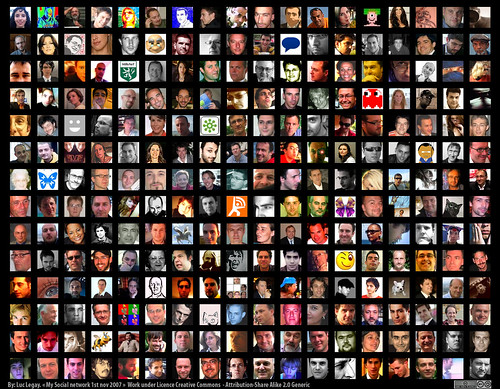
In other words, 86% of our first-year students, as of 2008, are spending time every single day with communities that look like this:
I don't have any easy answers to those questions, but I did suggest some ways that faculty at Ball State can incorporate microblogging into their curricula and pedagogies. I've embedded the slides from today's talk below, and as always, I'm happy to provide a transcript as well. Tommy and Ben from the Center for Media Design were there shooting some video, and I assume it will eventually surface at some point; when it does, I'll link to it!
The talk essentially mashed together ideas from some other research projects and presented some new material geared toward pedagogical approaches and student engagement.
This last bit was perhaps the most interesting, as it drew from the Ball State University Fall 2008 "Making Achievement Possible" survey of first-year students. The MAP Works survey indicates that 46% of first-year BSU students spend between 30 minutes and two hours on social networking websites each day. A full 40% of students spend 2 or more hours each day on such sites. My sense is that these numbers are underreported.
In other words, 86% of our first-year students, as of 2008, are spending time every single day with communities that look like this:
Creative Commons image by luc legay on Flickr.
I asked: as an educator, where are you in that picture? Where are the influential scholars and teachers in your field? Do we see their avatars represented in the social networks where our students are spending their time? Should they even be there in the first place?I don't have any easy answers to those questions, but I did suggest some ways that faculty at Ball State can incorporate microblogging into their curricula and pedagogies. I've embedded the slides from today's talk below, and as always, I'm happy to provide a transcript as well. Tommy and Ben from the Center for Media Design were there shooting some video, and I assume it will eventually surface at some point; when it does, I'll link to it!
10.14.2009
Backchannel Persistence and Collaborative Meaning-Making
Last week I had the pleasure of delivering a paper relatively close to home, at the 27th ACM International Conference on Design of Communication (SIGDOC), at Indiana University in Bloomington. I was especially excited to be on a panel with Shaun Slattery of DePaul University, and Jason Swarts of North Carolina State University--two scholars that I hold in high esteem.
Our panel explored the traces of literate activity that are surfaced and archived in new media writing environments, and which lead to the construction of "fact" on Wikipedia, and the development of provisional knowledge in microblogging platforms. All three papers called on Actor Network Theory and/or Cultural Historical Activity Theory as a way to frame and trace computer supported collaborative work.
I added some theoretical frameworks that are likely too much for a 6,000 word manuscript. I like what I have here, but it's meant to be the start of something much more substantial. In short, my paper amounts to a longish position piece which aims to establish a theoretical framework for tracing meaning-making in persistent backchannel platforms (such as Twitter).
The official published version, should you be able to navigate behind the paywall, is available through the ACM portal. The full proceedings--which include excellent papers from Shaun, Jason, and a number of other fantastic researchers--can also be accessed through ACM. I've uploaded a pre-publication version of the paper to Scribd, and it's available below:
Finally, I've embedded the slides for my presentation as well. If you've seen me present in the past, you'll know that I take a minimalist approach to slidedecks, favoring images over alphabetic text. So, if you'd like the script that accompanies the slides, let me know!
9.12.2009
A Look at Yahoo! Meme
Yahoo's recent struggles to remain relevant have been well documented, from upheaval in executive management to the significant search deal with Microsoft's Bing. As a long-time Flickr user, I've never been particularly happy with Yahoo. Under Yahoo! ownership, Flickr has arguably regressed as social networks have burgeoned all around them.
Earlier this year, Yahoo! rolled out a new service called Meme in a Portuguese-only version, a move described at the time as akin to a Twitter 'Clone'. I recently received an invite for the service's English-language rollout. Early impressions? It's very cool--lighter than Tumblr, more functional than Twitter. I've created a screencast with some initial thoughts, comparisons, and a brief demo...
Earlier this year, Yahoo! rolled out a new service called Meme in a Portuguese-only version, a move described at the time as akin to a Twitter 'Clone'. I recently received an invite for the service's English-language rollout. Early impressions? It's very cool--lighter than Tumblr, more functional than Twitter. I've created a screencast with some initial thoughts, comparisons, and a brief demo...
Subscribe to:
Posts (Atom)
