Showing posts with label invention. Show all posts

9.05.2012

The #1000genres Project

The 1000genres Project

“Genres are not simply text types; they are culturally and historically grounded ways of ‘seeing and conceptualizing reality.’” — Spinuzzi, 2003

This semester, in my Composition and Communication course, freshman at the University of Kentucky will be exploring genres in detailed and meaningful ways, seeing genres as forms of social practice and action (Wenger, 1998; Miller, 1984), as stable-for-now sites and instantiations of ideology (Schryer, 1993), as carriers of provisional knowledge (Shirky, 2008), and as culturally and historically grounded ways of knowing and being in the world (Spinuzzi, 2003).

That’s a mouthful, so let me say this another way: we’re going to be investigating genre all semester, and we’ll be documenting instances of genre in everyday life via Instagram and Twitter.

More importantly, we want you to help!

Where are the genres of your everyday life? What kinds of genres are the norm in your profession, discipline, or vocation? What genres are unique to your city, town, or region? What genres are important to you, and why?

Through the #1000genres project, we’ll be documenting the genres that surround us here in Lexington, at UK, and in local academic and professional contexts. In the process, the collected images and descriptions of genres will become source material for student projects near the end of the semester.

Why are we focusing on genre in this way? Because of David Russell, of course!

People do not “learn to write, period,” notes Russell (1995). Instead, he argues, “one acquires the genres (typified semiotic means) used by some activity field as one interacts with people involved in the activity field and the material objects and signs those people use” (p. 56). For Russell, “writing does not exist apart from its uses, for it is a tool for accomplishing object(ive)s beyond itself. The tool is continually transformed by its use into myriad and always changing genres” (p. 57). Stated another way, he notes that “Learning to write means learning to write in the ways (genres) those in an activity system write” (p. 57).

The #1000genres project is largely about learning how to learn genres—to recognize different genres in the world, the ways those genres arise from and operate within given social contexts, and the ways we might adapt our communication strategies to better match the norms and expectations carried through specific genres. But in doing so, we’ll also consider the ways that people not only adapt but in fact change genres over time.

Participating is easy! Take a picture of a genre that interests you (for whatever reason); write a brief description of the genre or how it operates; tag that photo #1000genres and post it to Instagram, Twitter, or both. That’s it!

Here’s an example of a branding genre at UK, and an example of a spatial genre on campus. Here are several genres layered and considered.

We probably won’t always nail it—sometimes things that seem like genres might be something else. But that’s ok. The point is to be looking, thinking about genres, and documenting what we see.

We can learn even more about genre by seeing the things you post. What kinds of genres are ubiquitous in your world? Show them, and show others!

8.11.2011

Sociotechnical Notemaking: Short-form to Long-form Writing Practices

I've just published a piece in the journal Present Tense that attempts to bring research from my discipline (Rhetoric and Writing) to a public debate about networked writing practices (especially via social software), while simultaneously bringing that public debate to the attention of scholars in my field.

In this sense, the article is less "academic" than other stuff I write because I'm explicitly trying to reach a public audience and show them that, hey, we've been researching this stuff for years, and it is meaningful ("it" being short-form writing). That said, it's still pretty academic in tone...

Sociotechnical Notemaking: Short-form to Long-form Writing Practices

On a related note, I wanted to mention how great it was to interact with Present Tense through the review process. I submitted my manuscript on May 4th and had a decision on May 26th. You read that right. The piece was reviewed by two referees (who provided excellent feedback) and returned with editor's comments in the space of 3 weeks!

If you're an academic, you know that this approaches the speed of light for peer-reviewing scholarship. Granted, part of the reason that Present Tense can turn manuscripts around so quickly is the brevity of the articles it publishes—2,000 to 2,500 words. In fact, part of the lag between the decision and today's publication was my need to trim my 3,100 word submission down to about 2,500 words.

I also really like that Present Tense publishes articles when they're ready rather than waiting to cobble together 6 or 8 articles before releasing a full issue. They still publish issues (my article is in Vol 2 Number 1), but they publish finished articles directly to the site when they're ready to go, which also decreases the overall turnaround time dramatically and gets ideas out into the public domain in a timely manner. Finally, they have fantastic Review and Advisory Boards, their editors were wonderful throughout the process, and articles are fully open access and published with a Creative Commons license.

If you have a shorter article or an idea for a more concise article (for example, I wrote my piece specifically for the journal), I'd highly recommend Present Tense.

1.31.2010

A Few Words About "Digital Literacies"

Just what constitutes literacy?

Too big a question to tackle in a blog post, and quite frankly, I'm not the one to tackle this problem. But a few approaches...

Google runs The Literacy Project.

Wikipedia essentially suggests it's the ability to read and write.

Brian Street says that literacy is "shorthand for the social practices and conceptions of reading and writing."

Lankshear and McLaren (1993) contend that "literacy is many rather than singular." Literacy doesn't just refer to "an essential technology, a specific skill, or a universal phenomena such as print or script. Rather, reading and writing consist in myriad social and socially constructed forms."

Lankshear and McLaren (1993) also argue that literacy is "entirely a matter of how reading and writing are conceived and practiced within particular social contexts."

In other words, literate action can be seen as synonymous with rhetoric as situated, strategic discourse, the working definition of rhetoric that I use and continually explore with students.

Because literacy is defined by and pushed around into so many different and overlapping social contexts, the term gets appended to all kinds of other concepts--extended in curious ways.

Health literacy.
Financial literacy.
Digital literacy.

Let's think in terms of what digital literacy might entail, beyond simple facility with reading and writing within and for digital environments. It might include:

:: Understanding what makes the basic tools of digital environments tick: server, browser, URL, command line, etc. ::

:: Understanding and working with the basic tools of digital media production and consumption--a functional literacy ::

:: A broader, critical understanding of the tendential forces driving and shaping technology and society--how did we get to where we are with this stuff? ::

:: Basic understanding and facility with major platforms, protocols, standards, and languages ::

:: What Selfe (1999) calls critical technological literacy: a reflective awareness of all of the above ::

So, back to the forms. Digital literacy involves writing and reading in digital environments, yes. But it also involves understanding and enacting the rhetorical infrastructures that dictate what form such writing work will take in digital environments.

To that end, digital literacy isn't about using the frames in a WYSIWYG interface, or about placing content inside template-based tools. Digital literacy is understanding what made the tools in the first place. And the broader social and technological factors that impact the development and use of those tools, forms, and platforms.

12.30.2009

On the "Death" of RSS...

A screencast showing a specific use case in favor of RSS within the context of the RSS vs. Twitter debate.

Here, we see how ineffectual Twitter search can be for finding older tweets, and how important a feed-reader can be for archiving and retrieving those same tweets...


11.07.2009

[ Locus Communis ] Twitter as Digital Commonplace

I gave a talk today at the International Digital Media and Arts Association annual conference. I almost always upload the slides for my talks, but because of the format for this conference--where presentations were limited to ten minutes--I decided to simply screencast the full talk and share it here.

I had a great time at the conference overall, and our panel fostered some excellent discussion. At just under ten minutes, the video takes some time to load; as always, I welcome feedback, questions, and discussion!


10.19.2009

:: repurposed ::

:: repurposed ::


:: repurposed :: is a blog exploring rhetorics, places, and publics from a group of researchers at Ball State University. It goes live tomorrow, though a preview version with a few posts are currently available. There are still some design issues to sort out, and some final preparations related to content.

While many of the contributions to the site will be from students in my senior seminar, the driving idea and impetus is the production of a sustainable and meaningful space for the ongoing discussion of the complex relationships between language, placemaking, and publics. Over the next few weeks, we expect to consistently have between 15 and 20 posts each week, and we are soliciting occasional guest posts from a variety of disciplinary and professional domains. We see this as a post-disciplinary endeavor, one which is ultimately focused on better understanding how we make meaning in and through our public places.

To that end, the site will consider wayfinding activities, architecture, mapping, ubiquitous computing and context-aware environments, the social production of place and the social construction of place, alleys and interstices, landmarks, edges, paths, and nodes, public discourse, walking, bikes, skateboards, autos, and the many ways that human beings repurpose their environments--discursively, materially, affectively--in order to make meaning.

Please consider adding :: repurposed :: to your feed reader or bookmarks. If you're interested in contributing--once or occasionally--on any aspect of rhetorics, places, and/or publics, please don't hesitate to contact me.

10.15.2009

Extending the Classroom: Conversations, Content, and Microblogging with Twitter

I had the opportunity to give a fun talk today about using Twitter in educational settings. I was able to present in the brand new Schwartz Digital Complex in Bracken Library, as part of Ball State's Tech4U series. I was also able to make use of an impressive visual display that allowed me to stream tweets in Seesmic, a hashtag search on FriendFeed, and my own slides simultaneously (I actually brought a class to the "learning pod" section of this fantastic facility on Tuesday and shot some video, which I'll upload soon).

The talk essentially mashed together ideas from some other research projects and presented some new material geared toward pedagogical approaches and student engagement.

This last bit was perhaps the most interesting, as it drew from the Ball State University Fall 2008 "Making Achievement Possible" survey of first-year students. The MAP Works survey indicates that 46% of first-year BSU students spend between 30 minutes and two hours on social networking websites each day. A full 40% of students spend 2 or more hours each day on such sites. My sense is that these numbers are underreported.

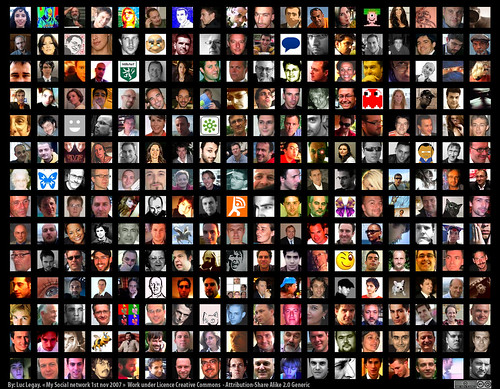
In other words, 86% of our first-year students, as of 2008, are spending time every single day with communities that look like this:

Creative Commons image by luc legay on Flickr.

I asked: as an educator, where are you in that picture? Where are the influential scholars and teachers in your field? Do we see their avatars represented in the social networks where our students are spending their time? Should they even be there in the first place?

I don't have any easy answers to those questions, but I did suggest some ways that faculty at Ball State can incorporate microblogging into their curricula and pedagogies. I've embedded the slides from today's talk below, and as always, I'm happy to provide a transcript as well. Tommy and Ben from the Center for Media Design were there shooting some video, and I assume it will eventually surface at some point; when it does, I'll link to it!

10.14.2009

Backchannel Persistence and Collaborative Meaning-Making

Last week I had the pleasure of delivering a paper relatively close to home, at the 27th ACM International Conference on Design of Communication (SIGDOC), at Indiana University in Bloomington. I was especially excited to be on a panel with Shaun Slattery of DePaul University, and Jason Swarts of North Carolina State University--two scholars that I hold in high esteem.

Our panel explored the traces of literate activity that are surfaced and archived in new media writing environments, and which lead to the construction of "fact" on Wikipedia, and the development of provisional knowledge in microblogging platforms. All three papers called on Actor Network Theory and/or Cultural Historical Activity Theory as a way to frame and trace computer supported collaborative work.

I added some theoretical frameworks that are likely too much for a 6,000 word manuscript. I like what I have here, but it's meant to be the start of something much more substantial. In short, my paper amounts to a longish position piece which aims to establish a theoretical framework for tracing meaning-making in persistent backchannel platforms (such as Twitter).

The official published version, should you be able to navigate behind the paywall, is available through the ACM portal. The full proceedings--which include excellent papers from Shaun, Jason, and a number of other fantastic researchers--can also be accessed through ACM. I've uploaded a pre-publication version of the paper to Scribd, and it's available below:


Finally, I've embedded the slides for my presentation as well. If you've seen me present in the past, you'll know that I take a minimalist approach to slidedecks, favoring images over alphabetic text. So, if you'd like the script that accompanies the slides, let me know!

10.12.2009

Considering Charles Mudede

My feed reader is mostly all business. I read items in the order they arrive--not by topic, not by blog--oldest to newest, in a great big tangled mess of interestingness.

The usual suspects are there: every major tech blog you can think of (and some you probably can't), stuff on ubicomp and mobile computing, academic blogs from colleagues in my field and someday colleagues in other fields, and feeds from architecture, urban planning, design, and computer science. There are, however, a few feeds pointed in other directions, mostly toward popular culture.

Of these "other" feeds, one of my favorites is The Stranger's SLOG (and its musical accomplice, Line Out). I read The Stranger for a variety of reasons, but mainly because I find the writing entertaining and because I love Seattle.

Charles Mudede is an associate editor at The Stranger, and a faculty member at Pacific Lutheran University. He's also a key reason why I read SLOG with interest.

Mudede's posts are anomalies to a certain extent; they stand out by virtue of their juxtaposition to the mass of posts published each day on SLOG. This is not to say that the other posts aren't entertaining, informative, and even heady; they often are--perhaps just as often as they are not--and I am often inclined to celebrate both eventualities.

But Mudede's posts are something different, and they always stand out within the feed. In this sense, his posts benefit from the juxtaposition.

Take Marxism and Insects for example. In between posts on Seattle politics or sex advice from Dan Savage, Mudede surfaces with a post that cobbles together Capital, the machinations of queen bees, Iranian politics, and Althusser's notion of the Ideological State Apparatus.

His posts are often pithily thought-provoking. Ideology Today contends that the national fuss over identity theft keeps us stridently and earnestly focused "on the least of [our] worries."

And then there's one of my favorite posts in recent memory, The Difference. A brief meditation on philosophy and representation through the forgotten Foucault and the remembered Foucault.

To consider Mudede in the midst of the madness is to consider a sharp arithmetic of cogitative concision: 2 fragments + 2 photos + 2 sentences = Foucauldian heuristic.

That commenters often seem befuddled, frustrated, and pissed off cements my admiration.

Long live Mudede, and long live SLOG.

4.24.2009

Practices of Ambient Research

I wanted to post a follow-up to my previous discussions of ambient research with some comments on how the collection and sharing of information played out in practice yesterday, for a very specific purpose.

First, a little context. In studying postmodern rhetorics during my doctoral coursework, I was introduced to postmodern and experimental geography by my eventual dissertation director, Helen Foster. We looked at theorists like Soja and Harvey from a decidedly rhetorical perspective, and I became very interested in the relationship between an ontological view of rhetoric and the production of space--so much so that I felt my dissertation work was trending in this direction. In addition to reading seminal work in both fields, I began using Delicious to bookmark links, articles, and especially blogs like City of Sound, BLDBLOG, and Critical Spatial Practice. In fact, the latter blog was tremendously useful, as Nicholas Senn's Delicious page fostered further research in this area.

But for a variety of reasons, my studies took me in different directions, despite some productive work on rhetorics of space (see, for example, the forthcoming Responsibilities of Rhetoric). Nonetheless, I have remained interested in geography and mapping on a more personal level, and in the move away from Delicious to Twitter and RSS (another post, perhaps), I have continued to collect work in this area, especially via feeds from some 15 space/place related blogs or sites. My admittedly inexpert knowledge on the topic has accumulated to the point that I have been able to at least suggest resources for others, or offer feedback on scholars like Sibley, Low, Auge, and Lefebvre.

What I'm getting at is this: through blog visits, then Delicious, and now feeds and Twitter, I have enabled ambient contact with some of the seminal and emerging topics in postmodern geography, and I've been able to contextualize that work within my own discipline by way of consistent wading in the flow of information. Even though I'm not explicitly researching in this area, the work that I come into contact with is still useful and interesting, often for others.

In recent weeks, several people have contacted me about sources on space/place for work in rhetoric and writing studies, and I've been able to pass along research both print-based and digital. Just yesterday, my own ambient infrastructure brought me a blog post on Mapping Play from Alex Reid (via RSS and Twitter), a post and conference presentation on urbanization and everyware (RSS), and an excellent post on experimental geography (RSS). In turn, I shared links to these articles via Twitter, for anyone interested, but especially for those who'd recently asked for sources. The sharing of these links on Twitter also prompted Collin Brooke to post an excellent list of sources in experimental geography.

Anyone following along with even a passive interest in space and place had several intriguing threads to follow, promoting a kind of shared or collective ambience. This is ambient research in practice, enabled by social platforms of distributed connectivity. This is good good stuff. This must be the kind of thing that Peter West experiences almost daily.

One last thought: if you use Google Reader to manage feeds (or if you're going to start), please feel free to contact me about sharing feeds!

4.22.2009

St. Bjork

4.17.2009

4 Reasons Why Twitter Resonates with Generation X

Have you noticed the recent spate of articles about Twitter user demographics? For example, one of my Twitter contacts, @dreig, pointed me to a Reuters piece which suggests that "you could be forgiven for thinking that Twitter was the latest example of youth culture," noting its increasing popularity with those in more, well, advanced demographic brackets ("Twitter Older than it Looks"). Then there's a similar CNET post which points out that "the majority of Twitter users are 35 or older" ("Why Facebook and Twitter are aging gracefully").

Assuming the accuracy of the ComScore numbers that both articles cite, what are some of the factors influencing Twitter adoption among the 35+ demographic? I'll discuss here four of the key features that I feel have contributed to Twitter's popularity with Generation X (full disclosure: I'm 35).

1. It's Dead Simple

Twitter is flexible. Twitter is agile. Twitter is mobile. Usability, thy name is Twitter. These properties could easily have been listed as adoption attributes in their own right for those 35+, but I've chosen to gather them under the rubric of "Dead Simple" here, because collectively they contribute to the fact that Twitter just works (occasional sightings of Fail Whales notwithstanding).

For a generation in college at the dawn of the web, finding unfettered, dead simple, web-based applications is particularly noteworthy, since that same generation has seen so much that didn't work over the years. And as David Weinberger notes, "twitter is an app that scales as a platform." Twitter's flexibility and agility have enabled user-generated innovation and robust third-party development; mired for so long in virtual walled gardens, users 35+ can uniquely appreciate the relative freedom of information circulation that Twitter enables (remember, one can grab an RSS feed of any public Twitter user without ever signing up!). Which leads us to point number two. . .

2. It's Distributed

Since it scales as a platform, Twitter realizes some of the potential of distributed knowledge work. I want to make a distinction here that this isn't necessarily the same type of distributed communication found on social networks like Facebook, where symmetry is enforced and past relationships--now distrubuted--are reinforced.

There is some sense of distributed communication with far-flung social ties on Twitter, to be sure, but the affordances for distributed knowledge work are also more easily leveraged (meaning that I can find and follow someone like Valdis Krebs, for example, without having an algorithm tell me that someone else I know is following him too). And since many of those 35+ are especially inclined to make use of such affordances--say, for professional reasons--Twitter easily enables distributed connections based upon self-identified shared interests, rather than a shared past or location.

Adina Levin argues that Twitter's dynamic asymmetry enables "discovery [of other, distributed users] with low social expense" ("How Asymmetry Scales"). It's easy to find and follow on Twitter, regardless of preexisting knowledge, relationship, or spatial proximity. As a distributed platform, then, the 35+ crowd can selectively receive information from others all over the world more easily than even an RSS feed.

3. It's Public

In a recent Microsoft Research talk, danah boyd argues that "social media continues to be age-graded. Right now, Twitter is all the rage, but are kids using it? For the most part, no" ("Social Media is Here to Stay ... Now What?"). She then explores why this is the case, and hits upon something that has been largely ignored: "the culture of Twitter is all about participation in a large public square ... many are leveraging Twitter to be a part of a broad dialogue. Teens are much more motivated to talk only with their friends..."

In my field, we approach this "participation in a large public square" from the perspective of civic rhetorics, of discursively contributing to culture at large. Those who are 35 and over are well-positioned and uniquely inclined to participate in civic rhetorics for personal, professional, and social reasons.

On a personal level, the 35+ user is likely to feel that age and experience lend a certain viability to their public voice. In professional terms, the 35+ user can leverage the distributed, public knowledge work noted above, while also deploying Twitter as a space to shape professional image. Finally, in social terms, a recognition of shared interests and a desire to shape shared futures allows the 35+ user to contribute publically to political discourse.

4. It's about Communication

In a certain sense, Twitter is really not a social network. The barriers to participation are tremendously low, and the primary--really the only--unit of social connection is discourse (isn't it nearly always so?). Twitter is about talk, and it's dead simple platform makes such talk travel and scale in ways that those 35+ are especially positioned to appreciate.


Generation X came of age with email, and likewise saw email's transition from novelty to nuisance. This morning when I checked my inbox, I found 40 things I didn't want; when I similarly checked my incoming tweets (on my mobie), I found 50 more things that I had explicitly asked for. And those tweets are incredible pivots for social interaction, for simple, agile, distributed, public connections with others that foster ineraction in ways that walled social networks and email simply cannot broach.

3.23.2009

Infrastructures of Ambient Research


As I've noted elsewhere, I use Twitter and other SNSs primarily for research and conversation about research. This post details a core approach to the kind of research one might pursue in leveraging the potential of ambient communication.

Defining Terms

Ambient research is precisely what one might expect it to be: a framework and approach to research that is enveloping, atmospheric, ubiquitous, and unflinchingly mutable. What I want to do in this post is briefly sketch the parameters of ambient research as I currently understand them, discussing the infrastructures that enable legitimate and productive research activity that is streaming, aggregable, searchable, and conversational. In a follow up post, I'll also consider the potential of ambient research for generative productivity and cognitive recursion in my own field and beyond.

Mobies


My oldest daughter's 11th birthday is this Saturday, and we're very excited to give her a new computer. Of course, she already has an older Windows XP desktop in her room, and she has frequent access to both Ubuntu and OS X laptops. But this is a computer that she can hold in the palm of her hand, that's wifi ready, and that she can use to text her friends via IM. This isn't a "computer" as we've come to understand the term, but instead a mobile computing device that can do more (better) than the laptops of just a few years ago. She's getting an iPod Touch.

Ambient research is predicated upon the growth and development of such devices, as ambient communication requires ubiquity and mobility. How, for example, can communication be ambient if there's no means for consistent contact--contact that occurs beyond the traditional screen? But even more to the point, ambient research at its most basic level is predicated upon the infrastructure of not just wifi or data enabled devices like my daughter's iPod Touch, but by the SMS capability found in standard mobile phones.

"Smart" phones are fine, but relatively new (and growing) communication platforms that leverage SMS technologies have significantly lowered the barriers to ambient communication, and therefore, research. The
combination of mobie + SMS + always-on communication platform (such as Twitter, which I discuss below) represents the fundamental infrastructure of ambient communication.

While this infrastructure is enough to support ambient communication, enabling a framework of ambient research requires an initial strategic outlay of intellectual capital in the deployment of three critical forms of information flow (Push, Pull, and Streams), and the eventual engagement of such frameworks in the form of conversation. Additionally, the initial parameters will need continual adjustment, depending, of course, on the nature of the research area and the ongoing effectiveness of incoming data. Like a growing tree, the forms of information flow will need consistent watering and pruning.

Push

Let's say that you're interested in researching "serendiptious search." One of the first and easiest means of systematically acquiring information on your topic is a
Google Alert. Periodically (each day, for example), Google will index sites that contain the phrase "serendipitous +search" and deliver that information to you via email. This is basic "push" information retrieval.

When Apple recently announced the release of iPhone OS 3.0, much of the buzz centered on the platform's "push notification model." As my friend and former colleague Shawn Miller notes, "push gathers info from other servers and pushes out notifications to apps in iPhones." And as Paul Golding recently argued, "a push notification service is a MINIMUM level of platform support to achieve the level of ambient communication that [applications like] Twitter brings."

In short, push notifications for data enabled phones raise the bar for real-time data streams in applications like Facebook, Twitter, Google Calender, et al. Instead of running the Tweetie app in the old iPhone OS, as Golding notes, push notifications bring the data to you--immediately. But what about SMS? This is where Twitter serves as a fascinating example. Tweets received in real-time via SMS aren't technically "push notifications," as they aren't reliant on relationships to individual apps (other than Twitter itself, of course). SMS tweets are more akin to the streaming information I'll discuss below.


Pull

RSS feeds are certainly not new, nor are they even necessary to develop a "pull" framework of information delivery based on one's interests. In fact, many have simply abandoned RSS in favor of the information streams of platforms like Twitter and FriendFeed. But the widespread adoption of RSS through tools like Google Reader have validated the importance of pull--of establishing and maintaining an aggregable and searchable "feed" of information specifically tailored to one's interests.

Whether one uses
Reader, Pipes, or a similar aggregator, feeds--and the sharing of feeds--are an essential
component of ambient research. In fact, both push and pull have explicit communicative components, as these aggregators are social, and work best when shared and discussed. For example, the work of Peter West in creating "living bibliographies," and subsequently sharing such work with others through platforms like Twitter, embodies the both/and proposition of ambient research. It is the combination of push, pull, streams, and conversations that make such a framework viable--not the reliance on any one form in isolation.

Streams

If you've ever used Twitter, Facebook, FriendFeed, or MySpace, then you've dipped your feet into the flowing currents of real-time conversation streams (or perhaps you're already an avid swimmer). Much has been made of the recent
Facebook redesign in the image of Twitter, and influential technologists like Robert Scoble have espoused the flexibility and potential of FriendFeed. For the present discussion of ambient research, these platforms all share certain essential characteristics.

First of all, they are
platforms. This seems rather obvious, I know, but this is a tremendously important distinction. Certainly all four simultaneously enable and constrain, and like any communication environment, there are agency/structure dynamics that must be critically considered. But the reality is that a platform is mainly flexible (within reason)--one can use it to catch up with friends (as in the case of Facebook and MySpace), share interesting
finds and photos (FriendFeed), or share peer-reviewed journal articles in knowledge management (as in the example of Peter West on Twitter, mentioned above). It should be noted that Peter's work is particularly expansive in scope, with timely links to recently announced books, conference proceedings, and articles in a variety of scholarly and professional areas. The platform enables the widespread dissemination of such work.

Secondly, these platforms only work when multiple connections are made. Having two contacts on any of these sites will not enable a stream of conversation and connection. Having 500 Facebook friends or following 200 people on Twitter changes the game. These contacts--and the frequent conversations they engender--are the key to ambient communication and research.

Finally, like "pull" information flows, these platforms are aggregable (to varying extents). Twitter is not only aggregable, it is impressively searchable, both through Twitter's proprietary search algorithm and through Google (which, as
John Battelle has noted, seems to love indexing tweets). Moreover, Twitter's "favorites" function, much like "starring" posts in Reader, allows selective and strategic aggregation.


Twitter is the platform I know best, and it is the form of ambient communication I have most readily in mind when I envision currents of information streams. David Weinberger's recent post "
4.5 Things Twitter teaches us" is worth referencing at length here to emphasize the power of Twitter as a platform and as a stream of information.

He notes that Twitter's web UI "assumes we're ok with not keeping up with abundance. Tweets are going to scroll by when you're not looking, and you're never going to see them." This is the nature of streams--you're going to catch some things, while others float on by--and that's just fine, because the communication event is fundamentally
ambient. You can never take it all in.


"At Twitter, the people you follow are not necessarily the people who are following you." This is an important difference between Twitter and Facebook as platforms, and it's one of the core reasons that I believe Twitter is growing exponentially. The reality here is that people like Tim O'Reilly and Kevin Marks and Clay Shirky do not follow me, and I'm okay with that because Twitter is a public forum, and they still provide me with tremendous information, sometimes even engaging in conversation. Twitter would be drastically less effective if follow ratios were exactly one-to-one. (See James Governor's post on
Asymmetric Follow for an insightful approach to @ replies and social scaling within Twitter)

"Twitter is an app that scales as a platform." Weinberg is right to note that Twitter
is an application, but this simply reinforces the point I've been making all along, that as a platform, Twitter enables robust connections,
conversations, and information sharing in ways that few other platforms can.

Adding SMS functionality to your tweet stream only enhances scalability. SMS is the key feature of Twitter for ambient research; it means that anyone with an SMS enabled phone and at least occasional access to a computer can combine push and pull (via more traditional means) and streams (via real-time tweets) to enact ambient research. (As I'll discuss in the follow-up post, this has tremendous implications for curriculum and pedagogy in a variety of content areas). Someone with a high-end mobie (like an iPhone or Pre) can engage ambient research collectively (push + pull + streams).

Wading at the Confluence of Push, Pull, and Streams

As an activity, ambient research is subjective in more ways than I have time or space to consider. We're all researching different things, and we all engage the information we encounter in different ways. That said, I'd like to share a few principles that have helped me effectively wade and grasp at the flows of information that comprise much of my online research.

First of all, I'm a wannabe polymath. I'm profoundly interested in the disciplinary discourse of my field, but I'm also doubly lucky to study what is essentially a metadiscipline, as virtually every human pursuit involves communication, and a great many involve writing. In this sense, I'm always interested in the environments where writing and rhetoric occur, which leads me to follow others on Twitter with diverse backgrounds, and subscribe to feeds and notifications that are sometimes flagrantly extradisciplinary. In this sense, effective streams are necessarily cross-disciplinary and often cognitively dissonant. This is a good thing.

On Twitter, I follow others in my discipline, and I'm continuously learning from them. But I also follow as many (or more) outside of my discipline, because I'm interested in what the software developers, information architects, sociologists, and business professionals are doing, and how they are communicating about their fields. I'm interested in the research they share with each other. And I'm engaging much of this information ambiently.

The benefit of this approach to ambient research is found in collision, bricolage, and aggregation; cross-disciplinary dialogue and information sharing accretes and collides in the streams of ambient research, and it is in this collision (and resultant bricolage) that new knowledge is born. These collisions leave traces, and over time a kind of reverse
hypertie emerges, connecting researchers in digital environments and beyond.

In a follow up post, I'll tie the notion of ambient research to work on recursion theory and rhetorical invention/innovation. I will also explore some of the implications of ambient research for issues in Rhetoric and Writing Studies.

(The tweets above that mention "PolyContextual" refer to my previous Twitter name, which I recently changed to
@bmcnely.)