Showing posts with label platforms. Show all posts

2.08.2010

Teaching in Public, Google Reader, and Self-Directed Learning

[ NB: this post was originally written for :: repurposed :: and is duplicated here because of clear overlapping concerns and dissemination for a different audience... ]

This is Bolutife (Bolu) Olorunda.

Bolu was a major contributor to my senior seminar for majors in English—Rhetorics, Places, and Publics, ENG 444—at Ball State University last semester. He's also an integral contributor to :: repurposed ::.

But Bolu is a Construction Management major. He doesn't really take any courses in English anymore. And he wasn't registered for my course at all.

Bolu's involvement in ENG 444 is absolutely fascinating to me.

I'm going to spend some time explaining why that is, and how opening our classrooms to broader publics through emerging media platforms can provide tremendous opportunities for self-directed, lifelong learning...

-----

The start of fall term brought the usual documentation from the registrar's office—class lists, classroom locations, final exam schedules and the rest. As a faculty fellow with BSU's Emerging Media Initiative, I naively assumed that I'd be working in computer classrooms.

Naturally, I didn't actually check to see where my classrooms were located and what kinds of technologies were available in those rooms until a week before the semester started.

Of course, ENG 444 was not in a computer classroom. I needed it to be. So I requested a change.

Wish granted.

The new classroom location was in the Applied Technology building, in an open computer lab, in a room at least 15 degrees warmer than a room should be, regardless of changing weather conditions outside.

The new room was an unusually apt assignment for a course exploring rhetorics of space, place, and the built environment. We confronted issues of placement, location, and the malleability of the learning environment from day one. Early in the semester, when the weather was stunningly gorgeous, we often met outside, just to escape the heat of Applied Technology 208.

But perhaps the most curious affordance of the new classroom was the fact that it wasn't really a classroom at all. It's a computer lab, staffed full-time by a student employee. Every Thursday evening, when we met from 5 to 6:15, the student employee was Bolu...

-----

A junior looking to graduate in 2011, Bolu is in many respects similar to thousands of other BSU students—he's bright, conscientious, responsible, and intellectually curious. Bolu's family is originally from Ibadan, Nigeria. His mother chose to pursue graduate studies at BSU (where she earned both an MA and PhD), and he moved to Muncie with his family when he was 14.

Bolu graduated from Muncie Central High School and enrolled at BSU. His father is an architect, and Bolu originally pursued architecture as his major. Though he is now studying Construction Management, he retains an interest in both architecture and engineering. He's started to think about his graduate school options in areas that may allow him to combine these interests.

Not surprisingly, the serendipity of Bolu's placement in an on-campus job in Applied Technology 208 each week, his interests in architecture and engineering, and the nature and tenor of our ongoing course on Rhetorics, Places, and Publics proved an important combination for his eventual involvement in 444.

-----

For several class periods, our group of English majors (and contributors to :: repurposed ::) thought and talked through the politics and rhetorics of Muncie's “Village,” a shopping area just a couple of blocks away from campus. We used The Village to discuss Kevin Lynch's paths, edges, nodes, districts, and landmarks. We discussed how different groups cognitively mapped the area. We thought through what it might mean to redesign The Village, thinking about Setha Low's work on the social construction and the social production of public space.

Most of these discussions were student-led. I often provided the framework and the theoretical prompting from our readings, but the contributors to :: repurposed :: were always the contributors to our reimaginings of The Village. They did the work. And they mostly had fun with it, I think.

During a particularly lively full-group discussion one Thursday evening, while the others deliberated amongst themselves, I sat near the front of AT 208, across the desk from where Bolu patiently waited for the classroom to become a computer lab again. But this evening, about 5 or 6 weeks into the semester, Bolu asked, “is this an English class?”

“Yes,” I said. “The students are working on cognitive maps of The Village, thinking through one of our readings.”

“This isn't like any English class I've ever seen,” Bolu said.

“Oh? Why do you say that?”

“Well, the things you're talking about, the way you teach the course, the way they're discussing things. It's different,” Bolu said.

After class, I spent some more time talking to Bolu about the course. He was genuinely interested in the subject matter—in rhetoric—and in learning more about the work we were doing.

The next day, I added him to the Blackboard site for our course, so that he could access supplemental readings from Emig, Spinuzzi, Brummett, Porter et al, Diehl et al, Low, Soja, Sack, and Massey, among others. He started reading, on his own. He listened during class and took notes.

I asked Bolu to sign up for Google Reader, and had him subscribe to the Bundle that we used in conjunction with the course.

One Thursday evening after class, he told me that ENG 444 was the highlight of his day.

The week that we had this blog up and running, the week of October 19th, I formally introduced Bolu to the class, and I informed everyone that he'd be an important contributor to the blog.

And he was. And he still is.

-----

At the end of finals week, Bolu came by my office so that I could ask him a little more about his involvement in the course. It was frankly thrilling for me to meet someone so interested in what we were doing, so invested in a course he wasn't even registered for, so intellectually curious.

I simply asked Bolu what interested him in 444, what made him participate in the ways that he did.

He told me that the course seemed informal and discussion-based—that there was room for participation from all who felt inclined to do so. As I mentioned above, the mere discussion of space, place, the built environment, and the use and theory of rhetoric was likewise interesting to him.

He told me again that he didn't think it was an English class.

For Bolu, the stereotypical English class involved students writing papers and reading things. But he felt like the 444 students were more than students. That they were doing things beyond simply writing papers. And they were interacting in class, in Reader, and on :: repurposed ::.

Bolu told me that he felt like a part of the class on those Thursday nights. He knew the others by name. He paid attention and took notes. He read many of the same things as those enrolled, and he followed along especially in our sharing of links and ideas on Google Reader.

Once :: repurposed :: was up and running, Bolu read every post. He told me that he was constantly refreshing the site, looking for new contributions.

Bolu is truly a self-directed learner. He's planning on graduate school after graduation, and eventually hopes to own his own business.

He doesn't want to work 9 to 5.

Knowing what I know about Bolu, I don't think that's going to be a problem.

-----

I have more to say about how our group blog and emerging media tools like Google Reader can open up our classrooms to self-directed learners and to broader publics. The notion of making our classrooms more open, and of involving the public in our formative course work through tools like Reader has tremendous potential for immersive learning, in my opinion. But that's for another post...
1.31.2010

A Few Words About "Digital Literacies"

Just what constitutes literacy?

Too big a question to tackle in a blog post, and quite frankly, I'm not the one to tackle this problem. But a few approaches...

Google runs The Literacy Project.

Wikipedia essentially suggests it's the ability to read and write.

Brian Street says that literacy is "shorthand for the social practices and conceptions of reading and writing."

Lankshear and McLaren (1993) contend that "literacy is many rather than singular." Literacy doesn't just refer to "an essential technology, a specific skill, or a universal phenomena such as print or script. Rather, reading and writing consist in myriad social and socially constructed forms."

Lankshear and McLaren (1993) also argue that literacy is "entirely a matter of how reading and writing are conceived and practiced within particular social contexts."

In other words, literate action can be seen as synonymous with rhetoric as situated, strategic discourse, the working definition of rhetoric that I use and continually explore with students.

Because literacy is defined by and pushed around into so many different and overlapping social contexts, the term gets appended to all kinds of other concepts--extended in curious ways.

Health literacy.
Financial literacy.
Digital literacy.

Let's think in terms of what digital literacy might entail, beyond simple facility with reading and writing within and for digital environments. It might include:

:: Understanding what makes the basic tools of digital environments tick: server, browser, URL, command line, etc. ::

:: Understanding and working with the basic tools of digital media production and consumption--a functional literacy ::

:: A broader, critical understanding of the tendential forces driving and shaping technology and society--how did we get to where we are with this stuff? ::

:: Basic understanding and facility with major platforms, protocols, standards, and languages ::

:: What Selfe (1999) calls critical technological literacy: a reflective awareness of all of the above ::

So, back to the forms. Digital literacy involves writing and reading in digital environments, yes. But it also involves understanding and enacting the rhetorical infrastructures that dictate what form such writing work will take in digital environments.

To that end, digital literacy isn't about using the frames in a WYSIWYG interface, or about placing content inside template-based tools. Digital literacy is understanding what made the tools in the first place. And the broader social and technological factors that impact the development and use of those tools, forms, and platforms.

12.30.2009

On the "Death" of RSS...

A screencast showing a specific use case in favor of RSS within the context of the RSS vs. Twitter debate.

Here, we see how ineffectual Twitter search can be for finding older tweets, and how important a feed-reader can be for archiving and retrieving those same tweets...


11.07.2009

[ Locus Communis ] Twitter as Digital Commonplace

I gave a talk today at the International Digital Media and Arts Association annual conference. I almost always upload the slides for my talks, but because of the format for this conference--where presentations were limited to ten minutes--I decided to simply screencast the full talk and share it here.

I had a great time at the conference overall, and our panel fostered some excellent discussion. At just under ten minutes, the video takes some time to load; as always, I welcome feedback, questions, and discussion!


10.15.2009

Extending the Classroom: Conversations, Content, and Microblogging with Twitter

I had the opportunity to give a fun talk today about using Twitter in educational settings. I was able to present in the brand new Schwartz Digital Complex in Bracken Library, as part of Ball State's Tech4U series. I was also able to make use of an impressive visual display that allowed me to stream tweets in Seesmic, a hashtag search on FriendFeed, and my own slides simultaneously (I actually brought a class to the "learning pod" section of this fantastic facility on Tuesday and shot some video, which I'll upload soon).

The talk essentially mashed together ideas from some other research projects and presented some new material geared toward pedagogical approaches and student engagement.

This last bit was perhaps the most interesting, as it drew from the Ball State University Fall 2008 "Making Achievement Possible" survey of first-year students. The MAP Works survey indicates that 46% of first-year BSU students spend between 30 minutes and two hours on social networking websites each day. A full 40% of students spend 2 or more hours each day on such sites. My sense is that these numbers are underreported.

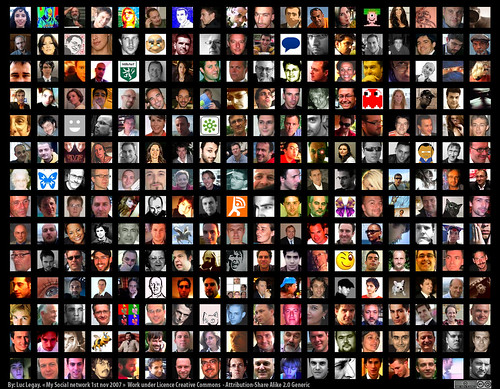
In other words, 86% of our first-year students, as of 2008, are spending time every single day with communities that look like this:

Creative Commons image by luc legay on Flickr.

I asked: as an educator, where are you in that picture? Where are the influential scholars and teachers in your field? Do we see their avatars represented in the social networks where our students are spending their time? Should they even be there in the first place?

I don't have any easy answers to those questions, but I did suggest some ways that faculty at Ball State can incorporate microblogging into their curricula and pedagogies. I've embedded the slides from today's talk below, and as always, I'm happy to provide a transcript as well. Tommy and Ben from the Center for Media Design were there shooting some video, and I assume it will eventually surface at some point; when it does, I'll link to it!

10.14.2009

Backchannel Persistence and Collaborative Meaning-Making

Last week I had the pleasure of delivering a paper relatively close to home, at the 27th ACM International Conference on Design of Communication (SIGDOC), at Indiana University in Bloomington. I was especially excited to be on a panel with Shaun Slattery of DePaul University, and Jason Swarts of North Carolina State University--two scholars that I hold in high esteem.

Our panel explored the traces of literate activity that are surfaced and archived in new media writing environments, and which lead to the construction of "fact" on Wikipedia, and the development of provisional knowledge in microblogging platforms. All three papers called on Actor Network Theory and/or Cultural Historical Activity Theory as a way to frame and trace computer supported collaborative work.

I added some theoretical frameworks that are likely too much for a 6,000 word manuscript. I like what I have here, but it's meant to be the start of something much more substantial. In short, my paper amounts to a longish position piece which aims to establish a theoretical framework for tracing meaning-making in persistent backchannel platforms (such as Twitter).

The official published version, should you be able to navigate behind the paywall, is available through the ACM portal. The full proceedings--which include excellent papers from Shaun, Jason, and a number of other fantastic researchers--can also be accessed through ACM. I've uploaded a pre-publication version of the paper to Scribd, and it's available below:


Finally, I've embedded the slides for my presentation as well. If you've seen me present in the past, you'll know that I take a minimalist approach to slidedecks, favoring images over alphabetic text. So, if you'd like the script that accompanies the slides, let me know!

10.02.2009

Twitter and Commonplace Books

Since 2006, I have been thinking through various iterations of a digital commonplace book. First, a little background on the traditional practice of commonplacing...

As early as the 14th Century in the west, literate populations began to cobble together bits of information--quotes, measures, thoughts, arguments, summaries, responses--on paper, an increasingly ubiquitous resource. These "note books" eventually came to be known as commonplace books, and they were a predicated upon tenets of classical rhetoric. George Eliot kept a commonplace book; so did Thoreau, Thomas Jefferson, and E.M Forster, among many, many others.

The Digital Commonplace

While people continue to keep journals--both offline and on--the online sourcing and collection of information and contemporary digital reading practices have provided different affordances for the same kinds of work accomplished in the traditional commonplace book. Delicious, Digg, Reader, FriendFeed--all of these tools enable knowledge curation practices which remediate the work of commonplacing to a certain extent. And the affordances are strikingly different: greater access to massive amounts of information, far flung, and harder to filter. If these affordances can be managed effectively, new communications tools can revive commonplacing in a significant way (in fact, if you're reading this, you are very likely already engaged in the kinds of digital commonplacing I am suggesting...).

As I mention above, I have been trying to develop the idea of digital commonplacing in concert with research on recursion in writing studies (and more recently, ambient research). For example, in 2006 my first-year writing students used a modified version of the WebCT discussions area to produce a (quasi) stream of short reading responses and thought pieces that eventually built from and played off of one another. Today, platforms like FriendFeed and Twitter afford commonplacing activities in ways that are persistent, searchable, copyable, and easily shareable.

A key, of course, is positioning the platform so that it can be effective for this kind of work.

I'm still thinking through these ideas, and I'll be discussing Twitter as digital commonplace book at the upcoming International Digital Media and Arts Association annual conference (iDMAa), held this year on my home campus of Ball State University. The abstract for that talk elaborates a bit on these ideas, and is embedded below. As always, I welcome feedback!

Google Wave :: First Impressions

As someone who's been eagerly anticipating the initial public rollout of Google Wave, I waited with much anxiety and baited breath as the distribution of invites were pushed later and later into the evening of 9/30. I went to bed still hopeful, and awoke early to see my invite on 10/1.

Unfortunately, I didn't have a great deal of time to work in Wave yesterday, but I started to get some interesting things done with the platform this morning. I've embedded a screencast below which details some of the basics and some first impressions of the service.

Rule #1 of Wave: find people to wave with. No contacts on Wave is probably akin to being the first person with a Compuserve email address.


:: Update ::

Things are really moving fast in Wave, now that the contact list is growing. I've added a brief screencast to provide some insights into realtime public collaboration within Wave:

9.12.2009

A Look at Yahoo! Meme

Yahoo's recent struggles to remain relevant have been well documented, from upheaval in executive management to the significant search deal with Microsoft's Bing. As a long-time Flickr user, I've never been particularly happy with Yahoo. Under Yahoo! ownership, Flickr has arguably regressed as social networks have burgeoned all around them.

Earlier this year, Yahoo! rolled out a new service called Meme in a Portuguese-only version, a move described at the time as akin to a Twitter 'Clone'. I recently received an invite for the service's English-language rollout. Early impressions? It's very cool--lighter than Tumblr, more functional than Twitter. I've created a screencast with some initial thoughts, comparisons, and a brief demo...

5.29.2009

Wave Hello to Your New CMS

Have you seen Google Wave yet?

For my colleagues in Rhetoric and Writing Studies, Technical and Professional Communication, New Media, and related fields, Wave represents your future course management system. Wave is going to make Blackboard, WebCT, Drupal, Wordpress, and other iterations of academic course management systems look awfully old-fashioned.

Now, a caveat. I have no more information about Wave than you yourself can obtain from any number of places, including first-look reviews from Tech Crunch, Mashable, and Google's Blog. I've even embedded the I/O keynote presentation which demos the new platform below.

That said, I do know a little something about working with CMSs from the perspective of writing research, curriculum, and pedagogy (as do many of my colleagues in the field who may be reading this post), and I can tell you that if the end-product performs anything like the demo, we can expect to use Wave to great effect in academe as soon as Spring 2010 (and more likely Fall 2010).

I want to do a couple of things in this post: first, I'll provide a little background on the idea of sympatry in the design of digital communication platforms. Then I'll discuss some of the highlights of the Wave demo from within this context, specifically addressing Wave's potential as a robust CMS for rhetoric, writing, and communications courses.

Finally, I've embedded the demo below. At around 80 minutes, it's not something you can digest quickly. However, it's very much worth your time if you're at all interested in exploring more effective CMS options. I also want to note that my enthusiasm for Wave is not based upon it's slick UI and the trappings of bleeding edge technology; Wave is significant because it's the first potential CMS I've seen that actually approximates sympatry, reveling in the complexity of contemporary, distributed, and digital knowledge work.

Sympatric Design Platforms

Back in 2007, I presented a paper at SIGDOC called "Agency, Invention, and Sympatric Design Platforms" (if you don't have access to the article through ACM and would like a copy, please don't hesitate to contact me). I argued that course management systems like WebCT and Blackboard (and, to a certain extent, even wikis) fostered frameworks of traditional writing pedagogy, partitioning student-users as isolated, individual producers of text-centric discourse.

Some of the problems with such platforms include poor or non-existent interoperability with other communication platforms where students already participate (such as IM clients, social network sites, etc.), little or no interface malleability (WebCT, for example, is essentially impervious to user-driven design changes), poor or non-exitsent collaborative writing/editing tools, poor collaboration with other institutional communication tools (like university email), little or no interoperability across courses a student might be taking (each course a walled garden), and a host of administrative issues for course designers.

The main issues for me, however, were the ways in which these course management systems reinforced problematic norms of traditional writing pedagogy. WebCT and Blackboard partition users as individual producers of alphabetic text. As an instructor working with and teaching postmodern notions of rhetoric, the course platforms themselves undermined my work, making distributed and collaborative knowledge work the exception rather than the rule, making student-driven design malleability a non-starter, and rendering alphabetic text as really the only valuable mode of communication, pushing visual and aural discourse to the margins, or to another digital space away from the CMS. Because of these problems, many instructors in my field have developed their own CMSs, using Drupal, WordPress, wikis, and blogs.

In 2007, I described traditional course delivery platforms (like BB or WebCT) as allopatric, a term from anthropology which theorizes speciation events as occuring through genetic separation and boundary formation. In terms of design and pedagogy, an allopatric classroom environment sees creativity emerging through separation, fostering traditional norms of text-centric individual creative genius in writing activity. This is a tremendously problematic position for folks in our field ascribing to notions of rhetoric as epistemic and ontological. The social turn has essentially argued exactly the opposite, in fact. Yet such norms are perpetuated in our predominant course delivery platforms.

I argued that sympatric design platforms should be developed, fostering collaboration, UI malleability, multi-modal rhetorics, and interoperability. Sympatry, in short, is the antithesis of allopatry. In genetic terms, sympatric environments see speciation occuring in the same geographic area, through genetic recombination and hybridization. A sympatric CMS, therefore, would foreground real-time collaboration, robust integration with other communication tools, and rhetorical knowledge work as complex, social activity. At the time, Microsoft's SharePoint was the platform closest to approximating this kind of complex distributed work. How things have changed in two short years.

Introducing Wave


Hopefully you're still with me. I provide the context above because without it my discussion of the Wave demo just won't make much sense. I recognize that borrowing terms from anthropology is somewhat problematic and even awkward, but I think the idea of sympatry in the design of digital communication platforms is still solid.

Vic Gundotra describes Wave as a "personal communication and collaboration tool," a description which barely hints at Wave's potential as a CMS for writing courses. In the notes to follow, I highlight some of this potential within the context of postmodern digital rhetorics. Wave, in other words, may actually be able to approach sympatry in communications platform design.

Wave is truly a platform--it's not an app, but a framework for communication ecologies that comes with a set of APIs that will (hopefully) enable robust extension and application development that operates within Wave (think of the iPhone application ecosystem, or the myriad Firefox extensions). Wave is premised on conversation and communication, not messages, as in email or threaded message-board posts. These conversations are hosted in the cloud, and thus always already internetworked; in other words, if I were typing this post on a Wave (such an option is built into the system, by the way), you would see it growing character by character, just as you experience speech, hand movements, and other bodily interaction in face-to-face conversation.

This real-time writing activity, just like face-to-face conversation, thus enables collaboration in a way that even current IM clients cannot approach. Rasmussen describes this as being able to devote 100% of your time to reading and writing. While this is certainly debatable, it introduces something to digital writing activity that has so far been absent.

Waves are essentially communication events that take a variety of forms--standard one-to-one asynchronous email-like conversations, group IM conversations in real-time, wiki-like environments for asynchronous collaborative document production, and even etherpad-like real-time collaborative writing. But Waves also enable something else: collaborative real-time blogging, webinar-like group interaction, collaborative real-time slideshow or presentation production, etc. These are, of course, just a hint of what can be done. Since Wave's APIs will be available to developers, the possibilities are as yet undetermined (think of the variety applications that have been built on the GoogleMaps API alone...).

Some other points of note: conversations in Wave include the ability to create private replies, so that backchannels can arise within primary communication spaces. You know how wikis have that cumbersome "previous versions" function? Wave has a "playback" function, so that if you enter a conversation some time after it began, you can hit playback (it's just like it sounds), bringing you up to speed by threading previous contrubutions contextually. Google is working on drag and drop operability between desktop and Wave (like dropbox), allowing you to add files, photos, videos, etc., instantly sharing that info across participant UIs.

Many writing instructors use blogging applications in their work. Waves can be published straight to Blogger. This is not simply embedding the content from the Wave, but embedding the full Wave on the blog, which means real-time, contextual collaboration on the blog. I could be editing from a Wave, you can be editing on the blog, and anyone viewing the blog can see this activity in real-time. Such embedding of Waves in blogs is important for student agency, allowing them to recontextualize work from the CMS to an environment which better reflects their own design choices.

Wave aggregates web conversations within the Wave UI. For example, I can integrate Tweets into a Wave, or conversations and information from FriendFeed. I can create Waves that pull data on a specific search term; like Gmail, I can search Google from within a Wave, embedding links with a couple clicks. I can import contacts not on Wave into the UI, allowing me to bring together previously splintered conversations and contacts. In collaboratively written Waves, there is support for illustrations, photos, videos, font differences, language differences--all in real-time; we are no longer talking about discrete and individualized text-centric writing production. Wave can enable complex rhetorical knowledge work, giving writing instructors a viable platform for teaching and exlploring that work.

From an application development perspective, Wave-as-platform has tremendous potential. But from the perspective of communication design, Wave is not revolutionary--this is what a CMS should be within the context of postmodern rhetorics, where writing isn't the product of isolated, creative genius, but the conflation and integration of overlapping publics.

I've said enough for now. If you're still with me, enjoy the Wave demo:

4.30.2009

The Age of Glosses?


Mitch Ratcliffe (@godsdog) recently posted a lengthy treatment on the future of the book for his occasional ZDnet column. It's an intriguing read, and definitely worth your time if you're interested in such things (as I am). Ratcliffe is a cerebral journalist, and he's likely to invoke theorists like Deleuze or Foucault to support an argument. This is one of the reasons why I like him, and why I follow him on Twitter.

His post, "Books: Entering the Age of Glosses," begins with the following assertion:
Here’s the key to thinking about the future of writing, something straight out of the manuscript era: the humble gloss or “scholia,” for those who prefer the Latin.
Ratcliffe follows this thread, picks up on others (including a very interesting discussion of curation and cryptography that's worth concerted attention), and generally covers substantial ground in his exploration of reader-response in digital environments. However, I'm troubled by the reverse-engineering I see here (and in so much new media scholarship); why should the "key" to the future of writing be formulated from within a paradigm fundamentally at odds with digital discourse? Why should the "key" be found among our print-based past, amongst dusty, closed, self-contained artifacts that talk to each other in only the most rudimentary form possible?

I've been known to comment on blog posts from time to time, and I took a moment to relay my thoughts on the "future of writing" as conceived from within print-based paradigms of the past:
A Normative Approach

Some very interesting insights here, Mitch. I'm excited about your work on the future of writing, and I eagerly look forward to your forthcoming book.

I do, however, have some trouble with the general framework from which you seem to be exploring the future of writing. Based on this entry, you are applying norms of print-based textuality to digital space, and this, I think, is a mistake. It's one that continues to be repeated in a variety of fields (not the least of which is my own--Rhetoric and Writing Studies--which continues to proffer hermeneutic norms of print-based textuality to all manner of meaning-making).

This is to be avoided, I think, if we are ever to effectively explore the potential of writing in digital environments. Quite simply, print-based norms are not seamlessly analogous to digital writing, and remediating those norms brings along all of the baggage of book culture and applies it, ipso facto, to digital writing (even when we pretend or hope that it does not).

In a certain sense, marginalia seems quite a suitable analogy to commenting, for example. But it's dangerous to extend that analogy into discussions of what writing might be in digital environments, because it so profoundly limits what we can see, reverse-engineering digital writing through the framework of book culture. Marginalia and glossing privileges The Text, not user interaction (see for example, C. Davidson, 1986 for more on marginalia). Glosses are furtive, individual acts, isolated and contained. Blog comments, tweets, et al., are fundamentally social and public, privileging interaction between users rather than the hailed alphabetic text. It's not about the book alone, but about the writing that extends beyond.

This is but one example, and the prevalence of normative, print-based approaches to writing in digital environments is overwhelming. So, more than anything, I stress caution in privileging such a framework.

A way of seeing is also a way of not seeing.
I am encouraged by novel approaches to writing in digital environments (like the unbook, for example), and am skeptical of those that attempt to seamlessly graft old ways of seeing onto new, and drastically different paradigms. In some sense, this grafting and reverse-engineering is natural--and therein lies the heart of the matter--the "key" to productively exploring the future of writing. We need to rethink what we assume we no longer have to think about (Kopelson, 2008).

4.24.2009

Practices of Ambient Research

I wanted to post a follow-up to my previous discussions of ambient research with some comments on how the collection and sharing of information played out in practice yesterday, for a very specific purpose.

First, a little context. In studying postmodern rhetorics during my doctoral coursework, I was introduced to postmodern and experimental geography by my eventual dissertation director, Helen Foster. We looked at theorists like Soja and Harvey from a decidedly rhetorical perspective, and I became very interested in the relationship between an ontological view of rhetoric and the production of space--so much so that I felt my dissertation work was trending in this direction. In addition to reading seminal work in both fields, I began using Delicious to bookmark links, articles, and especially blogs like City of Sound, BLDBLOG, and Critical Spatial Practice. In fact, the latter blog was tremendously useful, as Nicholas Senn's Delicious page fostered further research in this area.

But for a variety of reasons, my studies took me in different directions, despite some productive work on rhetorics of space (see, for example, the forthcoming Responsibilities of Rhetoric). Nonetheless, I have remained interested in geography and mapping on a more personal level, and in the move away from Delicious to Twitter and RSS (another post, perhaps), I have continued to collect work in this area, especially via feeds from some 15 space/place related blogs or sites. My admittedly inexpert knowledge on the topic has accumulated to the point that I have been able to at least suggest resources for others, or offer feedback on scholars like Sibley, Low, Auge, and Lefebvre.

What I'm getting at is this: through blog visits, then Delicious, and now feeds and Twitter, I have enabled ambient contact with some of the seminal and emerging topics in postmodern geography, and I've been able to contextualize that work within my own discipline by way of consistent wading in the flow of information. Even though I'm not explicitly researching in this area, the work that I come into contact with is still useful and interesting, often for others.

In recent weeks, several people have contacted me about sources on space/place for work in rhetoric and writing studies, and I've been able to pass along research both print-based and digital. Just yesterday, my own ambient infrastructure brought me a blog post on Mapping Play from Alex Reid (via RSS and Twitter), a post and conference presentation on urbanization and everyware (RSS), and an excellent post on experimental geography (RSS). In turn, I shared links to these articles via Twitter, for anyone interested, but especially for those who'd recently asked for sources. The sharing of these links on Twitter also prompted Collin Brooke to post an excellent list of sources in experimental geography.

Anyone following along with even a passive interest in space and place had several intriguing threads to follow, promoting a kind of shared or collective ambience. This is ambient research in practice, enabled by social platforms of distributed connectivity. This is good good stuff. This must be the kind of thing that Peter West experiences almost daily.

One last thought: if you use Google Reader to manage feeds (or if you're going to start), please feel free to contact me about sharing feeds!

4.17.2009

4 Reasons Why Twitter Resonates with Generation X

Have you noticed the recent spate of articles about Twitter user demographics? For example, one of my Twitter contacts, @dreig, pointed me to a Reuters piece which suggests that "you could be forgiven for thinking that Twitter was the latest example of youth culture," noting its increasing popularity with those in more, well, advanced demographic brackets ("Twitter Older than it Looks"). Then there's a similar CNET post which points out that "the majority of Twitter users are 35 or older" ("Why Facebook and Twitter are aging gracefully").

Assuming the accuracy of the ComScore numbers that both articles cite, what are some of the factors influencing Twitter adoption among the 35+ demographic? I'll discuss here four of the key features that I feel have contributed to Twitter's popularity with Generation X (full disclosure: I'm 35).

1. It's Dead Simple

Twitter is flexible. Twitter is agile. Twitter is mobile. Usability, thy name is Twitter. These properties could easily have been listed as adoption attributes in their own right for those 35+, but I've chosen to gather them under the rubric of "Dead Simple" here, because collectively they contribute to the fact that Twitter just works (occasional sightings of Fail Whales notwithstanding).

For a generation in college at the dawn of the web, finding unfettered, dead simple, web-based applications is particularly noteworthy, since that same generation has seen so much that didn't work over the years. And as David Weinberger notes, "twitter is an app that scales as a platform." Twitter's flexibility and agility have enabled user-generated innovation and robust third-party development; mired for so long in virtual walled gardens, users 35+ can uniquely appreciate the relative freedom of information circulation that Twitter enables (remember, one can grab an RSS feed of any public Twitter user without ever signing up!). Which leads us to point number two. . .

2. It's Distributed

Since it scales as a platform, Twitter realizes some of the potential of distributed knowledge work. I want to make a distinction here that this isn't necessarily the same type of distributed communication found on social networks like Facebook, where symmetry is enforced and past relationships--now distrubuted--are reinforced.

There is some sense of distributed communication with far-flung social ties on Twitter, to be sure, but the affordances for distributed knowledge work are also more easily leveraged (meaning that I can find and follow someone like Valdis Krebs, for example, without having an algorithm tell me that someone else I know is following him too). And since many of those 35+ are especially inclined to make use of such affordances--say, for professional reasons--Twitter easily enables distributed connections based upon self-identified shared interests, rather than a shared past or location.

Adina Levin argues that Twitter's dynamic asymmetry enables "discovery [of other, distributed users] with low social expense" ("How Asymmetry Scales"). It's easy to find and follow on Twitter, regardless of preexisting knowledge, relationship, or spatial proximity. As a distributed platform, then, the 35+ crowd can selectively receive information from others all over the world more easily than even an RSS feed.

3. It's Public

In a recent Microsoft Research talk, danah boyd argues that "social media continues to be age-graded. Right now, Twitter is all the rage, but are kids using it? For the most part, no" ("Social Media is Here to Stay ... Now What?"). She then explores why this is the case, and hits upon something that has been largely ignored: "the culture of Twitter is all about participation in a large public square ... many are leveraging Twitter to be a part of a broad dialogue. Teens are much more motivated to talk only with their friends..."

In my field, we approach this "participation in a large public square" from the perspective of civic rhetorics, of discursively contributing to culture at large. Those who are 35 and over are well-positioned and uniquely inclined to participate in civic rhetorics for personal, professional, and social reasons.

On a personal level, the 35+ user is likely to feel that age and experience lend a certain viability to their public voice. In professional terms, the 35+ user can leverage the distributed, public knowledge work noted above, while also deploying Twitter as a space to shape professional image. Finally, in social terms, a recognition of shared interests and a desire to shape shared futures allows the 35+ user to contribute publically to political discourse.

4. It's about Communication

In a certain sense, Twitter is really not a social network. The barriers to participation are tremendously low, and the primary--really the only--unit of social connection is discourse (isn't it nearly always so?). Twitter is about talk, and it's dead simple platform makes such talk travel and scale in ways that those 35+ are especially positioned to appreciate.


Generation X came of age with email, and likewise saw email's transition from novelty to nuisance. This morning when I checked my inbox, I found 40 things I didn't want; when I similarly checked my incoming tweets (on my mobie), I found 50 more things that I had explicitly asked for. And those tweets are incredible pivots for social interaction, for simple, agile, distributed, public connections with others that foster ineraction in ways that walled social networks and email simply cannot broach.