I spent some time over at the Center for Media Design during a break in the International Digital Media and Arts Association conference yesterday, and I had an opportunity to play around with the excellent integration of cross-platform media and information flow here at the conference. (If you have any interest, we've been blogging many of the conference sessions over at the iDMAa 2009 site).
Below are a couple of videos showing how iDMAa and the Center for Media Design have thoroughly integrated conference data (presenters, locations, abstracts) into the places, spaces, and ubiquitous devices that mediate our conference experience...
Showing posts with label mobile. Show all posts
Showing posts with label mobile. Show all posts
11.07.2009
10.15.2009
Extending the Classroom: Conversations, Content, and Microblogging with Twitter
I had the opportunity to give a fun talk today about using Twitter in educational settings. I was able to present in the brand new Schwartz Digital Complex in Bracken Library, as part of Ball State's Tech4U series. I was also able to make use of an impressive visual display that allowed me to stream tweets in Seesmic, a hashtag search on FriendFeed, and my own slides simultaneously (I actually brought a class to the "learning pod" section of this fantastic facility on Tuesday and shot some video, which I'll upload soon).
The talk essentially mashed together ideas from some other research projects and presented some new material geared toward pedagogical approaches and student engagement.
This last bit was perhaps the most interesting, as it drew from the Ball State University Fall 2008 "Making Achievement Possible" survey of first-year students. The MAP Works survey indicates that 46% of first-year BSU students spend between 30 minutes and two hours on social networking websites each day. A full 40% of students spend 2 or more hours each day on such sites. My sense is that these numbers are underreported.
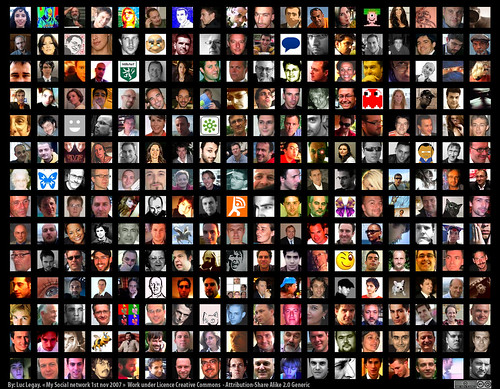
In other words, 86% of our first-year students, as of 2008, are spending time every single day with communities that look like this:
I don't have any easy answers to those questions, but I did suggest some ways that faculty at Ball State can incorporate microblogging into their curricula and pedagogies. I've embedded the slides from today's talk below, and as always, I'm happy to provide a transcript as well. Tommy and Ben from the Center for Media Design were there shooting some video, and I assume it will eventually surface at some point; when it does, I'll link to it!
The talk essentially mashed together ideas from some other research projects and presented some new material geared toward pedagogical approaches and student engagement.
This last bit was perhaps the most interesting, as it drew from the Ball State University Fall 2008 "Making Achievement Possible" survey of first-year students. The MAP Works survey indicates that 46% of first-year BSU students spend between 30 minutes and two hours on social networking websites each day. A full 40% of students spend 2 or more hours each day on such sites. My sense is that these numbers are underreported.
In other words, 86% of our first-year students, as of 2008, are spending time every single day with communities that look like this:
Creative Commons image by luc legay on Flickr.
I asked: as an educator, where are you in that picture? Where are the influential scholars and teachers in your field? Do we see their avatars represented in the social networks where our students are spending their time? Should they even be there in the first place?I don't have any easy answers to those questions, but I did suggest some ways that faculty at Ball State can incorporate microblogging into their curricula and pedagogies. I've embedded the slides from today's talk below, and as always, I'm happy to provide a transcript as well. Tommy and Ben from the Center for Media Design were there shooting some video, and I assume it will eventually surface at some point; when it does, I'll link to it!
10.14.2009
Backchannel Persistence and Collaborative Meaning-Making
Last week I had the pleasure of delivering a paper relatively close to home, at the 27th ACM International Conference on Design of Communication (SIGDOC), at Indiana University in Bloomington. I was especially excited to be on a panel with Shaun Slattery of DePaul University, and Jason Swarts of North Carolina State University--two scholars that I hold in high esteem.
Our panel explored the traces of literate activity that are surfaced and archived in new media writing environments, and which lead to the construction of "fact" on Wikipedia, and the development of provisional knowledge in microblogging platforms. All three papers called on Actor Network Theory and/or Cultural Historical Activity Theory as a way to frame and trace computer supported collaborative work.
I added some theoretical frameworks that are likely too much for a 6,000 word manuscript. I like what I have here, but it's meant to be the start of something much more substantial. In short, my paper amounts to a longish position piece which aims to establish a theoretical framework for tracing meaning-making in persistent backchannel platforms (such as Twitter).
The official published version, should you be able to navigate behind the paywall, is available through the ACM portal. The full proceedings--which include excellent papers from Shaun, Jason, and a number of other fantastic researchers--can also be accessed through ACM. I've uploaded a pre-publication version of the paper to Scribd, and it's available below:
Finally, I've embedded the slides for my presentation as well. If you've seen me present in the past, you'll know that I take a minimalist approach to slidedecks, favoring images over alphabetic text. So, if you'd like the script that accompanies the slides, let me know!
Our panel explored the traces of literate activity that are surfaced and archived in new media writing environments, and which lead to the construction of "fact" on Wikipedia, and the development of provisional knowledge in microblogging platforms. All three papers called on Actor Network Theory and/or Cultural Historical Activity Theory as a way to frame and trace computer supported collaborative work.
I added some theoretical frameworks that are likely too much for a 6,000 word manuscript. I like what I have here, but it's meant to be the start of something much more substantial. In short, my paper amounts to a longish position piece which aims to establish a theoretical framework for tracing meaning-making in persistent backchannel platforms (such as Twitter).
The official published version, should you be able to navigate behind the paywall, is available through the ACM portal. The full proceedings--which include excellent papers from Shaun, Jason, and a number of other fantastic researchers--can also be accessed through ACM. I've uploaded a pre-publication version of the paper to Scribd, and it's available below:
Finally, I've embedded the slides for my presentation as well. If you've seen me present in the past, you'll know that I take a minimalist approach to slidedecks, favoring images over alphabetic text. So, if you'd like the script that accompanies the slides, let me know!
6.16.2009
Tweet Research: Computers and Writing 2009
I'll be presenting at the 2009 Computers and Writing Conference at UC Davis this week, and I've included the slides for my presentation below. If you would like a transcript of the talk, please let me know--I'm happy to provide it.
One of the most rewarding aspects of preparing this presentation was my interaction with Peter West, a management consultant and principle of Continuous Innovation in London, Ontario. Peter is one of my most important Twitter contacts, and he was gracious enough to grant me an interview which detailed how he uses Twitter within a broader suite of knowledge management tools and ecologies. My work with Peter is so interesting that I hope to work with him on a more substantial project in the very near future, as much of the information that he provided must necessarily be truncated for a short conference presentation.
Regardless, I wanted to provide a preview of Peter's workflow now, in anticipation of a more detailed discussion on Friday:
The University of Texas at El Paso approval for this study is filed under IRB protocol ID #117301-1--"Tweet Research: Aggregating and Disseminating Organizational Knowledge Work through Twitter"
One of the most rewarding aspects of preparing this presentation was my interaction with Peter West, a management consultant and principle of Continuous Innovation in London, Ontario. Peter is one of my most important Twitter contacts, and he was gracious enough to grant me an interview which detailed how he uses Twitter within a broader suite of knowledge management tools and ecologies. My work with Peter is so interesting that I hope to work with him on a more substantial project in the very near future, as much of the information that he provided must necessarily be truncated for a short conference presentation.
Regardless, I wanted to provide a preview of Peter's workflow now, in anticipation of a more detailed discussion on Friday:
Peter has developed what he calls an “environmental scanning system” predicated upon a complex ecology of information sources ranging from RSS feeds of peer-reviewed journals to tools such as Twitter. He also relies heavily on both Google and Windows Desktops. He says that “each day, I manually scan the new citation releases from over 10,000 journals. Experience has proven that this is the most effective way to get a general sense of the literature that is being produced and to comprehensively capture relevant material.”Regardless of your perspective on Twitter, it's clear that Peter is a very unique user and participant in this evolving social space. For my own work, his diligence is invaluable. I'm very much looking forward to talking more about Twitter at #CW09!
To get a better sense of what this type of knowledge work entails, Peter graciously tracked his activity during the month of May, yielding some tremendous insights into how he scans and disseminates research:
He processed 23,970 total citations, and spent 89.1 total hours doing so.
The highest number of citations processed in one day was 1,630 and the longest one-day processing time was 6.42 hours. Alternatively, the lowest number of citations processed in one day was 108, and the shortest single-day processing time was 1.1 hours.
He averaged 773 citations per day for an average processing time of 2.87 hours.
The Total number of journals included in these statistics was 4,298, however, he scanned another 5,834 journals during the period whose articles were not posted in Twitter, primarily because they do not provide open access.
Peter began sharing citations publicly via a blog called “SynapShots” back in 2002. One of his objectives was to foster reciprocity and conversation, an ethos achieved more readily through Twitter.
The University of Texas at El Paso approval for this study is filed under IRB protocol ID #117301-1--"Tweet Research: Aggregating and Disseminating Organizational Knowledge Work through Twitter"
6.03.2009
Twitter, Mobile Devices, and User Retention
As I've argued on this blog and elsewhere, the mobile component of Twitter is essential to a rich user experience. Having SMS updates enabled or using a mobile client such as Tweetie or Twitterific is a key factor in getting the most out of Twitter as a robust communications platform and as a framework for ambient research. While I've maintained this position over the last few months, I recently had the misfortune/opportunity to experience Twitter sans mobility, and I didn't like it much.
As you may know, one of my primary areas of research is the study of writing and rhetorics on ubiquitous and mobile small-screen devices. In fact, my impending move to Ball State University includes support for a new, more robust mobile device and data plan, as well as affiliation with the Center for Media Design, where I hope to procure funding and develop empirical studies of mobile media consumption and ambient communication.
The long and the short of the story is that my phone broke last week. More specifically, my phone's screen functioned intermittently and not very well, mostly not at all (though banging it on my desk seemed to help at times). There was no disruption is service or functionality--messages and calls still came through just fine--but I couldn't read those messages or determine who might be calling. As you might imagine, this presented some problems. I'm the type of person who will go on using something until it just won't work anymore (I still have--and use--a Palm Vx, for Pete's sake!), but this was something different.
My first order of business was to remove device updates from Twitter. That "solved" some of the problem, but I was still faced with incoming calls that I couldn't see, and additional text messages from others that I couldn't read. Moreover, my engagement with Twitter was rather poor. I figured it would be easier to elaborate on some of this via video:
So, certainly my experience here is purely anecdotal, but I am left wondering how mobile adoption might enrich one's experience of using Twitter, how it might make it easier for a new user to engage in conversation and to feel as though they are part of a larger community, and how their reading and writing practices travel with them. My unintended experiment in reverse-engineering the mobile UX of Twitter gave me a very different, rather underwhelming perspective on the service. In explaining Twitter going forward, I know that I'll be emphasizing mobile usage even more.
As you may know, one of my primary areas of research is the study of writing and rhetorics on ubiquitous and mobile small-screen devices. In fact, my impending move to Ball State University includes support for a new, more robust mobile device and data plan, as well as affiliation with the Center for Media Design, where I hope to procure funding and develop empirical studies of mobile media consumption and ambient communication.
The long and the short of the story is that my phone broke last week. More specifically, my phone's screen functioned intermittently and not very well, mostly not at all (though banging it on my desk seemed to help at times). There was no disruption is service or functionality--messages and calls still came through just fine--but I couldn't read those messages or determine who might be calling. As you might imagine, this presented some problems. I'm the type of person who will go on using something until it just won't work anymore (I still have--and use--a Palm Vx, for Pete's sake!), but this was something different.
My first order of business was to remove device updates from Twitter. That "solved" some of the problem, but I was still faced with incoming calls that I couldn't see, and additional text messages from others that I couldn't read. Moreover, my engagement with Twitter was rather poor. I figured it would be easier to elaborate on some of this via video:
So, certainly my experience here is purely anecdotal, but I am left wondering how mobile adoption might enrich one's experience of using Twitter, how it might make it easier for a new user to engage in conversation and to feel as though they are part of a larger community, and how their reading and writing practices travel with them. My unintended experiment in reverse-engineering the mobile UX of Twitter gave me a very different, rather underwhelming perspective on the service. In explaining Twitter going forward, I know that I'll be emphasizing mobile usage even more.
3.30.2009
Informal HCI and Media Consumption Study
Okay, not really. You may remember that my daughter's birthday was on Saturday, and we were very excited to give her an iPod Touch.

She's had a little over two full days of use by now, and I thought I'd talk a bit about how she's actually using the device so far. I must say that I'm not surprised, as I've always seen the Touch as more analogous to a laptop than to the Nano, for example. So, this is all very informal, very anecdotal, and by no means rigorously tracked. First, some details on what she actually received:
Then she hopped on YouTube. Then she closed out and headed to her email. Then she set up her contacts. Then she went to her feed reader. Then she streamed music from Pandora. Then she played games, and on her brother's advice, downloaded a couple more free games (Papi Jump is now a family favorite). See a pattern here?
What's most interesting (to me anyway) is what she didn't do: she didn't head over to the desktop and transfer music from iTunes. She didn't really even listen to music (other than through Pandora).
In the afternoon, she had a few friends over for a birthday party. They played outside, and generally did the things that normal 11 year olds do. Then my daughter connected her Touch to the main television, and they watched a little YouTube and then Twilight while eating pizza. Still no music playing. . .
Yesterday, I set up the TextFree Unlimited app from Pinger. She spent much of the afternoon and evening periodically texting her friends, cousins, grama, and mom (who was at Starbucks grading papers) from her iPod. She spent more time playing games and checking out viral videos on YouTube.
I'll not bore you with more details; my point should be abundantly clear by now. The overwhelming majority of the time my daughter spent on her Touch was in activities that we traditionally associate with "computing." Even most of the media consumed (everything other than watching Twilight, it seems) was obtained via the cloud. To me, this pattern of activity is not surprising in the least, yet completely fascinating.
She's had a little over two full days of use by now, and I thought I'd talk a bit about how she's actually using the device so far. I must say that I'm not surprised, as I've always seen the Touch as more analogous to a laptop than to the Nano, for example. So, this is all very informal, very anecdotal, and by no means rigorously tracked. First, some details on what she actually received:
- iPod Touch 2nd Generation, 8GB
- Preloaded with: Twilight movie (a gift from my son), third Twilight book via the Kindle app, 2 free games and one paid game (Labyrinth), new Hannah Montana album (thanks to @amazonmp3), another full album and one other song that she likes, several tv shows that were already on her Nano, and the free Pandora app
- Wifi via WEP encrypted home connection, which I set up before unwrapping
Then she hopped on YouTube. Then she closed out and headed to her email. Then she set up her contacts. Then she went to her feed reader. Then she streamed music from Pandora. Then she played games, and on her brother's advice, downloaded a couple more free games (Papi Jump is now a family favorite). See a pattern here?
What's most interesting (to me anyway) is what she didn't do: she didn't head over to the desktop and transfer music from iTunes. She didn't really even listen to music (other than through Pandora).
In the afternoon, she had a few friends over for a birthday party. They played outside, and generally did the things that normal 11 year olds do. Then my daughter connected her Touch to the main television, and they watched a little YouTube and then Twilight while eating pizza. Still no music playing. . .
Yesterday, I set up the TextFree Unlimited app from Pinger. She spent much of the afternoon and evening periodically texting her friends, cousins, grama, and mom (who was at Starbucks grading papers) from her iPod. She spent more time playing games and checking out viral videos on YouTube.
I'll not bore you with more details; my point should be abundantly clear by now. The overwhelming majority of the time my daughter spent on her Touch was in activities that we traditionally associate with "computing." Even most of the media consumed (everything other than watching Twilight, it seems) was obtained via the cloud. To me, this pattern of activity is not surprising in the least, yet completely fascinating.
Subscribe to:
Comments (Atom)
