Showing posts with label education. Show all posts

1.22.2012

Dirty Secret: I Don't Hate Blackboard

Dirty Secret: I Don't Hate Blackboard

It begins a few days before the start of each semester. Tweets of frustration. Tweets of anger. Tweets of stupefied ambivalence. Tweets of unfettered rage. Many of the educators that I follow on Twitter have serious problems with Blackboard or similar “learning management systems.”

I’m no fan either, and I never have been. My first peer-reviewed publication attempted to describe why learning management systems are especially stifling for instruction in writing and rhetoric. I’m also sure that I too have tweeted something to the effect of “Blackboard/WebCT is horridly horrible” in the past. But I feel as though I’ve been harboring a dirty secret, especially when I read those tweets tweets of frustration.

I don’t hate Blackboard.

Over that last couple of years I’ve really backed away from a militant anti-LMS perspective in everyday practice, in large part because it’s simply not conducive to getting things done with what we have.[1]

A rhetorician, after all, makes do with what’s available.[2]

Because of any number of limitations, many instructors simply find ways to play their hands with the cards that they’ve been dealt. For me, this means working within the constraints of the LMS in the most effective way possible, and with the least amount of time, energy, and headache. I wonder if much of the frustration that instructors feel is borne of simply trying to make the LMS do more than it is actually capable of accomplishing on a day-to-day basis.

In point of fact, Blackboard does few things well. Its constraints are massive. Once acknowledged, this perspective actually frees the instructor (and students) to make a deliberate move toward metis.

So, let me begin with some basic premises: first, a locked-down LMS is simply not designed to facilitate public or semi-public discourse; second, the usability of Blackboard and WebCT (the two learning management systems with which I have first-hand experience) is notoriously poor for all users—instructors and students alike; and third, with its profound ontological and epistemic limitations and soul-sucking user experience, it makes sense to spend as little time in the LMS as possible.

Given these premises, then, of what use is Blackboard? Well, there are a couple of areas where the university-sanctioned LMS actually excels: first, it’s great at storing stuff; and second, it’s intentionally designed to facilitate assessment.[3]

I don’t hate Blackboard because I recognize and accept that its limitations are enormous, and as such, I don’t try to make it do anything beyond its extremely limited capabilities. Blackboard, therefore, doesn’t frustrate me in the least.

Here’s a quick rundown of how I use Blackboard:

  • To store my syllabus (which includes lots of hyperlinks and can be viewed in-browser)
  • To store supplemental reading material (PDFs of articles and such)
  • To store assignment descriptions and rubrics
    • To store student deliverables in a knowledge work model, so that everyone in the class can see what everyone else did for a given deliverable
  • To privately message my students with feedback and assessments

That’s it. I use Blackboard to do basically the two things (only things?) that it does reasonably well: store stuff and provide private, individual feedback.

And because this is all I do with the LMS, usability improves by simple subtraction.[4] The homepage basically has nothing (I use none of Blackboard’s faux-clever mix and match modules for “assignments,” “announcements,” or anything else; I delete them all). I have a simple left-hand menu which lists:

  • Home
  • Syllabus
  • Supplemental Readings
  • Discussions
  • Messages

The Discussions area contains one forum, called “Deliverables.” Within this forum there are several threads, each of which corresponds to a given assignment (e.g., “Practicum 1”). The first post in a given thread is my assignment description and any attendant documents; when students have completed a deliverable, they simply reply to a message in the thread and upload their document (or hyperlink).

I use Messages to give my students feedback; they have a running tally of exactly where they stand at any point in the semester by simply consulting their private messages.

To reiterate: my Blackboard experience begins with deleting almost everything the LMS suggests I use; then I add only the things that the LMS can handle with reasonable efficiency. I store stuff there so it can be easily retrieved by students, and I provide feedback that can likewise be easily retrieved and maintained throughout a given semester.

This scenario leverages Blackboard’s few strengths. It means students can upload huge files (like PDFs with video and audio files related to their qualitative studies), that they can safely retrieve copyrighted work (such as articles provided as part of the course readings), and that they can safely maintain a record of their achievement in the course.

For everything else, there’s our face-to-face discussions and the interwebs, where they can have meaningful public and semi-public interactions with authentic audiences.[5]


  1. This is certainly not meant to shame anyone who tweets about the ontological frailties of Blackboard. I rather enjoy them, actually. Instead, I’ve chosen to take a more Stoic approach: some things are up to us, some things aren’t, and we would do well to focus on the things we can control, and those things alone. I don’t have the energy or influence to overturn my university’s LMS policy; I can offer my students interesting workarounds to the limitations of the LMS, however.  ↩

  2. I believe it was either Aristotle or Morrissey who argued that “Rhetoric may be defined as the faculty of observing in any given case the available means of persuasion.”  ↩

  3. I can hear you screaming at you screen: “It’s terrible at assessment!!1!” Stay with me here; I don’t use it for assessment in the ways that the designer intended…  ↩

  4. Figuring out Blackboard’s Messaging UI, however, remains a serious problem for first-time users. I’m not sure how one could design a poorer messaging workflow. Honestly.  ↩

  5. A final note. I have a colleague who grew up in Berkeley; I grew up in the East Bay as well. When I found out he was from Berkeley, I asked him if he hated Piedmont, an affluent enclave in the Berkeley hills that I resented when I was an angsty youngster. He replied, “No, I don’t hate Piedmont.” He understood why some folks did, but he didn’t see the point of hating something like an entire city. “What good could that possibly bring me?,” he wondered. Any residual disgust I harbored towards Piedmont disappeared on the spot.  ↩

1.31.2010

A Few Words About "Digital Literacies"

Just what constitutes literacy?

Too big a question to tackle in a blog post, and quite frankly, I'm not the one to tackle this problem. But a few approaches...

Google runs The Literacy Project.

Wikipedia essentially suggests it's the ability to read and write.

Brian Street says that literacy is "shorthand for the social practices and conceptions of reading and writing."

Lankshear and McLaren (1993) contend that "literacy is many rather than singular." Literacy doesn't just refer to "an essential technology, a specific skill, or a universal phenomena such as print or script. Rather, reading and writing consist in myriad social and socially constructed forms."

Lankshear and McLaren (1993) also argue that literacy is "entirely a matter of how reading and writing are conceived and practiced within particular social contexts."

In other words, literate action can be seen as synonymous with rhetoric as situated, strategic discourse, the working definition of rhetoric that I use and continually explore with students.

Because literacy is defined by and pushed around into so many different and overlapping social contexts, the term gets appended to all kinds of other concepts--extended in curious ways.

Health literacy.
Financial literacy.
Digital literacy.

Let's think in terms of what digital literacy might entail, beyond simple facility with reading and writing within and for digital environments. It might include:

:: Understanding what makes the basic tools of digital environments tick: server, browser, URL, command line, etc. ::

:: Understanding and working with the basic tools of digital media production and consumption--a functional literacy ::

:: A broader, critical understanding of the tendential forces driving and shaping technology and society--how did we get to where we are with this stuff? ::

:: Basic understanding and facility with major platforms, protocols, standards, and languages ::

:: What Selfe (1999) calls critical technological literacy: a reflective awareness of all of the above ::

So, back to the forms. Digital literacy involves writing and reading in digital environments, yes. But it also involves understanding and enacting the rhetorical infrastructures that dictate what form such writing work will take in digital environments.

To that end, digital literacy isn't about using the frames in a WYSIWYG interface, or about placing content inside template-based tools. Digital literacy is understanding what made the tools in the first place. And the broader social and technological factors that impact the development and use of those tools, forms, and platforms.

11.07.2009

[ Locus Communis ] Twitter as Digital Commonplace

I gave a talk today at the International Digital Media and Arts Association annual conference. I almost always upload the slides for my talks, but because of the format for this conference--where presentations were limited to ten minutes--I decided to simply screencast the full talk and share it here.

I had a great time at the conference overall, and our panel fostered some excellent discussion. At just under ten minutes, the video takes some time to load; as always, I welcome feedback, questions, and discussion!


CMD, RFID, QR, and Touch at iDMAa 2009

I spent some time over at the Center for Media Design during a break in the International Digital Media and Arts Association conference yesterday, and I had an opportunity to play around with the excellent integration of cross-platform media and information flow here at the conference. (If you have any interest, we've been blogging many of the conference sessions over at the iDMAa 2009 site).

Below are a couple of videos showing how iDMAa and the Center for Media Design have thoroughly integrated conference data (presenters, locations, abstracts) into the places, spaces, and ubiquitous devices that mediate our conference experience...


10.19.2009

:: repurposed ::

:: repurposed ::


:: repurposed :: is a blog exploring rhetorics, places, and publics from a group of researchers at Ball State University. It goes live tomorrow, though a preview version with a few posts are currently available. There are still some design issues to sort out, and some final preparations related to content.

While many of the contributions to the site will be from students in my senior seminar, the driving idea and impetus is the production of a sustainable and meaningful space for the ongoing discussion of the complex relationships between language, placemaking, and publics. Over the next few weeks, we expect to consistently have between 15 and 20 posts each week, and we are soliciting occasional guest posts from a variety of disciplinary and professional domains. We see this as a post-disciplinary endeavor, one which is ultimately focused on better understanding how we make meaning in and through our public places.

To that end, the site will consider wayfinding activities, architecture, mapping, ubiquitous computing and context-aware environments, the social production of place and the social construction of place, alleys and interstices, landmarks, edges, paths, and nodes, public discourse, walking, bikes, skateboards, autos, and the many ways that human beings repurpose their environments--discursively, materially, affectively--in order to make meaning.

Please consider adding :: repurposed :: to your feed reader or bookmarks. If you're interested in contributing--once or occasionally--on any aspect of rhetorics, places, and/or publics, please don't hesitate to contact me.

10.15.2009

Extending the Classroom: Conversations, Content, and Microblogging with Twitter

I had the opportunity to give a fun talk today about using Twitter in educational settings. I was able to present in the brand new Schwartz Digital Complex in Bracken Library, as part of Ball State's Tech4U series. I was also able to make use of an impressive visual display that allowed me to stream tweets in Seesmic, a hashtag search on FriendFeed, and my own slides simultaneously (I actually brought a class to the "learning pod" section of this fantastic facility on Tuesday and shot some video, which I'll upload soon).

The talk essentially mashed together ideas from some other research projects and presented some new material geared toward pedagogical approaches and student engagement.

This last bit was perhaps the most interesting, as it drew from the Ball State University Fall 2008 "Making Achievement Possible" survey of first-year students. The MAP Works survey indicates that 46% of first-year BSU students spend between 30 minutes and two hours on social networking websites each day. A full 40% of students spend 2 or more hours each day on such sites. My sense is that these numbers are underreported.

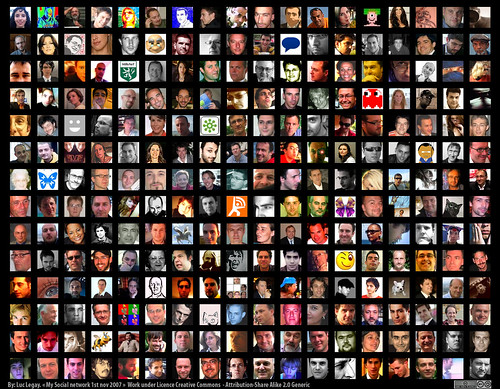
In other words, 86% of our first-year students, as of 2008, are spending time every single day with communities that look like this:

Creative Commons image by luc legay on Flickr.

I asked: as an educator, where are you in that picture? Where are the influential scholars and teachers in your field? Do we see their avatars represented in the social networks where our students are spending their time? Should they even be there in the first place?

I don't have any easy answers to those questions, but I did suggest some ways that faculty at Ball State can incorporate microblogging into their curricula and pedagogies. I've embedded the slides from today's talk below, and as always, I'm happy to provide a transcript as well. Tommy and Ben from the Center for Media Design were there shooting some video, and I assume it will eventually surface at some point; when it does, I'll link to it!

10.14.2009

Backchannel Persistence and Collaborative Meaning-Making

Last week I had the pleasure of delivering a paper relatively close to home, at the 27th ACM International Conference on Design of Communication (SIGDOC), at Indiana University in Bloomington. I was especially excited to be on a panel with Shaun Slattery of DePaul University, and Jason Swarts of North Carolina State University--two scholars that I hold in high esteem.

Our panel explored the traces of literate activity that are surfaced and archived in new media writing environments, and which lead to the construction of "fact" on Wikipedia, and the development of provisional knowledge in microblogging platforms. All three papers called on Actor Network Theory and/or Cultural Historical Activity Theory as a way to frame and trace computer supported collaborative work.

I added some theoretical frameworks that are likely too much for a 6,000 word manuscript. I like what I have here, but it's meant to be the start of something much more substantial. In short, my paper amounts to a longish position piece which aims to establish a theoretical framework for tracing meaning-making in persistent backchannel platforms (such as Twitter).

The official published version, should you be able to navigate behind the paywall, is available through the ACM portal. The full proceedings--which include excellent papers from Shaun, Jason, and a number of other fantastic researchers--can also be accessed through ACM. I've uploaded a pre-publication version of the paper to Scribd, and it's available below:


Finally, I've embedded the slides for my presentation as well. If you've seen me present in the past, you'll know that I take a minimalist approach to slidedecks, favoring images over alphabetic text. So, if you'd like the script that accompanies the slides, let me know!

8.26.2009

Fall Syllabi

It's that time of year once again, when the heat of summer dissipates into crisp fall evenings and the trees gain shape by losing shape, molting brilliantly colored leaves which fall into the paths of so many university students on so many campuses around the world. Marching bands will march, coffee will be consumed, and my students will scratch their heads for a few weeks...

In the time-honored tradition of my field, I make available to any and all the syllabi and course calendars from which my students will teach me and teach one another. There is some overlap, yes, but the two courses, despite the apparent similarity of the deliverables, will end up in very different places in just a few weeks. Comments and suggestions are warmly appreciated.


6.24.2009

Un/Commonplaces

Below you will find my completed dissertation, Un/Commonplaces: Redirecting Research and Curricula in Rhetoric and Writing Studies. If you have an interest in reading the document, please follow the link to Scribd, where you can download a PDF.

I am resisting the urge to comment on the document, but it is what it is. At times controversial, at times pedantic, at times, hopefully, insightful--I welcome feedback regardless. Enjoy (or not)!

Un/Commonplaces: Redirecting Research and Curricula in Rhetoric and Writing Studies

4.19.2009

Usurping Usability

Rensselaer Polytechnic Institute, Troy NY

4.02.2009

Game Theories

I am by no means any kind of expert in game theory. There are many brilliant people in my field that study gaming and game theory, and I've been very lucky to have met a few of them, and to have discussed digital gaming with folks from other disciplines, such as Steven Conway from the New Media Research Group.

These conversations have essentially changed my perspective on digital gaming and its role in childhood educational development. I played video games as a kid (hello Atari 2600!), but I also spent an inordinate amount of time outside, breaking things, making things, and pretending to be a sports superstar. Like many parents, I have at times suggested that my kids don't do enough of this kind of play, and too much of the gaming that is now ubiquitous and digital.

But there's a preponderance of evidence which suggests that gaming in digital environments is actually good for the kids, and combined with my own research interests in digital media, I have relented on how much time my kids spend gaming. In fact, I'm even promoting it, within reason.

There have been some interesting recent developments in applied game theory and primary education. The Institute of Play, for example, promotes "gaming literacies" and seeks to "build new domains of knowledge connected to gaming, digital media, and learning." In fact, a new(ish) public school in NYC called Quest to Learn admitted its first 6th grade class in the fall, which "uses the underlying design principles of games to create highly immersive, game-like learning experiences for students." And a recent NY Daily News article looks at the transition from pencils to joysticks.

All of which leads me to share a short video of my five year-old's first attempt at playing FIFA (my all-time favorite game) on the Xbox 360: