Showing posts with label epistemology. Show all posts

10.18.2014

Picturing Writing with Visual Research Methods

Picturing Writing with Visual Research Methods

In Academic Writing as a Social Practice, Linda Brodkey (1987) argued that composition studies needed a new cultural conception of composing, one that reimagined the tired trope of the alienated and anguished writer who writes alone. In a chapter titled “Picturing Writing,” Brodkey relies heavily on visual metaphors; she passionately argued that we need new pictures of writers and composing practices in their rich, socially situated complexity. She asked readers to re-see writing, to consider alternative viewpoints, and in the process, to break away from popular perceptions of composing, particularly because such perceptions obviate new, different, or even challenging perspectives about writing (58).

More recently, Jody Shipka (2011) draws on Brodkey to suggest that one charge of contemporary composition research is to foreground and make more visible the circulatory processes of composing and textual distribution (38). In response to these and similar exigencies, I compose with photography as one way in which to see writing anew—a method for re-seeing the complexity of composing processes by literally and systematically picturing writers and writing.

As a qualitative researcher focused on the activities, objects, and environments of composing, I conduct ethnographies and case studies of writers in everyday life—from academe and industry to religious practice and social gaming. In these studies, I use traditional fieldwork methods such as semi-structured interviews, participant observation, and artifact collection and analysis. In my early fieldwork, I often used photography and videography as well, mainly as means of augmenting observational fieldnotes and capturing informal talk, gestures, and spatial and material arrangements.

A few years ago, however, I realized that my use of visual fieldwork methods, while beneficial, was also somewhat facile in its execution. I learned that over the last four decades, social scientists have explored the nuances of visual methods in studies of social life (see, for example, Pink, 2007; Spencer, 2011; and Pinney, 2011), of which writing is, of course, an inescapable mediator. The subfields of visual anthropology and visual sociology have enriched my understanding and use of visual methods in fieldwork. These approaches have developed in parallel to our own field’s explorations of visual rhetorics, resulting in complementary empirical perspectives on visuality and visibility.

Writing in the world: a tiny geocache container and scroll for logging visits.

More recently, therefore, I have adapted approaches from visual anthropology and visual sociology to the study of writers and their composing practices and environments. Doing so has resulted in many trials and errors, but the struggle has been rewarding: I have learned to use visual methods to explore, analyze, and present the rich materiality of everyday composing practices, and in the process, to formulate new pictures of writers and writing that may be generative for participants and composition researchers alike. More important, by using visual methods in field studies I have been able to create new forms of material engagement with participants about the role of composing in their learning, work, and play.

While critics such as Susan Sontag (1977) have suggested that photography results in the distancing of photographic subjects from photographers, I have found opposite to be true: Visual methods of fieldwork result in qualitatively different forms of intersubjective understanding between researchers and participants. Composing with photography throughout fieldwork can help researchers of writing move beyond mere tautological illustration; by using visual methods, researchers may document and engage simultaneously.

More important, participants may see their own composing environments, tools, and practices in new ways, from different perspectives. A technique known as photo-elicitation uses fieldwork photographs as pivots for better understanding participant practice. For example, by photographically demonstrating a writer’s well-maintained mise en place, the researcher may help make the familiar strange for a participant, and through discussion, develop new insights about their composing practices.

In a similar way, visual methods may result in presentations of experience that are more hyaline and evocative than traditional forms of reporting. Qualitative data is notoriously dense, and for readers, the mass of fieldwork supporting ethnographies and case studies is often opaque. In addition, traditional methods of collection and representation are necessarily sequential; observational fieldnotes, for example, may miss crucial details of actual practice—movements, tools, arrangements, or cross-talk that may meaningfully mediate composing.

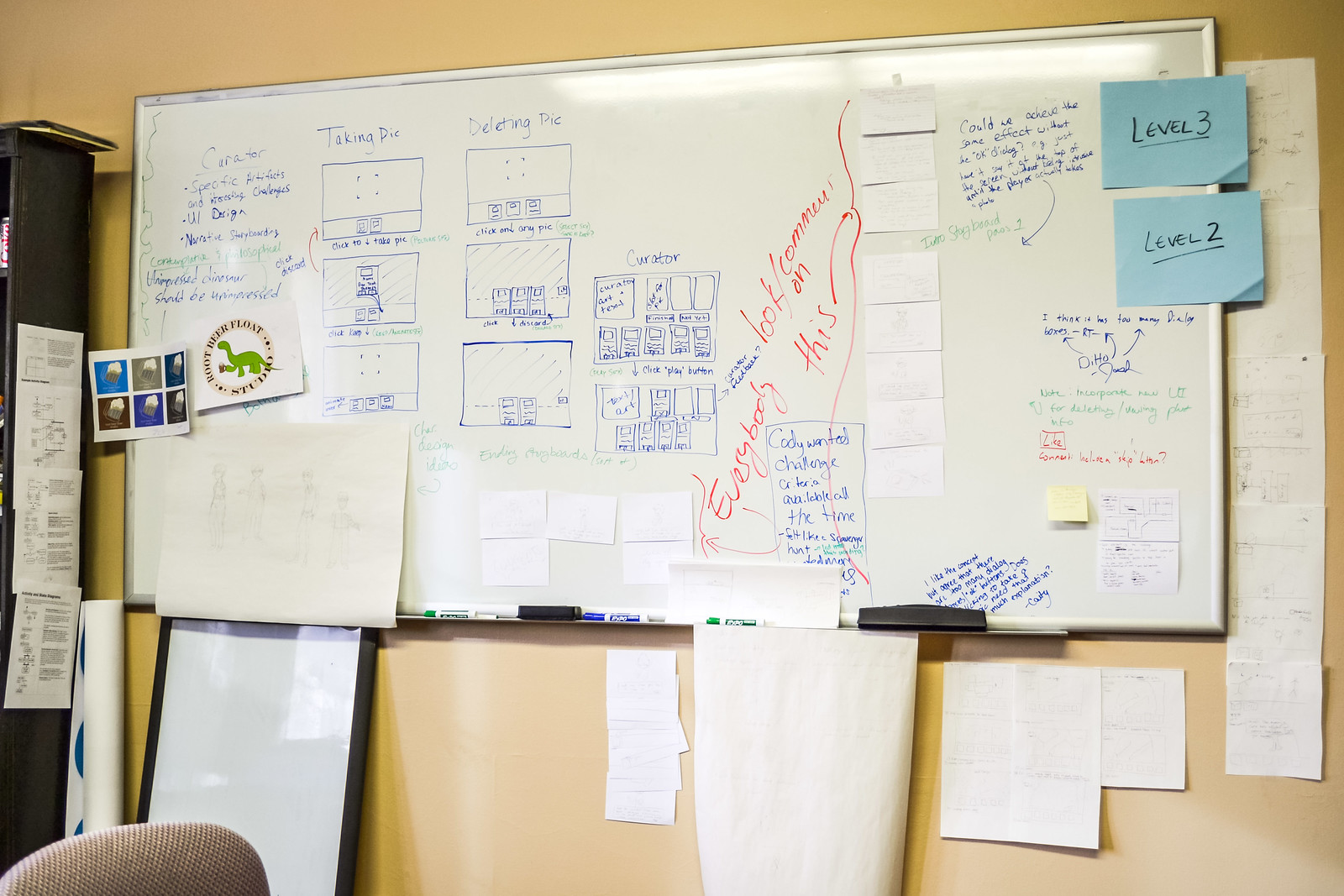
A software studio’s whiteboard is a collaborative space for composing and ideation.

Photographs offer simultaneous renderings of practice, what Flusser (2002) terms surfaces rather than lines. A traditional ethnographer detailing the complex, collaborative work pictured above must transform the simultaneously visible surface of a software studio’s whiteboard into a linear representation of activity. A visual ethnographer, however, can present that visible surface in its full complexity; when coupled with an analytic narrative that details punctuated development, a more hyaline rendering of complex composing practices emerges.

Qualitative research is characteristically ideographic; indeed, visual methods foreground the situated materiality of composing practices. This is a key strength of visual methods as I practice them in studies of writers and writing: the ability to document and collaboratively explore particular systemic contexts and the ways in which artifact assemblages participate in composing processes.

However, in developing new pictures of writers and writing, visual methods have the potential to be nomothetic in the aggregate. Because visual methods may be more hyaline—presenting richer data than traditional methods alone—they carry the potential for fruitful cross-case comparisons of composing practices. Imagine, for a moment, systematically composed and collected photographs of 20,000 first year writers’ typical composing environments and the resulting wealth of both particular (ideographic) and tendential (nomothetic) pictures of writing that might emerge from careful analysis.

Visual methods in empirical studies of writing carry the potential to further develop and realize Brodkey’s argument for re-seeing our object of study, and more important, the people who write. Barthes (1981) argued that “the camera can be an instrument of deep meaning, connecting the scene to the viewer and the viewer to existence” (131). With visual methods, writing researchers can reframe cultural conceptions of where, how, why, and with whom people write in their everyday lives.

9.05.2012

The #1000genres Project

The 1000genres Project

“Genres are not simply text types; they are culturally and historically grounded ways of ‘seeing and conceptualizing reality.’” — Spinuzzi, 2003

This semester, in my Composition and Communication course, freshman at the University of Kentucky will be exploring genres in detailed and meaningful ways, seeing genres as forms of social practice and action (Wenger, 1998; Miller, 1984), as stable-for-now sites and instantiations of ideology (Schryer, 1993), as carriers of provisional knowledge (Shirky, 2008), and as culturally and historically grounded ways of knowing and being in the world (Spinuzzi, 2003).

That’s a mouthful, so let me say this another way: we’re going to be investigating genre all semester, and we’ll be documenting instances of genre in everyday life via Instagram and Twitter.

More importantly, we want you to help!

Where are the genres of your everyday life? What kinds of genres are the norm in your profession, discipline, or vocation? What genres are unique to your city, town, or region? What genres are important to you, and why?

Through the #1000genres project, we’ll be documenting the genres that surround us here in Lexington, at UK, and in local academic and professional contexts. In the process, the collected images and descriptions of genres will become source material for student projects near the end of the semester.

Why are we focusing on genre in this way? Because of David Russell, of course!

People do not “learn to write, period,” notes Russell (1995). Instead, he argues, “one acquires the genres (typified semiotic means) used by some activity field as one interacts with people involved in the activity field and the material objects and signs those people use” (p. 56). For Russell, “writing does not exist apart from its uses, for it is a tool for accomplishing object(ive)s beyond itself. The tool is continually transformed by its use into myriad and always changing genres” (p. 57). Stated another way, he notes that “Learning to write means learning to write in the ways (genres) those in an activity system write” (p. 57).

The #1000genres project is largely about learning how to learn genres—to recognize different genres in the world, the ways those genres arise from and operate within given social contexts, and the ways we might adapt our communication strategies to better match the norms and expectations carried through specific genres. But in doing so, we’ll also consider the ways that people not only adapt but in fact change genres over time.

Participating is easy! Take a picture of a genre that interests you (for whatever reason); write a brief description of the genre or how it operates; tag that photo #1000genres and post it to Instagram, Twitter, or both. That’s it!

Here’s an example of a branding genre at UK, and an example of a spatial genre on campus. Here are several genres layered and considered.

We probably won’t always nail it—sometimes things that seem like genres might be something else. But that’s ok. The point is to be looking, thinking about genres, and documenting what we see.

We can learn even more about genre by seeing the things you post. What kinds of genres are ubiquitous in your world? Show them, and show others!

6.19.2012

Annotations | Weinberger, 2011: Too Big to Know

Annotations | Weinberger, 2011

[ NB: “Annotations” are occasional posts that explore selections from my research reading—articles or books—in rhetoric, technical and professional communication, and related fields. ]

Weinberger, D. (2011). Too big to know: Rethinking knowledge now that the facts aren’t the facts, experts are everywhere, and the smartest person in the room is the room. New York: Basic Books.

This is a book that, like Clay Shirky’s work, is written for an educated lay audience, but that has tremendous influence for folks in both academe and industry. Unlike some books in this genre, Weinberger’s work carries a learned gravitas that others rarely approach.

I think that, for researchers in Rhetoric and Writing (and related fields), Too Big to Know is one of the most important popular books to emerge in the last decade, for reasons that I’ll explain in more detail below. But the upshot for scholars of writing is this: Weinberger reinforces many of the things that scholars in our field have been saying for years: writing is epistemic; there are multiple ontologies and epistemologies at work in the world; things are messy and complex and always already rhetorically fraught; writing is bigger than books, but written genres carry and instantiate what we call knowledge; knowledge and facts are spatially, temporally, historically, societally, and socially conditioned and thus provisional.

Weinberger’s argument, in a nutshell, is that “knowledge is becoming a property of the network, rather than of individuals who know things, of objects that contain knowledge, and of the traditional institutions that facilitate knowledge” (p. 182). From the Prologue forward, this argument is explored—sometimes tacitly, but often explicitly—through the tension between what can be committed to print, (cf. Updike’s paper trail, p. viii; “book-shaped thought,” p. 96–100) and what the affordances of networked knowledge mean for an exponential expansion of writing work (cf. Chapter 7’s discussion of Mendeley, Open Notebook Science, Eureqa, et al.).

In this post, I’ll hew mainly to Weinberger’s juxtaposition of print-based knowledge making and networked knowledge making.

One of the first moves that Weinberger makes is to question the role of expertise, the notion of accuracy, and the notion of credibility, among other ideas that have become entrenched in Western culture. He asks, “Does there turn out to be a benefit to letting events have blurry edges of ignorance?” (p. ix; cf. Spinuzzi, 2009). The focus on the instantiations of knowledge—primarily written instantiations—is clear from the start: “Transform the medium by which we develop, preserve, and communicate knowledge, and we transform knowledge” (p. ix).

In other words, change the shape and delivery of written communication and you change the shape and understanding of knowledge, facts, expertise, and a host of innumerable ontologies.

A central claim of Weinberger’s initial chapter is this: “Our most basic strategy for understanding a world that far outruns our brain’s capacity has been to filter, winnow, and otherwise reduce it something more manageable” (p. 4). We need to distill abundance and complexity so that we can wrap our arms around it.

The early information age facilitated the sifting and winnowing; our databases distilled essential information into categories and classifications: “our information systems worked only because they so rigorously excluded just about everything” (p. 4; cf. Bowker and Star, 1999). We’ve risen to prominence as a species, he argues, because our filtering systems work so well. But the devil is in the details here: “The real limitation isn’t the capacity of our individual brains but that of the media we have used to get past our brains’ limitations” (p. 5). The medium of knowledge for the last few hundred years or so has been print, and print is constraining in many ways.

A funny thing has happened, though. Despite alarm about information overload hearkening back to at least the 17th century, and despite the exponential overload afforded by the internet, “we have not proportionately suffered from information anxiety, information tremors, or information butterflies-in-the-stomach” (p. 9). Instead, we’ve developed cognitive tools to cope, both algorithmic and social (and usually a combination of the two).

So, he asks, “How has the new overload affected our basic strategy of knowing-by-reducing?” (p. 9). For one thing, filters no longer filter things out; now they filter things forward, which means that whatever is technically invisible due to a filter is still technically available, though it may be buried a few pages below (p. 11). There has always been too much to know, Weinberger argues, but now “we know there’s too much for us to know,” and there are consequences in having that understanding (p. 11).

There is lots of resonance with Bowker and Star (1999) early in the book, including the argument that filters—classification mechanics—are now “particularly crucial content” (p. 13; emphasis added). The implications of emergent forms and understandings of knowledge include a focus on width in addition to depth (“with a big enough population engaged, sufficient width can be its own type of depth”), boundary-free and populist contributions to public knowledge, extra-academic and extra-professional credentials, and unsettled, amorphous knowledge about many previously nailed down “facts” (p. 13–14).

Ultimately, the internet doesn’t have any discernible edges, which means that it doesn’t have a discernible shape; with no discernible shape, “networked knowledge lacks what we have so long taken to be essential to the structure of knowledge: a foundation” (p. 17).

In the past, we have been good at establishing “stopping points for knowledge” (p. 20); indeed, we still arbitrarily define such stopping points because there is simply too much to know (this is a continual problem in qualitative research: what things do we include and what gets left out? when do we stop observing? how do we know what may be essential and what’s not? cf. Spinuzzi, 2011). We’ve long seen knowledge as built upon firm foundations that allow us to add new pieces that extend the solid base. “But the idea that the house of knowledge is built on a foundation of facts is not itself a fact,” Weinberger argues (p. 23). Instead, “It’s an idea with a history that is now taking a sharp turn” (p. 23).

Networked facts are not the same as non-networked (or traditionally networked) facts: they “exist within a web of links that make them useful and understandable” (p. 39). A data table detailing a stratified sample of census data can link readers to the original dataset with virtually no expense in time or energy to either writer or reader. The new norm, therefore, is “If you’re going to cite the data, you might as well link to it” (p. 39).

But linking has an unintended consequence: it reveals the instability of facts that has always existed, but that has been literally papered over—a “continuos, multi-sided, linked contradiction of every fact changes the nature and role of facts for our culture” (p. 40).

These arguments lead Weinberger toward exploring the tyranny of print culture on our understanding of what constitutes facts and knowledge. The traditional view of facts

was based not in fact but in the paper medium that published facts. Because of the economics of paper, facts were relatively rare and gem-like because there wasn’t room for a whole lot of them. Because of the physics of paper, once a fact was printed, it stayed there on the page, uncontradicted, at least on that page. The limitations of paper made facts look far more manageable that they seem now that we see them linked into our unlimited network. (p. 40)

Ultimately, the role of facts doesn’t go away in our networked world; instead, the internet means that contradictions lurk around every corner, just a click away. For every fact a counter fact, linked symmetrically in dialectical tension.

The internet, Weinberger argues, is too wide open to simply create a body of knowledge by fiat. There is little of the permanence or stability (or “fealty”) that characterized traditional paradigms of print-based knowledge making. “The Internet is what you get when everyone is a curator and everything is linked” (p. 45). But “Traditional knowledge is what you get when paper is its medium” (p. 45). Weinberger explains:

There is nothing mystical about this. For example, if your medium doesn’t easily allow you to correct mistakes, knowledge will tend to be carefully vetted. If it’s expensive to publish, then you will create mechanisms that winnow out contenders. If you’re publishing on paper, you will create centralized locations where you amass books. The property of knowledge as a body of vetted works comes directly from the properties of paper. Traditional knowledge has been an accident of paper. (p. 45)

What happens when the body of knowledge and the mechanisms for knowledge-making are moved from books, brains, and bodies, to bodies, brains, and networks? The bulk of the book takes up the spirit of this question.

Weinberger explores at length our rapidly changing notions of expertise, noting the uncomfortable transition from “expertise modeled on books to expertise modeled on networks” (p. 67). We’re moving from “contained and knowable to linked and unmasterable” (p. 67).

Again, this seems relevant to writing researchers, since the fundamental point of this line of argument is that print culture instantiates a very specific kind of knowledge, and that this kind of knowledge is no longer tenable. This also means that writing, so often seen as contained and finite, bursts the bounds of print culture—spills out of the containers of print culture to many richer forms of work in the world, mediating a multitude of everyday knowledge making activities.

And so now we’re a bundle of contradictions, and these contradictions are a result of the internet’s bustling conflation of ideas, “forcing us to face a tension in our strategy of knowledge that the old medium of knowledge [literally] papered over. We thought that knowledge thrives in a lively ‘marketplace of ideas’ because the constraints of paper-based knowledge kept most of the competing ideas outside our local market” (p. 69). Of course, this is no longer the case, as the internet brings every conceivable contradictory perspective directly into view.

In Chapter 6: Long Form, Web Form we see perhaps the crux of Weinberger’s arguments about the impact of print culture on knowledge.

He begins by outlining Darwin’s masterwork, noting the brief asides and raised objections that characterize that work—imagined conversations with a objecting reader. Weinberger suggests that we engage in

this sort of play-acting not because that’s how thought should work but because books fix thought on paper. We’ve had to build a long sequence of thoughts, one leading to another, because books put one page after another. Long-form thinking looks the way it does because books shaped it that way. And because books have been knowledge’s medium, we have thought that that’s how knowledge should be shaped. (p. 95)

And we’re off and running!

He argues here that “physical books will no longer be the dominant cultural form of knowledge, if only because the physical book is such a bad fit for the structure of knowledge it’s intended to represent and enable” (p. 96). Parsing Nicholas Carr’s arguments in The Shallows, Weinberger contends that a central question is “how the nature of the book qua book affected the form of its content” (p. 98).

The fact that technology shapes content is not merely metaphorical—it has real, tangible affects, whether your perspective is like Carr’s (the internet is making is stupid) or like Weinberger’s (print culture shapes, instantiates, and naturalizes a specific cultural notion of knowledge that’s not immutable). He argues that “When you sit down to write a book, the bound pages—the boundness, the pageness—make demands of you” (p. 98). Books have beginning points because books have first pages; pages are bound and sequenced, which leads to arguments that are contained and sequenced (p. 98–99).

Weinberger continues:

The physical book’s demands have thus had you reinvent long-form writing. The book develops an idea from start to finish, across many—but not too many—pages. It also has to contain within its covers everything relevant to that idea because there is no easy way for the reader to access the rest of what she might need. You the author determine the sequence of ideas. The book’s physical finality encourages a finality of thought: You don’t finish writing it until you believe you have it done and right. (p. 99)

“The physical nature of books thereby enables and encourages long-form thought,” he argues (p. 99). In a masterful turn of phrase, Weinberger ends this section with the following: “To think that knowledge itself is shaped like books is to marvel that a rock fits so well in its hole in the ground” (p. 100).

And Weinberger is not done examining the relationship between print culture and “natural” understandings of knowledge; his next section is called “The Embarrassment of Books.” Weinberger suggests that the ways our culture often lionizes books “often sounds like the sublimation of an embarrassment about the sudden exposure of that old medium’s weaknesses” (p. 100).

“We have idealized books,” he argues, we have romanticized and even fetishized them (p. 102). The physical properties of books “squeeze ideas onto long, narrow paths that head the reader forward” (p. 103). The “physicality of books tends toward sequence, not divergence”; we’ve “elevated private thought because of the limitations of writing” (p. 103).

Here, I think Weinberger means the limitations of print, since writing unbound is what drives the new forms of knowledge on the web that he juxtaposes against the limitations of print. “The physics of books generally makes writing them a solo project” (p. 103).

Weinberger turns next to new forms of thinking in public, of writing within the context of broader social ecologies (I actually wrote a short article about this!). He uses Jay Rosen’s blog posts and the formidable cross-talk they engender as an example; but he also notes nine advantages to this kind of public writing and thinking:

  1. arguments are as long as they need to be
  2. arguments are responsive and malleable
  3. writing here reflects the actual mess of knowledge-making
  4. readers don’t have to deal with artificial objections or leave an argument early
  5. ideas reach the public, faster
  6. once public, ideas have escape velocity, “so that they can change the world” (p. 107)
  7. readers are potentially more involved
  8. “the author’s authority gets right-sized” (p. 108)
  9. connections, ripples, and traceable after-effects.

But there are disadvantages too, of which Weinberger enumerates five:

  1. readers may foster noise
  2. some arguments are more rhetorically effective when presented together (instead of as a string of blog posts)
  3. commercial opportunities may be diminished
  4. book = credibility, still
  5. a multiplicity of voices means it’s hard to know who to believe and trust.

He notes that one mode needn’t vanquish the other—there’s room for traditional long-form writing alongside emergent forms of networked knowledge making.

A key argument that Weinberger makes here is about how others use and misuse knowledge. He asserts that authors have always been “misquoted, degraded, enhanced, incorporated, passed around through a thousand degrees of misunderstanding” (p. 110). The crucial difference is that we can now see it as it happens, and that’s disturbing and potentially disruptive. It brings to the surface practices that were long invisibilized.

And still, we maintain a “picture of knowledge that lets objectivity make sense as a concept” (p. 111). “But objectivity,” he argues, “arose as a public value largely as a way of addressing a limitation of paper as a medium for knowledge” (p. 112).

Paper necessitates stopping points: “Paper is such an inconveniently disconnected medium that it’s important to include everything that the reader needs in order to understand a topic” (p. 113). “Paper-based citations,” therefore, “are like nails: If you wonder why the author made a particular claim, you can see that it’s nailed down by a footnote. Paper-based citations attempt to keep the reader within the article” (p. 113).

On the internet, “hyperlinks are less nails than invitations” (p. 113), leading a reader away from the article, “a visible manifestation of the author giving up any claim to completeness or even sufficiency” (p. 113). The messiness of the web, it’s intertwingularity, “should lead us to wonder if one of the problems with objectivity and long-form argument is that they aren’t a good match to structure the world” (p. 115).

But we still need stopping points, Weinberger argues, and we still need long-form writing; what we need is that long-form writing to be articulated with the web of ideas available on the internet, linked and traversable (p. 116). Trying to determine if the internet is good or bad for us is the wrong question to ask—the problem is far too nuanced and technology is not bound by finite outcomes: “now that ideas are freed of bound pages for their embodiment, it turns out that long-form works were never nearly long enough” (p. 118).

Weinberger’s exploration of emergent forms of science again views scientific knowledge making within the context and constraints of print culture: “In a phrase: Science had been a type of publishing and now it is becoming a network” (p. 152). The publishing model, he contends, has “silently shaped science” (p. 153), has given it a form that we assume to be natural and ordered, but this form is a response to the physics and sociocultural norms of print.

The scientific process, he argues, “could be said to include scientists, hypotheses, equipment, and publishers: Take away any one element, and science would not exist in recognizable form” (p. 153). These are wonderful arguments, and they resonate, I’m sure, with folks in our field who have read Bazerman and Latour, among others.

The system of publishing, then, “has marked the nature of science itself. Science aims at settling matters as far as possible—albeit with admirable humility—in part because it has relied on a medium that prints irrevocably on paper” (p. 154). Due to the physics of print, “science is generally accomplished in article-sized chunks that are relatively self-standing” (p. 154).

Scientific knowledge, therefore, has been “a type of publishing…broken off from its source because it was embodied in a physical thing with a life of its own,” as an article in Nature, for example, with stable boundaries and persistent characteristics (p. 155). But no longer. Today, “the final product of science is now neither final nor a product. It is the network itself,” an interwoven collection of scientists, datasets, methods and methodologies, theories and speculations, amateurs, citizens, publishers and open platforms (p. 156).

As Weinberger’s book comes to a close, he’s still positioning paper against the internet: “When knowledge was communicated and preserved on paper, it had to work around the fact that connected ideas were expressed in a disconnected medium” (p. 177). Authors became spokespeople for networks of knowledge that were tightly constrained by the physics of print.

Hyperlinks, however, “change the basic topology of knowledge” (p. 177). We can see ideas develop and shift on the web, in part because links expose knowledge-making—they surface and often make public conversations that were once invisibilized by the infrastructures of print.

Many of our modern notions of science, objectivity, and knowledge were predicated upon a priori understandings: “We had hoped that knowledge is independent of us. Now we know for sure it is not” (p. 180). This surely sounds familiar to rhetoricians. But before you say “duh! So and so has been saying that for years!” keep this in mind: Weinberger is talking to a popular audience comprised of folks who likely have never heard of our discipline.

He’s greasing the gears of postmodern knowledge-making—of epistemic rhetoric—for us, and he’s doing so masterfully. These arguments, old hat for us, are especially good news for us because of what they do in the world.

Weinberger ends with this salient insight: “We thought that knowledge was scarce, when in fact it was just that our shelves were small” (p. 196). Our new knowledge isn’t a canon, but an “infrastructure of connection” (p. 196).

2.20.2012

Annotations | Nardi, 1996: Studying Context

Annotations | Nardi, 1996: Studying Context

[ NB: “Annotations” are occasional posts that explore selections from my research reading—articles or books—in rhetoric, technical and professional communication, and related fields. ]

Nardi, B. (1996). Studying context: A comparison of activity theory, situated action models, and distributed cognition. In B. Nardi (Ed.), Context and Consciousness: Activity Theory and Human-Computer Interaction (69–102). Cambridge, MA: MIT Press.

In my last post, I considered how and why human beings become attached to particular artifacts and technologies. Trauman offered a compelling response in the comments area, and I thought I’d respond to at least part of his query here: how to get started with activity theory…

This semester, I’m teaching a special topics graduate seminar exploring activity theory and writing technologies. I’ve posted the syllabus for the course on Scribd, but the actual reading list is hardly innovative—it’s all the usual stuff to get one primed on the basics of AT and its application in rhetoric and writing studies. For deeper reading, have a look at Clay Spinuzzi’s list of activity theory sources on Mendeley.

But I thought I’d address some of the basics of activity theory by considering one of its primary applications: studying particularized contexts and situatedness by deploying a methodological framework (activity theory) that moves a given researcher beyond an overdetermined particularity. This is actually one of Nardi’s (1996) goals in her excellent chapter comparing activity theory to situated action models and distributed cognition.

I thought I’d kill two birds here by exploring some AT basics through an annotation of Nardi’s chapter.

This chapter of Context and Consciousness is, like the one before and the one that follows, essential reading for the budding activity theorist. Nardi explores the notion of context in a given research site by considering perspectives from three similar methodological/theoretical approaches: activity theory, situated action models, and distributed cognition. In this chapter, she asks:

  • What exactly is context?
  • What is the correct unit of analysis if the individual is no longer the primary locus?
  • What are the relations between artifacts, individuals, and social groups?

Nardi begins by making the argument (drawing on several other studies) that it is simply not possible to understand how people learn or work when the unit of analysis is “the unaided individual with no access to other people or to artifacts” (p. 69). In other words, artificial lab settings are no longer sufficient for truly approximating the complexity of human beings acting with technology. She also asks, crucially, how we might study complex, situated contexts while still producing research findings that are generalizable (p. 70).

Essentially, Nardi’s goal is to explore the three approaches noted above to see how each deals with the problem of research contexts, considering the benefits and drawbacks of each for studying HCI in particular.[1]

A situated action model, Nardi argues, “deemphasizes study of more durable, stable phenomena that persist across situations” (p. 72). Situated action models, therefore, are highly particularistic: “These analyses offer intricately detailed observations of the temporal sequencing of a particular train of events rather than being descriptive of enduring patterns of behavior across situations” (p. 72). She adds that situated action models suggests that the structuring of activity emanates from the immediacy of a given situation. This is extremely problematic, of course, because it essentially elides cultural-historical factors that surely impinge upon how a human being uses a particular artifact, for example.

Nardi moves next to a discussion of activity theory, where activity systems are the unit of analysis, comprised of “subject, object, actions, and operations,” and where the object held by any one subject “motivates activity” and gives it shape and direction (p. 73).[2] “Actions are goal-directed processes that must be undertaken to fulfill the object,” she states. Actions are conscious, and different actions may be linked in the service of the same goal. Chains of actions work in support of the more complex activity.

Objects, Nardi notes, are not immutable structures, but they also don’t change on a moment-by-moment basis, thus offering some stability (p. 74). Actions also have operational aspects—routinized, unconscious operations (such as accelerating and breaking while driving a car). Nardi points out that “Activity theory holds that the constituents of activity are not fixed but can dynamically change as conditions change. All levels can move both up and down” (p. 75).

Nardi then describes mediation as a key notion in activity theory approaches. “Artifacts carry with them a particular culture and history,” she argues, drawing on Kuutti (1991), and they are “persistent structures that stretch across activities through time and space” (p. 75). Activity theory, she argues, has a very strong notion of context: “the activity itself is the context. What takes place in an activity system composed of object, actions, and operation, is the context” (p. 76, emphasis in original). Moreover, “People consciously and deliberately generate contexts (activities) in part through their own objects; hence context is not just ‘out there’” (p. 76).

Nardi takes us next through the particulars of the distributed cognition approach, where the representation of knowledge is both in the head and in the world, that is, in and between individuals and artifacts (p. 76–77). For distributed cognition, “we cannot understand how a system achieves its goal by understanding ‘the properties of individual agents alone’” (p. 77). Distributed cognition “moves the unit of analysis to the system and finds its center of gravity in the functioning of the system” (p. 77).

In this chapter, we can see that Nardi establishes a continuum, with the constrained particularity of situated action models at one end, and the systems level approach of distributed cognition at the other. Activity theory, with its recognition of both individual particularity and collective sociocultural histories within a given context, sits somewhere in the middle of this continuum.

Nardi moves next to exploring the key differences between these frameworks, starting with how each structures or models human activity. In an activity theory approach, “activity is shaped first and foremost by an object held by the subject” (p. 79). Activity theory, therefore, emphasizes motivation and intentionality of the human or collective. This differs markedly from the situated action approach, where plans, and presumably intentions, are “retrospective reconstructions” (p. 79) that somehow justify an individual’s response to a given situation.

Nardi’s chapter is as much about research methods as it is exploring the three frameworks noted above. For example, she notes that interviewing is a way of bringing operations to a research participant’s “conscious awareness,” and that doing so can empirically demonstrate “the dynamism of the levels of activity as posited by activity theory” (p. 82). In a situated action model, Nardi argues, “what constitutes a situation is defined by the researcher; there is no definitive concept such as object that marks a situation” (p. 82). This is extremely important, methodologically: in activity theory, “the structuring of activity is determined in part, and in important ways, by human intentionality before the unfolding in a particular situation” (p. 82). So, for a researcher to identify an activity system, she can simply start with the object defined by a given research participant rather than imposing her own view (p. 82–83).

Nardi’s next section explores the important role of persistent structures. She notes that understanding the role played by persistent structures—“artifacts, institutions, and cultural values” (p. 83)—in the structuring and shaping of activity is crucial. Drawing on Leont’ev (1974), she illustrates how activity theory is “concerned with the historical development of activity and the mediating role of artifacts” (p. 83). Nardi then explores the ways in which each approach considers the mediating role of artifacts, suggesting that distributed cognition “has taken most seriously the study of persistent structures” (p. 85). In activity theory approaches, things like artifacts or the work practices in a given community are important “precisely because they span particular situations” (p. 86). In other words, the activity theorist looks for patterns that stretch across individual situations, since those patterns are indicative of larger contexts comprised of genres and norms (Engeström’s “rules”), collaborations and interactions (Engeström’s “division of labor”).

Despite the focus on artifacts, for activity theory, unlike actor network theory, “people and things are unambiguously asymmetrical” (p. 86). Nardi argues that, compared to distributed cognition’s tendency to overdetermine the cognitive properties of artifacts, “The activity theory notion of artifacts as mediators of cognition seems a more reasonable way to discuss relations between artifacts and people” (p. 87). “Activity theory says, in essence, that we are what we do,” she argues (p. 88).

One of the most important contributions of this chapter is Nardi’s argument that activity theory gives researchers a shared vocabulary and outlook on a given research site, and that this shared vocabulary and approach allows us to generalize qualitative research. She gives a compelling example of the three different walkers in a forest near the end of this chapter, and in so doing she provides an application of an activity theoretical lens—one that helps researchers see how situatedness constrains human beings, but doesn’t determine their agency.

Of activity theory, Nardi argues:

Aiming for a broader, deeper account of what people are up to as activity unfolds over time and reaching for a way to incorporate subjective accounts of why people do what they do and how prior knowledge shapes the experience of a given situation is the more satisfying path in the long run. (p. 94)

Activity theory, therefore, comes with the following methodological implications:

  1. It requires “A research time frame long enough to understand users’ objects”
  2. It requires “Attention to broad patterns of activity rather than narrow episodic fragments”
  3. It suggests “The use of a varied set of data collection techniques, including interviews, observations, video, and historical materials” (without an over-reliance on any one method)
  4. It suggests “A commitment to understanding things from users’ points of view” (p. 95)

Nardi concludes with the argument that “Activity theory seems the richest framework for studies of context in its comprehensiveness and engagement with difficult issues of consciousness, intentionality, and history” (p. 96). I would add, following Kaptelinin (1996) and Engeström (1999), the centrality of mediation (which is especially important for writing researchers), and following Tolman (1999), I would further stress the “societal nature of the human individual” (p. 71).


  1. I’m making the tacit assumption that we have much to apply from this approach to studying writing, especially as it largely occurs today, as technologically mediated human-computer interaction…  ↩

  2. If you are new to activity theory, the nomenclature can be a bit disorienting at first. “Object,” for example, refers not to an artifact, but is more akin to objective. The object is the thing motivating activity…  ↩

1.22.2012

Dirty Secret: I Don't Hate Blackboard

Dirty Secret: I Don't Hate Blackboard

It begins a few days before the start of each semester. Tweets of frustration. Tweets of anger. Tweets of stupefied ambivalence. Tweets of unfettered rage. Many of the educators that I follow on Twitter have serious problems with Blackboard or similar “learning management systems.”

I’m no fan either, and I never have been. My first peer-reviewed publication attempted to describe why learning management systems are especially stifling for instruction in writing and rhetoric. I’m also sure that I too have tweeted something to the effect of “Blackboard/WebCT is horridly horrible” in the past. But I feel as though I’ve been harboring a dirty secret, especially when I read those tweets tweets of frustration.

I don’t hate Blackboard.

Over that last couple of years I’ve really backed away from a militant anti-LMS perspective in everyday practice, in large part because it’s simply not conducive to getting things done with what we have.[1]

A rhetorician, after all, makes do with what’s available.[2]

Because of any number of limitations, many instructors simply find ways to play their hands with the cards that they’ve been dealt. For me, this means working within the constraints of the LMS in the most effective way possible, and with the least amount of time, energy, and headache. I wonder if much of the frustration that instructors feel is borne of simply trying to make the LMS do more than it is actually capable of accomplishing on a day-to-day basis.

In point of fact, Blackboard does few things well. Its constraints are massive. Once acknowledged, this perspective actually frees the instructor (and students) to make a deliberate move toward metis.

So, let me begin with some basic premises: first, a locked-down LMS is simply not designed to facilitate public or semi-public discourse; second, the usability of Blackboard and WebCT (the two learning management systems with which I have first-hand experience) is notoriously poor for all users—instructors and students alike; and third, with its profound ontological and epistemic limitations and soul-sucking user experience, it makes sense to spend as little time in the LMS as possible.

Given these premises, then, of what use is Blackboard? Well, there are a couple of areas where the university-sanctioned LMS actually excels: first, it’s great at storing stuff; and second, it’s intentionally designed to facilitate assessment.[3]

I don’t hate Blackboard because I recognize and accept that its limitations are enormous, and as such, I don’t try to make it do anything beyond its extremely limited capabilities. Blackboard, therefore, doesn’t frustrate me in the least.

Here’s a quick rundown of how I use Blackboard:

  • To store my syllabus (which includes lots of hyperlinks and can be viewed in-browser)
  • To store supplemental reading material (PDFs of articles and such)
  • To store assignment descriptions and rubrics
    • To store student deliverables in a knowledge work model, so that everyone in the class can see what everyone else did for a given deliverable
  • To privately message my students with feedback and assessments

That’s it. I use Blackboard to do basically the two things (only things?) that it does reasonably well: store stuff and provide private, individual feedback.

And because this is all I do with the LMS, usability improves by simple subtraction.[4] The homepage basically has nothing (I use none of Blackboard’s faux-clever mix and match modules for “assignments,” “announcements,” or anything else; I delete them all). I have a simple left-hand menu which lists:

  • Home
  • Syllabus
  • Supplemental Readings
  • Discussions
  • Messages

The Discussions area contains one forum, called “Deliverables.” Within this forum there are several threads, each of which corresponds to a given assignment (e.g., “Practicum 1”). The first post in a given thread is my assignment description and any attendant documents; when students have completed a deliverable, they simply reply to a message in the thread and upload their document (or hyperlink).

I use Messages to give my students feedback; they have a running tally of exactly where they stand at any point in the semester by simply consulting their private messages.

To reiterate: my Blackboard experience begins with deleting almost everything the LMS suggests I use; then I add only the things that the LMS can handle with reasonable efficiency. I store stuff there so it can be easily retrieved by students, and I provide feedback that can likewise be easily retrieved and maintained throughout a given semester.

This scenario leverages Blackboard’s few strengths. It means students can upload huge files (like PDFs with video and audio files related to their qualitative studies), that they can safely retrieve copyrighted work (such as articles provided as part of the course readings), and that they can safely maintain a record of their achievement in the course.

For everything else, there’s our face-to-face discussions and the interwebs, where they can have meaningful public and semi-public interactions with authentic audiences.[5]


  1. This is certainly not meant to shame anyone who tweets about the ontological frailties of Blackboard. I rather enjoy them, actually. Instead, I’ve chosen to take a more Stoic approach: some things are up to us, some things aren’t, and we would do well to focus on the things we can control, and those things alone. I don’t have the energy or influence to overturn my university’s LMS policy; I can offer my students interesting workarounds to the limitations of the LMS, however.  ↩

  2. I believe it was either Aristotle or Morrissey who argued that “Rhetoric may be defined as the faculty of observing in any given case the available means of persuasion.”  ↩

  3. I can hear you screaming at you screen: “It’s terrible at assessment!!1!” Stay with me here; I don’t use it for assessment in the ways that the designer intended…  ↩

  4. Figuring out Blackboard’s Messaging UI, however, remains a serious problem for first-time users. I’m not sure how one could design a poorer messaging workflow. Honestly.  ↩

  5. A final note. I have a colleague who grew up in Berkeley; I grew up in the East Bay as well. When I found out he was from Berkeley, I asked him if he hated Piedmont, an affluent enclave in the Berkeley hills that I resented when I was an angsty youngster. He replied, “No, I don’t hate Piedmont.” He understood why some folks did, but he didn’t see the point of hating something like an entire city. “What good could that possibly bring me?,” he wondered. Any residual disgust I harbored towards Piedmont disappeared on the spot.  ↩

1.04.2012

Annotations | Marino, "Critical Code Studies"

[ NB: "Annotations" are occasional posts that explore selections from my research reading—articles or books—in rhetoric, technical and professional communication, and related fields. ]

Marino, M. (2006). Critical code studies. Electronic Book Review.

This piece is a hallmark of the critical code studies movement; I believe that I first heard of this article at the CCCC conference in 2011, and I've finally taken some time to give the piece a read. It is important to note that Marino calls this a "proposal" in the penultimate section of the article, so I think it's fair to allow two caveats: first, since this was early days for critical code studies, it's important to keep in mind that some of these ideas needed room to develop (in other words, I don't want to blithely assume that this iteration of CCS is in any way equivalent to today's iteration of CCS; at the same time, this iteration is often seen as foundational); and second, Marino is clearly writing from the disciplinary perspective of literary studies, while I am responding to this work from outside that perspective.

Marino's brief introduction raises some thoughtful questions about an ontology of code and our relationship to programming languages as something more than executable files. Indeed, he notes that to "critique code merely for its functionality or aesthetics is to approach code with only a small portion of our analytic tools" (para. 4). His final question (and final sentence) of his introduction asks: "What would happen if we began to interpret the meaning of the code?" (para. 4).

In the section that follows, "Making the Code the Text," I become disheartened by what seems to be Marino's invocation of the standard literary paradigm for textualizing and then interpreting a given artifact, in this case code. However, my mind is open to the CCS approach, and this section is largely given over to reviewing previous work by individuals who have taken an academic or critical interest in programming languages and executables—Raley (2007), Cayley (2002), Cramer (2005), et al. Marino unpacks Cramer's (2005) expansive definition of software, a definition I resist since it seems to be formulated by a literary critic as opposed to a software engineer—a definition, perhaps, that allows said literary critic the latitude to fold an array of technical artifacts under the rubric of hermeneutics. Marino rejects Cramer's definition, suggesting that it "directs the discussion away from the direct analysis of specific source code" (para. 14).

Marino then argues that scholars eschew code as metaphorical text and instead suggests that "we begin to analyze and explicate code as a text, as a sign system with its own rhetoric, as verbal communication that possesses significance in excess of its functional utility" (para. 15). The last clause in that sentence prefigures the nugget of the article: a code artifact, however it's designed and whatever it actually does in the world, has some symbolic significance beyond its function. This seems very similar to a standard move in rhetorical criticism, where an artifact such as the Bill of Rights—a legal document with functional utility—is analyzed in a manner similar to what one might do with an exemplary text, such as an epic poem. At root, the artifact is abstracted in some important way from its actual context ("its functional utility") and seen as worthy of study as a stand alone object. From here, the rhetorical critic can apply all manner of clever analytic permutations that largely serve the rhetorical critic. But I'm probably cynical.

In a follow-on sentence, Marino suggests the potential value that humanities scholars might bring to computer science, but his piece seems to rest on the following argument: "I am proposing that we can read and explicate code the way we might explicate a work of literature in a new field of inquiry that I call Critical Code Studies (CCS)" (para. 15). That's precisely what I was afraid of when I first caught wind of critical code studies. Marino goes on to argue that "code itself is a cultural text worthy of analysis and rich with possibilities for interpretation" (para 16). I certainly don't disagree, but since I haven't seen any discussion of methods or methodology, I'm very skeptical that this is simply literary studies' next foray into appropriating and textualizing things for which they can be arbiters of cultural normativity. I also wonder at this point how many computer scientists have read this piece, and what they think.

In his next major section, Marino introduces the reader to CCS and maps out its import and relevance. This section is broken into several subsections, which include headers such as "What Can Be Interpreted?," "Why Study the Paint?," and "Code (most of it) Is Not Poetry." In the first sentence of this section, my growing trepidation is all but confirmed: "Critical Code Studies (CCS) is an approach that applies critical hermeneutics to the interpretation of computer code, program architecture, and documentation within a sociohistorical context" (para. 18). As I read these lines, my mind conjures a vision of early anthropologists visiting "savage" peoples—"we're here to examine your culture and tell the world what it means!" Marino, drawing an analogy to the framework of critical legal studies, claims that CCS will help "explicate meaning in excess of the document's functionality, critiquing more than merely aesthetics and efficiency" (para. 18). Yet we're still left with no discussion of methods or methodology, other than the vaguely hermeneutic methods implied in the phrase "critical hermeneutics," which I resist the urge to simplify as "literary interpretation."

And yet a couple paragraphs later, Marino likens CCS to literary analysis, "an interpretive process rather than an instrumentally proscriptive or solely descriptive process" (para. 20). Basically, in Marino's lit review on code as metaphorical text he distances himself from previous instantiations of code that is written as literature (e.g., Perl Poetry) and instead argues that we take extant code, produced by programmers, and analyze it as text, with a careful understanding of the professional nomenclature of software development (see para. 23, for example). We should, therefore, interpret code because "it is a form of symbolic expression and interaction" (para. 23). A couple paragraphs down, Marino hits on some of the most intriguing aspects of studying programming—the complex sociohistorical infrastructures at work in the everyday production of a given program or project. But rather than prying apart these infrastructures by actually studying how they're held together and enacted (as an ethnographer might), it seems that Marino is interested only in post hoc artifactual interpretation, and that's a methodology that seems to be tightly congruent with literary criticism; same approach, different texts.

In describing what can be interpreted in a CCS framework, Marino argues that "The goal need not be code analysis for code's sake, but analyzing code to better understand programs and the networks of other programs and humans they interact with, organize, represent, manipulate, transform, and otherwise engage" (para. 27). Again, this is a promising site of potential research for scholars in rhetoric and writing studies; one could take an empirical approach to studying these very things! But I fear that instead, CCS will foment new spins on things like intertextuality. Indeed, throughout the article so far, I don't recall that Marino has referred to programming as writing in any meaningful way (he does state that it has its own grammar and rhetoric). For Marino, quite simply, "code is not merely a means or a procedure, it is a text" (para. 33). In the work I've done with software engineers (both novice and expert), I've never once heard a participant refer to his, her, or their collaborative code as a "text," though my participants frequently (and sometimes reverentially) refer to programming as a kind of writing work.

As Marino moves to the next major section of his article, "Current Practitioners of Critical Code Studies," I'm still deeply troubled by the utter lack of discussion regarding methodology and methods. The methodology, it seems, is simply critical hermeneutics. This must be well known to literary scholars, but the methods of effecting critical hermeneutics are nebulous (or simply unspoken) in this piece. We've been given a definition of CCS, and a rationale for the approach. We've been given sample objects of study, and Marino has even provided a brief but nuanced treatment of the complex sociocultural infrastructures within which code may be produced. But how will the CCS researcher actually study code? In this section, Marino notes that "notable readings of code have" already been conducted (para. 41), and it seems that in this statement I am given an answer to the methods question: the CCS researcher learns the nomenclature of the programming he or she wishes to study, performs a close reading of a code artifact, and then tells us what it means (see para. 41; this is not an exaggeration).

Finally, in paragraph 42, we get an oblique reference to programming as writing, as Marino reviews the work of Cayley and Glazier (who cite Hayles). But this is short lived. In his penultimate section, "Cautionary Comments," Marino is right to point out the futility of exploring code without closely attending to "historical, material, [and] social context[s]" (para. 54). Yet his corrective is hollow: he recommends more close readings of artifacts related to coding contexts. In other words, keep doing literary analysis of the things near the thing you want to analyze, but make sure not to get your hands dirty by actually deploying a social scientific methodology to see how people actually act with programming technologies (see Kaptelinin and Nardi, 2006). I see no mention here of an obvious approach: working collaboratively with programmers to better understand their code.

It occured to me this morning that this is a prime example of the hammer/nail paradigm. If you wield a big hammer, everything starts to look like a nail. His final sentence says as much: "Let us make the code the text" (para. 57). This is an approach that's perhaps congruent with mainstays of rhetorical criticism, but few empirical (associational or sociocultural, for example) approaches to rhetoric and writing studies. In short, I don't see what this piece has to offer to researchers in technical and professional communication and writing studies, though I suppose the piece might be attractive to folks doing traditional rhetorical criticism.

Studying the work of software development is exciting and rewarding. In the studies that I've conducted, programming is a fascinating, rich, and extraordinarily complex professional activity. As I've written previously, collaborative work is tremendously important to programming, and writing code is knowledge work. Studying programming as knowledge work is incredibly complex—there's much writing and communicative work that never becomes manifest in either code or documentation, and yet these forms of collaboration would be near impossible to trace by simply performing a "close reading" of "code as text." Take a look at Alistair Cockburn's advice for describing methodologies, for example. This is crucial writing work that supports the production of code, and it's something that will likely only be uncovered by an ethnographer who spends lots and lots of time observing and working with a team of developers. This is where common methods in technical and professional communication shine, but I have serious doubts about a critical code studies approach after reading Marino's article.

11.29.2011

Informal Communication, Sustainability, and the Public Writing Work of Organizations

My most recent paper, "Informal Communication, Sustainability, and the Public Writing Work of Organizations," was recently published on IEEE Xplore. This piece offers findings from two different qualitative studies of social software use within professional organizations.

Because the paper will not be accessible to folks without an individual or institutional subscription to IEEE, I have provided a pre-publication version below. As always, I welcome your thoughts on this work!

8.11.2011

Sociotechnical Notemaking: Short-form to Long-form Writing Practices

I've just published a piece in the journal Present Tense that attempts to bring research from my discipline (Rhetoric and Writing) to a public debate about networked writing practices (especially via social software), while simultaneously bringing that public debate to the attention of scholars in my field.

In this sense, the article is less "academic" than other stuff I write because I'm explicitly trying to reach a public audience and show them that, hey, we've been researching this stuff for years, and it is meaningful ("it" being short-form writing). That said, it's still pretty academic in tone...

Sociotechnical Notemaking: Short-form to Long-form Writing Practices

On a related note, I wanted to mention how great it was to interact with Present Tense through the review process. I submitted my manuscript on May 4th and had a decision on May 26th. You read that right. The piece was reviewed by two referees (who provided excellent feedback) and returned with editor's comments in the space of 3 weeks!

If you're an academic, you know that this approaches the speed of light for peer-reviewing scholarship. Granted, part of the reason that Present Tense can turn manuscripts around so quickly is the brevity of the articles it publishes—2,000 to 2,500 words. In fact, part of the lag between the decision and today's publication was my need to trim my 3,100 word submission down to about 2,500 words.

I also really like that Present Tense publishes articles when they're ready rather than waiting to cobble together 6 or 8 articles before releasing a full issue. They still publish issues (my article is in Vol 2 Number 1), but they publish finished articles directly to the site when they're ready to go, which also decreases the overall turnaround time dramatically and gets ideas out into the public domain in a timely manner. Finally, they have fantastic Review and Advisory Boards, their editors were wonderful throughout the process, and articles are fully open access and published with a Creative Commons license.

If you have a shorter article or an idea for a more concise article (for example, I wrote my piece specifically for the journal), I'd highly recommend Present Tense.

2.06.2011

"Look at the documentation"

I'm going to make a very obvious point in this post.

It's so obvious, in fact, that I hesitate to make the point at all for fear of looking like an utter fool. But in several years of graduate school, in lots and lots of research reading, and in hours and hours of observations and interviews with research subjects it's a point which is tacit and almost never explicitly stated: we often know because we write; we often remember because it's written down; and we often reflect meaningfully because there are observable traces (written records) upon which to reflect.

This stunningly obvious realization was brought home to me while reading three very different pieces of writing recently. First, there's this bit of advice from Stake's (2010) Qualitative Research:
“...if I were nowadays asked to give just one piece of advice to the novice researcher, it would be as follows: look at the documentation, not merely its content but more at how it is produced, how it functions in episodes of daily interaction, and how, exactly, it circulates.” (p. 89, note)

Stake is an 80-something year-old veteran and pioneer of qualitative research in education studies. It's interesting to see his focus on documentation (written records—writing) here, as a footnote midway through his book, almost an afterthought. More important, to my way of thinking, is his contention that a novice researcher should pay attention to how documentation is produced, how it circulates within a given research context.

To study writing is to study more than texts—it is to study texts in contexts of production and circulation—writing as an activity, sure, but more importantly, writing as a benchmark of human activities where the actual writing is often merely an afterthought, some convenient residue.

I'll give you another example. In June of 2010 Errol Morris wrote a five-part essay for the New York Times called The Anosognosic's Dilemma. It's all very interesting, but what stood out to me was the discussion of Woodrow Wilson's health problems near the end of his presidency, recounted by Morris in part 3 of the series.

"Wilson’s personal physician, Admiral Cary T. Grayson, took elaborate notes and kept a day-to-day log of the president’s condition," Morris tell us. Admiral Grayson wasn't the only person close to Wilson to commit so much to writing. Detailing a series of strokes during the last 10 years of the president's life, Morris goes on to discuss the diagnosis of Wilson's neurological problems by a neuropsychiatrist named Edwin Weinstein, some 50 years after Wilson's death.

How could a neuropsychiatrist in the 1970s be called upon to make such a diagnosis? By poring over copious documentation.

Wilson's physicians, his head usher, his wife, Edith, and a series of others close to the president wrote things down, repeatedly, in great detail.

I'm certainly in no position to determine the merits of a neuropsychiatric diagnosis. Instead, I read this article in awe, dumfounded and amazed by the very attempt to determine the neurological disorder of a man who had been dead for over 50 years by simply reading through the notes that remained. Morris himself seems to see nothing interesting in this point.

To me, focused as I am on writing as a human activity, a thing like this is incredible in the sense of "difficult or impossible to believe." Further still, I marvel at how little attention is paid to the writing, or to the contexts of writing (the subjectivity of the various writers, their specific perspectives, the pressures under which they wrote, their reasons for writing, the accuracy of their observations, etc., etc., etc.). To be fair, Morris attends to some of these factors to the extent that they help him recount the story, and I understand that a focus on writing as an activity is not his purpose here.

But in such situations (this is hardly an isolated example), the writing is this inert thing, a transparent record of actuality that can simply be consulted for truth and accuracy, or plumbed to find something that someone else missed.

Perhaps I've lost you by now. I'm probably not making this point as clearly as I should, but I'll press on, offering one more example.

Michael Lewis's The Big Short is amazing—both the story it tells and the way it's told. Early in the book, Lewis brings the reader into contact with the life and professional dealings of one of the major figures in the subprime mortgage debacle, Michael Burry.

Lewis is an expert storyteller who paints a vivid picture of the events leading up to the 2008 financial collapse, weaving together character-driven narratives about the real people who saw the bubble years before anyone else. The case of Burry is particularly intriguing on a variety of levels, but part of the reason that Lewis is able to tell his story so well is embedded in the narrative itself.

In developing the reader's interest in Burry's professional life, Lewis repeatedly describes Burry as someone who is socially awkward in face-to-face scenarios, but socially and professionally astute in writing. In fact, Burry's preferred mode of interaction, Lewis tells us, was via email, professional newsletters, forum posts, and the equivalent of a blog (before blogs were blogs). Burry's great friendships, we are told, were fostered via email and supplemented with very little face-to-face interaction.

More to the point, Lewis is able to yield such intricate detail about Burry's professional history largely because such things were written down and archived by Burry himself.

In other words, Burry's professional life left traces—a time and date-stamped, infinitely copyable and archivable record of the things he saw in the subprime mortgage market, years before the rest of the world noticed or cared.

Perhaps most importantly, Burry noticed trends light years before the major banks and investment firms caught wind of them because he was willing to do something almost no one else would: he read the documentation.
Every mortgage bond came with its own mind-numbingly tedious 130-page prospectus. If you read the fine print, you saw that each was its own little corporation. Burry spent the end of 2004 and early 2005 scanning hundreds and actually reading dozens of them, certain he was the only one apart from the lawyers who drafted them to do so—even though you could get them all for $100 a year from 10KWizard.com. (Lewis, 2010, p. 27)

The focus here is on Burry, his fastidious research, and his keen understanding of the impending subprime mortgage crisis. The story is about interesting people and the things they do—novice qualitative researchers, president Woodrow Wilson, Michael Lewis and Mike Burry.

But let me make this obvious point once again: we often know because we write; we often remember because it's written down; and we often reflect meaningfully because there are observable traces (written records) upon which to reflect.

11.08.2010

"Connected Knowing"

I'm currently reading Stake (2010), Qualitative Research: Studying How Things Work, and have so far found it to be eminently readable and insightful (I've read 4 chapters, not in order).

Part of what attracted me to the book was the simplicity of the subtitle, actually. It's kind of how I view my job: I study how people work.

Stake cites Candib (1995), Medicine and the Family: A Feminist Perspective, and I think the concept he invokes—Candib's "connected knowing"—is noteworthy. He says that
connected knowing is the embodiment of empathy, using personal experiences and relationships to inquire how others see how things work. It relies on a studied perception of situations in context, thus working toward credibility and esteem (p. 47).
I don't think this is the same as saying one is a participant researcher, in the sense of Malinowski, for example. Since it is empathic, connected knowing is a construct that relies on keen observation and perception—on embodied observation and perception, I might argue.

Part of the reason that this construct resonates with me has to do with one of my ongoing studies, an investigation of embodied interaction in religious practice. That inquiry is guided by the desire to better understand how people know the ineffable, how their embodied practices enable their knowing.

As a researcher, a kind of connected knowing—an embodied observation and perception—is a method I deploy for understanding participant practice.

I just didn't know what it was called.

9.20.2010

Jumping Into Epistemic Rhetoric

I've now taught Barry Brummett's 1979 conference talk "Three Meanings of Epistemic Rhetoric" to 10 sections of undergraduate students—either in professional writing or my introduction to digital literacies course.

I teach the piece for several reasons: it's fairly brief (at about 7 pages); it's incredibly complex; it offers breadth in perspective; it suggests important implications for the study of rhetoric; and it deals with fundamental human problems concerning the relationships among truth, reality, and language.

I realize the piece is difficult for students who are overwhelmingly unfamiliar with the insider discourse that permeates Brummett's argument.

But what continually amazes me is how much students actually get out of the article. Literally every time I've taught it, regardless of the institution or course, I've been shocked by how many students "get it."

My dissertation director, Helen Foster, once suggested to me that undergraduate students were often able to deal with the really big problems in rhetoric better than graduate students—that they might perhaps be more willing to weigh contradictory ideas simultaneously. Though it's anecdotal, I've found that, despite the difficulties of the article, my undergraduate students consistently display a willingness to explore what it means to be, how we come to know, and how language plays a significant role in both.

One of the key components of Brummett's article is his discussion of the implications for rhetoric associated with each of the three meanings he details. So, for example, if we subscribe the methodological perspective that he lays out, our notions of a posteriori knowledge are seriously limited, and rhetoric's role in the shaping of truth and knowledge is virtually nil. In this view, rhetoric is simply a means of communicating an a priori reality and has no significant role in shaping that reality. It's a conduit, a dumb pipe.

But the implications of studying rhetoric and literacy change drastically when we consider the other two meanings he details. And once students begin to thoughtfully consider how human knowledge gets made and communicated, and what rhetoric's role is in doing so, the importance of studying rhetoric—regardless of one's discipline or professional domain—becomes not just significant, but crucial.

I typically provide a little bit of background before they jump in to the article, letting students know that he's not arguing for all three perspectives, that he's doing some lit review in each instance, and that he's using a very specific disciplinary discourse. By the time they encounter it, they've also had a basic primer on terms like epistemology, ontology, rhetoric, and discourse.

But other than that, I don't provide much detail. I encourage them to simply dive in and work hard to make sense of the ideas.

It's continually amazing to see what they generate.

2.22.2010

:: Deliberative Ecologies :: Technologies, Practices, Actants

As a follow up to last week's collaboratively written post, On the Atomization of Rhetoric, Christa Teston and I have written a companion post: Deliberative Ecologies: Technologies, Practices, Actants, which is published on Christa's professional blog.

Please have a look at our post when you have a moment; it describes in more detail the messy complexity of our collaboration, and we take initial steps toward thinking through the notion of "deliberative ecologies" by attempting to surface our formative rhetorical knowledge work.

As always, we appreciate feedback--here, there, or on Blogora.

2.15.2010

On the Atomization of Rhetoric

Faust sits translating the Bible. He is working on the beginning of the Gospel according to St. John. The troublesome word is logos, which he renders as "word," then “mind,” then “power,” then “act.” ~Scott (1967)

This post explores theoretical propositions that have potentially broad implications for researchers and practitioners in the field of Rhetoric and Writing Studies and related disciplinary and professional domains.

These propositions and speculation about their implications have developed as a result of ongoing collaboration between myself and Christa Teston as we've sought to examine how our field, writ large, understands, theorizes, enacts, and inculcates various modes of representation and rhetorical action (visual :: aural :: haptic :: spatial :: embodied :: linguistic) in both our disciplinary episteme, and when creating meaning about our discipline for broader (extra-disciplinary) audiences.

Specifically, this post is inspired by recent professional deliberations and experiences that seem to suggest that our field fails to centrally position and explicitly theorize the epistemic and ontological nature of rhetoric when investigating and articulating how various modes of representation afford knowledge-making; implications abound, then, for how the complex act of constructing knowledge with rhetoric-as-epistemic at the helm informs our discipline's theories and practices.

Following Scott's (1967) assertion that “the terms 'certainty' and 'knowledge' confront one with what has become known as epistemology,” we are interested here in what and how rhetoric means, how our disciplinary gazes should be governed, and what our philosophical and pragmatic understandings of rhetoric say about our discipline beyond academe.

Consequently, this post aims to foster theoretical discussion about the implications associated with what we're calling the atomization of rhetoric. We present here a credo of sorts, a series of propositions concerned with our desire to better understand rhetoric as object/focus/field of study, and rhetoric's role in meaningful (everyday) human activity.

-----

Scott (1967) posits that “rhetoric may be viewed not as a matter of giving effectiveness to truth but of creating truth.”

We argue, therefore, that rhetoric is no mere tool, the dressing or art of language. It cannot simply be just the art of persuasion.

According to Enos and Lauer (1992), "Aristotle holds not that rhetoric creates all reality but rather that it creates the meaning of that reality." And yet, Scott argues that “if truth is somehow both prior and substantial, then problems need not be worked out but only classified and disposed of.” Consequently, Scott rejects “prior and enabling truth as the epistemological basis” for rhetoric; so do we.

We argue, therefore, that rhetoric is worldview; it is underlying philosophy and tacit understanding.

We argue that rhetoric is no more teleologic than time. Rhetoric makes as it goes, and defines its ends along the way. It is not circumscribed; it circumscribes. Rhetoric deploys as it is deployed.

We argue that rhetoric ought not be treated as a conduit, a dumb pipe connecting human knowledge to an a priori Reality and Truth. Rhetoric does not discover; it invents and produces.

These propositions neither invalidate nor ignore the role of human agency in the making of meaning. In fact, we argue that rhetoric is embodied and materially instantiated, and because of this, rhetoric is grounded in human agency.

Pierre Thevenaz claims that “man acts and speaks before he knows. Or, better, it is by acting and in action that he is enabled to know” (quoted in Scott 1967).

So, because rhetoric is being and knowing, because knowing and being are rhetoric (and not merely rhetoric-al), we argue that rhetoric structures, facilitates, and makes possible human agency. Human agency and rhetoric cannot be excised from one another. They are mutually constitutive.

Further, Brummett (1979) asserts that rhetoric "is epistemic in an ontological sense," and "creates all of what there is to know." He asserts that "discourse does not merely discover truth or make it effective," but that discourse "creates realities rather than truths about realities."

We argue, therefore, that rhetoric is epistemic. It is ontological.

Rhetoric is "a dimension of all activity rather than [...] an activity in its own right" (Brummett 1979).

These are not beliefs. This is not theory hope.

These are propositions that ground our theorizing about and approaches toward understanding how meaning gets made in the overlap between modes of representation, human interaction, and everyday experiences--experiences bound by space and time. But we sense that these propositions are not shared within our field. There are profound disciplinary and pragmatic implications for accepting, rejecting, or ignoring these propositions.

Our observation is that rhetoric as an academic discipline and professional practice suffers from a kind of insidious atomization—a context-stripping particularity that reduces rhetorical practice to departments, domains, specialties, sub-disciplines, colloquialisms. And yet we simultaneously recognize that such atomization has been historically productive; atomization has fostered new approaches and understandings that, for so long, have been othered or invisible. Atomization in part yields feminisms, body studies, LGBT studies, Critical Race Studies. Atomization gives us rhetorical criticism, writing studies, technical communication. Atomization is crucial to the viability of studying and doing rhetoric.

And yet atomization separates, bifurcates, siloizes. Atomization necessitates a particularized and specious division of multivalent, polymorphous, polycontexts.

Atomization comfortably compartmentalizes—culturally, philosophically, theoretically—meaning and being. It ameliorates our need to explore through the practice of exploding contexts. It assuages our uncertainty, allows us to reduce writing to this, visual to that, performance to here, orality there. Consequently, atomization draws lines, then builds fences, then erects walls, borders, and territories.

Image becomes a province, alphabetic text an imperial kingdom, orality a third-world domain, art a margin, film a continent to be conquered, digital media a competing power.

In the atomization of rhetoric, the visual in particular is seen from across the border, with suspicion—a potential threat. When atomized, the visual is simultaneously embraced and othered. It is not granted the capacity for meaning without the contextualization of alphabetic text, a decree of its (un)worthiness.

Our argument proceeds from these principles. Image and alphabetic text are not atomized domains, but mutually constitutive actors in meaning making. Yet the very atomization of rhetoric, which generously gives and insidiously takes away, will not let image stand alone, even though the image is always already rhetoric.

Similar bifurcations materialize themselves in troubling ways. News anchors claim to "get to the bottom of" or beyond a certain politician's "rhetoric." Oral presentation skills aren't taught in Business and Professional writing courses because it's a course on "writing," not "communication."

-----

Rhetoric as a discipline suffers from failing to join the productive tensions of atomization with a kind of theoretical baseline or shared understanding among contingencies that all discourse is at once particular and holistic, situated and situating, epistemic ontologically.

Taking to be true,

(i) Scott's (1967) argument that, if there can be "truth in human affairs," it is "the result of a process of interaction at a given moment," and

(ii) Toulmin's (1958) assertion that "claim(s) to knowledge" can't always be "backed by an analytic argument," else "the future, the past, other minds, ethics, even material objects: about all of these we ought, strictly speaking, to admit that we know nothing,”

we see meaning making as always already mediated in and through rhetoric.

Instead of considering the rhetoric of images or the rhetoric of alphabetic text, therefore, we propose an approach to rhetoric, proper. We eschew the "of"--an indication that rhetoric is part rather than whole. We no longer need the "of" if we are to learn from our atomization and challenge ourselves toward holistic theorizing. We argue for is rather than of.

The visual is rhetoric. There should be no rhetoric of the visual.
Writing is rhetoric. There should be no rhetoric of writing.
Bodies are rhetoric. There should be no rhetoric of bodies.

The bricolage of visual~writing~bodies is not merely rhetoric-al, since being rhetoric-al pigeonholes rhetoric as a mere attribute, appendage, or add-on, rather than understanding rhetoric as the constitutive property of that polycontextual whole.

This is not to say that in order to know we cannot or should not first fracture and make strange previously held assumptions or understandings about our objects of study (a la Glaser & Strauss, 1967; Strauss & Corbin, 1997). What we propose is that the lines upon which those fractures take place ought not be solely dependent on mode, medium, or material form. We argue, instead, that by exploring knowledge-making holistically and in situ, rhetoric is precisely what facilitates the ontological reevaluation, reassembling, and restructuring of previously held assumptions and understandings.

We accept that our propositions are potentially troubling or problematic for a discipline that has, for years, been wedded to close textual analyses and hermeneutic approaches to understanding phenomena. We acknowledge that the arguments above are deserving of refinement; we ask you to consider this work as but a “process of interaction in a given moment.” Above all, we invite you to join us in “cooperative critical inquiry” (Scott 1967) so that we might reevaluate, reassemble, and restructure previously held assumptions and understandings about the field of Rhetoric and Writing Studies.

Our aim is to move from the above described philosophical revival of rhetoric-as-epistemic toward constructs that support more grounded investigations of rhetoric and writing practices as they occur in the world. We want to explode contexts, to make strange, and to complicate without sacrificing the holistic nature of rhetoric. Grounded, activity- and practice-based methodologies and methods, therefore, are where we turn from here. We welcome and look forward to the ongoing conversation that will develop from this and any subsequent posts.

Brian McNely
Ball State University

Christa Teston
Rowan University