Showing posts with label qualitative. Show all posts

10.18.2014

Picturing Writing with Visual Research Methods

Picturing Writing with Visual Research Methods

In Academic Writing as a Social Practice, Linda Brodkey (1987) argued that composition studies needed a new cultural conception of composing, one that reimagined the tired trope of the alienated and anguished writer who writes alone. In a chapter titled “Picturing Writing,” Brodkey relies heavily on visual metaphors; she passionately argued that we need new pictures of writers and composing practices in their rich, socially situated complexity. She asked readers to re-see writing, to consider alternative viewpoints, and in the process, to break away from popular perceptions of composing, particularly because such perceptions obviate new, different, or even challenging perspectives about writing (58).

More recently, Jody Shipka (2011) draws on Brodkey to suggest that one charge of contemporary composition research is to foreground and make more visible the circulatory processes of composing and textual distribution (38). In response to these and similar exigencies, I compose with photography as one way in which to see writing anew—a method for re-seeing the complexity of composing processes by literally and systematically picturing writers and writing.

As a qualitative researcher focused on the activities, objects, and environments of composing, I conduct ethnographies and case studies of writers in everyday life—from academe and industry to religious practice and social gaming. In these studies, I use traditional fieldwork methods such as semi-structured interviews, participant observation, and artifact collection and analysis. In my early fieldwork, I often used photography and videography as well, mainly as means of augmenting observational fieldnotes and capturing informal talk, gestures, and spatial and material arrangements.

A few years ago, however, I realized that my use of visual fieldwork methods, while beneficial, was also somewhat facile in its execution. I learned that over the last four decades, social scientists have explored the nuances of visual methods in studies of social life (see, for example, Pink, 2007; Spencer, 2011; and Pinney, 2011), of which writing is, of course, an inescapable mediator. The subfields of visual anthropology and visual sociology have enriched my understanding and use of visual methods in fieldwork. These approaches have developed in parallel to our own field’s explorations of visual rhetorics, resulting in complementary empirical perspectives on visuality and visibility.

Writing in the world: a tiny geocache container and scroll for logging visits.

More recently, therefore, I have adapted approaches from visual anthropology and visual sociology to the study of writers and their composing practices and environments. Doing so has resulted in many trials and errors, but the struggle has been rewarding: I have learned to use visual methods to explore, analyze, and present the rich materiality of everyday composing practices, and in the process, to formulate new pictures of writers and writing that may be generative for participants and composition researchers alike. More important, by using visual methods in field studies I have been able to create new forms of material engagement with participants about the role of composing in their learning, work, and play.

While critics such as Susan Sontag (1977) have suggested that photography results in the distancing of photographic subjects from photographers, I have found opposite to be true: Visual methods of fieldwork result in qualitatively different forms of intersubjective understanding between researchers and participants. Composing with photography throughout fieldwork can help researchers of writing move beyond mere tautological illustration; by using visual methods, researchers may document and engage simultaneously.

More important, participants may see their own composing environments, tools, and practices in new ways, from different perspectives. A technique known as photo-elicitation uses fieldwork photographs as pivots for better understanding participant practice. For example, by photographically demonstrating a writer’s well-maintained mise en place, the researcher may help make the familiar strange for a participant, and through discussion, develop new insights about their composing practices.

In a similar way, visual methods may result in presentations of experience that are more hyaline and evocative than traditional forms of reporting. Qualitative data is notoriously dense, and for readers, the mass of fieldwork supporting ethnographies and case studies is often opaque. In addition, traditional methods of collection and representation are necessarily sequential; observational fieldnotes, for example, may miss crucial details of actual practice—movements, tools, arrangements, or cross-talk that may meaningfully mediate composing.

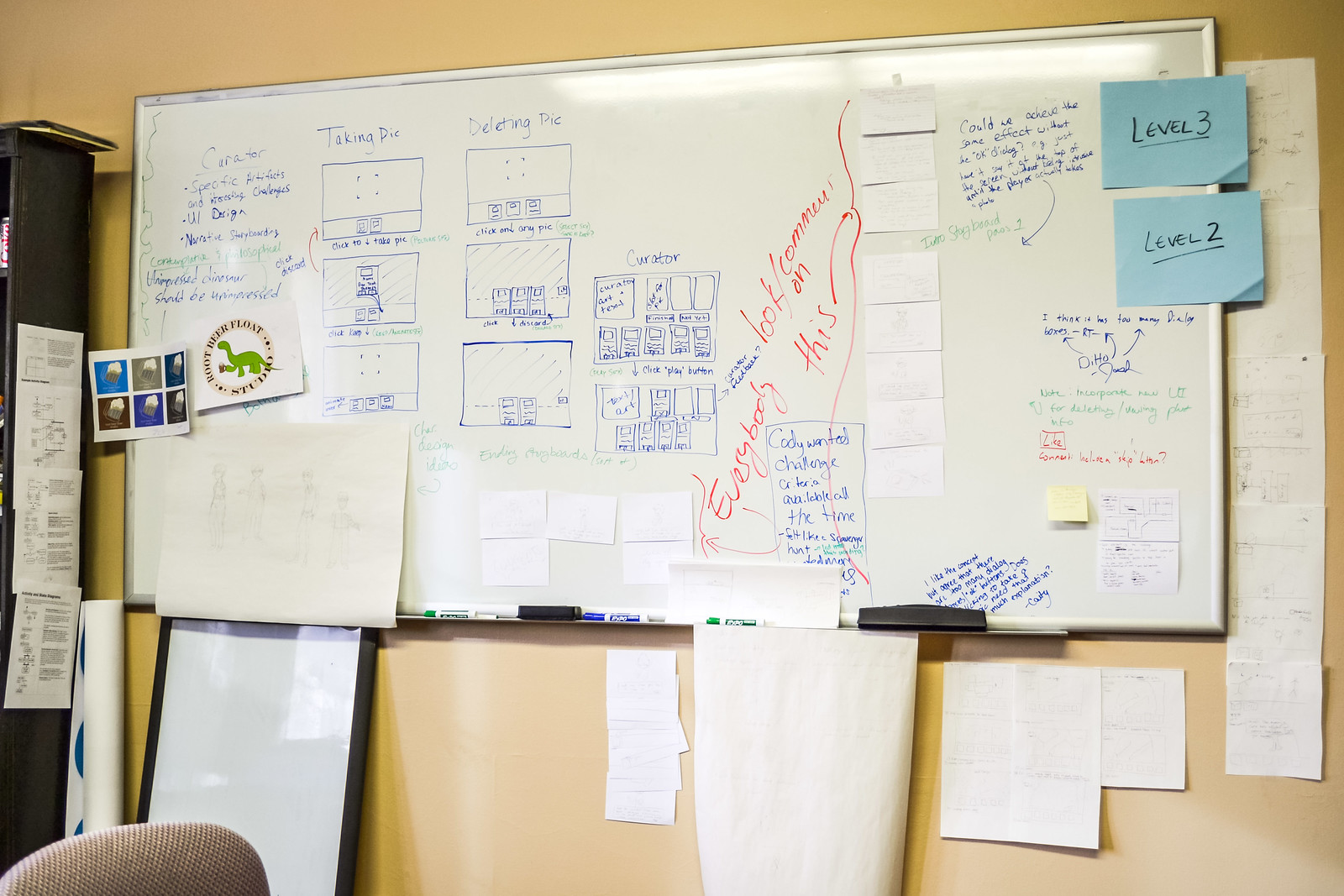
A software studio’s whiteboard is a collaborative space for composing and ideation.

Photographs offer simultaneous renderings of practice, what Flusser (2002) terms surfaces rather than lines. A traditional ethnographer detailing the complex, collaborative work pictured above must transform the simultaneously visible surface of a software studio’s whiteboard into a linear representation of activity. A visual ethnographer, however, can present that visible surface in its full complexity; when coupled with an analytic narrative that details punctuated development, a more hyaline rendering of complex composing practices emerges.

Qualitative research is characteristically ideographic; indeed, visual methods foreground the situated materiality of composing practices. This is a key strength of visual methods as I practice them in studies of writers and writing: the ability to document and collaboratively explore particular systemic contexts and the ways in which artifact assemblages participate in composing processes.

However, in developing new pictures of writers and writing, visual methods have the potential to be nomothetic in the aggregate. Because visual methods may be more hyaline—presenting richer data than traditional methods alone—they carry the potential for fruitful cross-case comparisons of composing practices. Imagine, for a moment, systematically composed and collected photographs of 20,000 first year writers’ typical composing environments and the resulting wealth of both particular (ideographic) and tendential (nomothetic) pictures of writing that might emerge from careful analysis.

Visual methods in empirical studies of writing carry the potential to further develop and realize Brodkey’s argument for re-seeing our object of study, and more important, the people who write. Barthes (1981) argued that “the camera can be an instrument of deep meaning, connecting the scene to the viewer and the viewer to existence” (131). With visual methods, writing researchers can reframe cultural conceptions of where, how, why, and with whom people write in their everyday lives.

11.17.2012

From ZPD to WAGR: An Activity Theory Primer

An Activity Theory Primer

Context

I recently gave a talk to members of Frontera Retorica, a graduate student chapter of the Rhetoric Society of America at the University of Texas at El Paso (and also my grad school alma mater!). They asked me to talk a bit about activity theory basics and some things that researchers in writing and rhetoric might consider when using AT to design a study.

What follows is a written version of my talk.

Tl;dr: a very basic overview of activity theory and why it’s useful, a perspective on why AT and rhetorical genre studies go together like PB&J, and some brief thoughts on deploying AT in studies of writing and rhetoric. If you’re an AT veteran, there’s nothing new here; if you’re new to AT, this may be useful!


AT as a theoretical frame

Nardi (1996) notes that activity theory is a “a research framework and set of perspectives,” not a hard and fast methodology or single theory (p. 7).

Another way of thinking about activity theory is as a particular governing gaze (Emig, 1982); it’s a way of viewing everyday human activity, with a corresponding framework and relatively stable nomenclature for understanding that activity.

Grounded in dialectical materialism, “activity theory focuses on practice, which obviates the need to distinguish ‘applied’ from ‘pure’ science—understanding everyday practice in the real world is the very objective of scientific practice” (Nardi, 1996, p. 7).

Activity theory, therefore, “is a powerful and clarifying descriptive tool rather than a strongly predictive theory. The object of activity theory is to understand the unity of consciousness and activity," (Nardi, 1996, p. 7) a very Vygostkian perspective (more on that below).

Activity theory is rooted in the phenomenological facets of lived experience: “consciousness is located in everyday practice: you are what you do” (Nardi, 1996, p. 7). And what you do, as Vygotsky, Lave and Wenger (1991), Nardi and O’Day (1999), and Kaptelinin and Nardi (2006), have pointed out, is “firmly and inextricably embedded in the social matrix of which every person is a part,” a matrix comprised of people, histories, genres, technologies, and material artifacts (Nardi, 1996, p. 7). Activity theory “incorporates strong notions of intentionality, history, mediation, collaboration and development in constructing consciousness” (Nardi, 1996, p. 7).

Indeed, mediation is perhaps the key theoretical idea behind activity. We don’t just use tools and symbol systems; instead, our everyday lived experience is significantly mediated and intermediated by our use of tools and symbols systems. Activity theory helps frame, therefore, our understanding of such mediation.

What mediates the everyday lived experience of contemporary individuals absent of writing and rhetoric? Almost nothing…

In this sense, we might view activity theory as a methodological foundation for studying lived experience, following Spinuzzi (2003): “a methodology is the theory, philosophy, heuristics, aims, and values that underlie, motivate, and guide the method[s]” (p. 7).


A Generational History of AT (aka “CHAT”)

Proto-First Generation

The work of Russian psychologist Vygotsky and his students in the early 1930s may be seen as the (proto)first generation of AT (though most everyone agrees that this wasn’t actually activity theory, as we’ve come to know it; instead, Vygotsky and his colleagues were exploring sociocultural psychology). His main works detailing some of the perspectives (particularly mediation) that would later come to be known as activity theory are:

  • Vygotsky, L. (1934/1986). Thought and language. Cambridge, MA: MIT Press.
  • Vygotsky, L. (1978). Mind in society: The development of higher psychological processes. Harvard University Press.

Both books are accessible in translation, and contain many of the formative ideas that would later be developed by AT researchers. Key ideas include a strong focus on material and symbolic mediation, internalization of external (social, societal, and cultural) forms of mediation, and the zone of proximal development (ZPD)—the distance between what an individual (child, in Vygotsky’s work) can accomplish on her own, versus what she can accomplish with the help of another (more advanced or even expert) individual.

Vygotsky saw the past and present as fused within the individual, that the “present is seen in the light of history” (1978, p. 64). His cultural-historical psychology attempted to account for the social origins of language and thinking.

Second Generation

One of Vygotsky’s students, A.N. Leontiev, may be seen as the founder of AT proper. We can consider his work the second generation of activity theory (though this is sometimes seen as the first generation AT; see Engeström, 1999, for more details on the “generations” of AT). His main works include:

  • Leontiev, A.N. (1978). Activity, consciousness, and personality. Englewood Cliffs, NJ: Prentice-Hall.
  • Leontiev, A.N. (1981). Problems of the development of mind. Moscow: Progress.

Several of Leontiev’s most important works, translated into English, may be found online, here.

Leontiev’s breakthrough was primarily twofold: first he theorized activity as resulting from the confluence of a human subject, the object of his/her activity (predmet in Russian—“the target or content of a thought or action” (Kaptelinin, 2005, p. 6)), and the tools (including symbol systems) that mediate the object(ive); second, he saw activity as essentially tripartite in structure, being comprised of unconscious operations on/with tools, conscious but finite actions which are goal-directed, and higher level activities which are object-oriented and driven by motives (Leontiev, at times, seems to conflate object and motive, which is potentially problematic).

Third Generation (3GAT)

The work of Michael Cole and Yro Engeström in the 1970s and 1980s—mostly in parallel, but occasionally in collaboration—brought activity theory to a much wider audience of scholars in Scandinavia and North America. Engeström (1987) in particular is credited with expanding Leontiev’s model of activity, particularly via expansion of the basic activity triangle, an example of which may be found here.

Engeström re-envisioned Leontiev’s basic model of activity to account for assemblages of artifacts and tools and collectives of people working together to accomplish objectives. 3GAT, therefore, adds rules/norms, intersubjective community relations, and the division of labor to the basic model of activity. More importantly, Engeström theorized how multiple activity systems could share an object.

Around the same time that cultural-historical activity theory was becoming increasingly deployed as a way to understand complex human interactions in a variety of empirical and theoretical studies, other, very similar approaches were also coming to prominence, including situated cognition and situated action models (see Suchman, Gibson, Norman, Lave & Wenger, Lave, Wenger), and distributed cognition (see Hutchins, Norman).

In addition, AT was picked up by scholars in the emerging fields of human-computer interaction, interaction design, computer-supported cooperative work, and related areas to both study and theorize how technologies mediate human work, learning, and play. Sometimes scholars used AT alongside approaches like distributed cognition, and sometimes instead of those approaches (because AT was believed to offer something better). Nardi (1996) is a good place to start if you’re interested in digging into this body of work.

The majority of research in rhetoric and writing studies that calls upon an AT framework is 3GAT.


Genre as Social Action—An Interlude

In 1984, Carolyn Miller published “Genre as Social Action,” calling on ethnomethodology and social science research to see genres as “typified rhetorical actions based in recurrent situations” (p. 31). Miller argued that we needed to explore genres in contexts of use, and that we consider how they are developed within complex social and cultural histories, how they regulate those histories in the present, and how they situate human subjects. Genres, in short, mediate human experience. Sound familiar?

Miller wasn’t the only scholar in our field working on new approaches to (especially everyday and professional) genres around this time. Foundational work in what has been called “North American Genre Theory” or “Rhetorical Genre Studies” was developed by the following scholars in the 1980s and 1990s:

  • Bazerman
  • Schryer
  • Freedman
  • Smart
  • Devitt
  • Swales
  • Yates & Olikowski (and vice versa)
  • Berkenkotter & Huckin
  • and many, many others

Bawarshi & Reiff (2010) argue that RGS “has tended to focus more on how genres enable their users to carry out situated symbolic actions rhetorically and linguistically, and in so doing, to perform social actions and relations, enact social roles, and frame social realities” (p. 59). Genres, as Schryer (1993) has famously argued, are only stable-for-now; they change and develop, they carry along cultural and institutional histories, and yet they seem solid, stable, and even permanent in actual practice. Their use within a given workplace, classroom, discipline, culture, etc., helps maintain, reproduce, and frame the social realities of lived experience.

Everyday contexts, therefore, are viewed by RGS scholars “as an ongoing, intersubjective performance, one that is mediated by genres and other culturally available tools” (Bawarshi & Reiff, 2010, p. 59). Again, this should be sounding very familiar, and very congruent with the general framework of 3GAT. “RGS scholars,” Bawarshi & Reiff argue, “have tended to understand genres as sociological concepts mediating textual and social ways of knowing, being, and interacting in particular contexts” (p. 59).

Proto-WAGR and WAGR

David Russell’s work represents the most comprehensive and salient attempts at synthesizing rhetorical genre studies and activity theory. By now, it should be plain to see that activity theory provides a framework and model for understanding how genres and the artifacts of particular genres and assemblages of genres (read “writing and rhetorical work!”) mediate human activity. Russell’s work is the reason why this synthesis seems obvious, in hindsight. Some of his key works include:

  • Russell, D. (1995). Activity theory and its implications for writing instruction. In J. Petraglia (Ed.), Reconceiving Writing, Rethinking Writing Instruction (51–76). Mahwah, NJ: LEA
  • Russell, D. (1997). Rethinking genre in school and society: An activity theory analysis. Written Communication 14(4), 504–54.
  • Bazerman, C, & Russell, D. (2002). Writing selves/writing societies: Research from activity perspectives. Ft. Collins, CO: WAC Clearninghouse.
  • Russell, D. 2009. Uses of activity theory in written communication research. In A. Sannino, H. Daniels, and K. D. Gutiérrez (Eds), Learning and Expanding with Activity Theory. Cambridge: Cambridge University Press, 40–52.

Russell’s 1997 Written Communication article is magisterial, fusing Bakhtinian dialogism, dialectical materialism, rhetorical genre studies, and activity theory. I am calling these early works proto-WAGR, for in 2009, Russell would call the fusion of activity theory and RGS “writing, activity, and genre research,” or WAGR. From a WAGR perspective, written communication genres, Russell contends, are “arguably the most powerful mediational means for organizations and institutions” (2009, p. 40). Genre, therefore (and as we have seen), is a unit of social action; “the object of activity,” Russell argues, “can be seen to attain its stability, reproduction, and continuity through genres,” such that genres then serve as “crucial links between subjects, tools, and objects” (2009, p. 45).

Clay Spinuzzi, one of Russell’s most important students, has continued to develop and refine the scholarly confluence of RGS and AT. Some of his most important works include:

  • Spinuzzi, C. (2003). Tracing genres through organizations: A socio-cultural approach to information design. Cambridge, MA: MIT Press.
  • Spinuzzi, C. (2004). Four ways to investigate assemblages of texts: Genre sets, systems, repertoires, and ecologies. In SIGDOC ’04: Proceedings of the 22nd Annual Conference on Design of Communication. New York: ACM. 110–116.
  • Spinuzzi, C. (2008). Network. Cambridge: Cambridge: Cambridge University Press.
  • Spinuzzi, C. (2010). Secret sauce and snake oil: Writing monthly reports in a highly contingent environment. Written Communication 27(4), 363–409.
  • Spinuzzi, C. (2011). Losing by expanding: Corralling the runaway object. Journal of Business and Technical Communication 25(4), 449–486.
  • Spinuzzi, C. (2012). Working alone together: Coworking as emergent collaborative activity. Journal of Business and Technical Communication 26(4), 399–441.

In short, activity theory is an incredibly useful and malleable framework for understanding and exploring complex, intersubjective, historically and culturally-conditioned, object-oriented human work and learning and the genres and artifacts that mediate such work and learning.

The final two Spinuzzi articles actually take us toward fourth generation activity theory…


Fourth Generation AT (4GAT)

The rise of distributed work environments and the dominance of knowledge work has made it difficult to clearly bound new kinds of activity systems and activity theoretical objects. Engeström (2009) calls for a fourth generation of activity theory; as Spinuzzi (2012) explains, knowledge work is potentially problematic to investigate with a 3GAT approach, but “4GAT understands internetworked activities by examining the interorganizational collaborations to which they contribute” (p. 404). Because 4GAT responds to the same kinds of features that have led to the coworking movement that Spinuzzi investigates in his 2012 JBTC article, he adopts a 4GAT approach, seeing coworking as “an interorganizational, collaborative object” (p. 404).

One of the reasons that 4GAT is needed is to better understand what Edwards (2009) calls multiactivity interagency. As work becomes more complex, more internetworked, and distributed across more (and different) professional domains, the utility of 3GAT becomes problematic and will need to adapt. But as several AT researchers have argued over the years, AT is not a monolithic approach; instead, it is dynamic and adaptive.


So Why Use AT/WAGR?

Different scholars will have different reasons, to be sure, but for my money, AT (and ANT, but that’s for another day) provide rich frameworks for exploring and understanding the true complexity of writing and rhetorical work in everyday practice. WAGR helps us, as researchers of writing and rhetoric, to explore, document, and understand many of the situational variables (Faigley & Witte, 1981) that impact and influence how people write and communicate, and how their written and rhetorical genres help mediate the things they do in the world.

Indeed, as Faigley & Witte argued so many years ago, “Perhaps what we need now are more observational studies of writers revising [and simply working] in nonexperimental situations rather than more studies of student writers in contrived situations” (1981, p. 412). Amen.

The Wikipedia article on AT actually answers the “so what” question well:

“AT is particularly useful as a lens [or framework] in qualitative research methodologies (e.g., ethnography, case study). AT provides a method of understanding and analyzing a phenomenon, finding patterns and making inferences across interactions, describing phenomena and presenting phenomena through a built-in language and rhetoric. A particular activity is a goal-directed or purposeful interaction of a subject with an object through the use of tools. These tools are exteriorized forms of mental processes manifested in constructs, whether physical or psychological.”

Clay Spinuzzi has started a Mendeley Group on Activity Theory, and there are hundreds of articles listed there!


Designing an AT/WAGR Study

It must be said that AT can be productively applied to many forms of inquiry. Most forms of AT scholarship, however, fall into one of two strains: empirical or theoretical. Most of the theoretical work has been developed by folks who have done lots of empirical work, or who are/have been affiliated with the Vygotskian school. Empirical work, then, is a key to AT/WAGR approaches.

Empirical studies of activity must be well-designed in terms of protocol and research questions, and well-triangulated: collecting multiple forms of data across multiple instances of collection with (preferably) multiple participants is key to understanding complex mediation. It’s nigh impossible to understand activity if you expect only one form of data to carry the weight of your inquiry…

Systematic qualitative case studies and ethnographies are common approaches. The more that a given activity system may be clearly defined, the easier it will be to apply 3GAT. The more that a given activity system is distributed, internetworked, and interorganizational, the more you will need a 4GAT approach.

Above all, you will want to understand the collective object (or at least the assumed or stated collective object) of an activity system as soon as possible; without a shared and understood object, understanding activity becomes very, very difficult (if not impossible).

What kinds of methods work best in WAGR?

  • Observation, observation, observation
    • I can’t stress enough how important extended, in situ observation is to understanding activity
  • Interviews, questionnaires, and/or surveys
  • Visual research methods where ethical, feasible, and appropriate
  • Participant-produced artifacts
  • Audio recordings (including ambient and non-obvious audio)

Participants are object-oriented, but researchers should be project-oriented. In other words, in what seem to be clear 3GAT scenarios, try to follow participants through a clearly defined project, if possible. Some examples from my own work:

  • I and R — visual ethnography, clear participant-defined work object, 8.5 months, solo
  • VBC — visual ethnography, clear participant-defined work object, 16 weeks, 4 field researchers
  • TM — systematic qualitative case study, assumed collective object, two weeks, solo
  • TM IN — visual ethnography, clear participant-defined work object, 10 months, 2 field researchers
  • Eucharist — multi-sited visual ethnography, assumed individual objects, 2+ years and counting, solo

Memo, read, code, compare, document, trace, theme. Standard qualitative research practices framed by WAGR will bear fruit and answer many potentially interesting research questions about how people use writing and rhetoric in their individual and collective activities…

6.12.2012

Annotations | Hutchins and Klausen, 1996

Annotations | Hutchins & Klausen, 1996

[ NB: “Annotations” are occasional posts that explore selections from my research reading—articles or books—in rhetoric, technical and professional communication, and related fields. ]

Hutchins, E., & Klausen, T. (1996). Distributed cognition in an airline cockpit. In Y. Engeström and D. Middleton (Eds.), Cognition and communication at work (15–34). Cambridge: Cambridge University Press.

This piece is interesting from a number of perspectives, but I want to focus here on the methods section, which is both fascinating and disappointing to me. So, this isn’t a full annotation of the piece, though I will provide a bit of context up front.

The chapter begins with a transcript from a flight simulation involving a commercial airline Captain, First Officer, Second Officer, and two different ground crews (air traffic control). This transcript, of course, makes little sense unless you are familiar with the vagaries of commercial airline flights; indeed, this is part of the point.

The authors foreground a systemic approach for analyzing this scenario early in the chapter. Analysis of a system, rather than an actor or even (only) the interactions between actors, calls for a different unit of analysis, they contend, one that must foster the description and exploration of “the cognitive properties of the cockpit system that is composed of the pilots and their informational environment” (p. 17).

The unit of analysis, then, is a system of distributed cognition (p. 17). The chapter, Hutchins and Klausen explain, is a descriptive implementation of a theory of distributed cognition—they’ll go through the episode of flight simulation chronologically and describe the actions and operations of actors as occurring within a system of distributed cognition.

“We will attempt to show,” they argue, "that certain observed behaviors are instances of certain theoretical concepts. It is only by mapping from the data to a theory that we can generalize beyond the specifics of these observations” (p. 17). This leads them into the cognitive problems of actually doing what they say they’ll do, a meaningful digression, therefore, into their methods section.

In their study, “the theoretical interpretation of some events may depend on the meanings that the participants themselves attach to those events” (p. 17). There are no simple operational definitions of terms that will easily and seamlessly allow readers to interpret, with the authors, the meanings at the research site. So, the authors argue, “we must rely on an ethnography of the setting to provide the interpretive bridge from the structure of the recordings of activity to the terms of the theory of distributed cognition” (p. 17). This moves them into a discussion of their data collection, and the specific affordances of those forms of data. Some of this is very Inside Baseball (which is worth attending to), but it’s also somewhat cynical, as we’ll see below.

They note that “One way to protect oneself from the possibility of unexamined assumptions” in writing up ethnographic research is to try to build some kind of “objectivity” through which such assumptions are banished (p. 18). They point out that these kinds of approaches “cling to a ‘coding scheme,’ a set of ‘objective criteria’ for the existence of instances of various classes of events” (p. 18). Here’s where the cynicism creeps in, for me. Beyond the scare quotes, this seems a very cynical view of qualitative coding; they note that coding schemes are a function of the skill and situated interpretations of particular researchers. Well, yes. Who is arguing otherwise?

I don’t know any qualitative researcher who would claim objectivity because of a coding scheme. I don’t recall reading any key sources in qualitative methodology from around the time of this chapter (cf. Miles & Huberman, 1994; Strauss, 1987; Strauss & Corbin, 1990; etc.) that claims as much (I could certainly be wrong, of course). Instead, coding schemes provide, among many other things, analytic systematicity and transparency.

But the authors argue for another approach: making sure that their assumptions do not remain unexamined (p. 18). They “ground the translation from video and audio record to transcription in an explicit set of propositions that are independently verifiable in the ethnography of the setting” (p. 18). But shouldn’t a grounded coding schema be expected to do the same? This is where they’ve lost me to a certain extent. They seek to be “completely explicit about the grounds for the composition of every action” (p. 19). “The development of ethnographic grounding,” they argue, “leads us to many sources of cultural knowledge,” including documentation, layout and arrangement of cockpit instrumentation, heuristics, interviews, observations, etc. (p. 19).

I’m with them here, but I’m not sure how this differs from other forms of qualitative analysis except for the fact that they intend to be more narrative about an ethnomethodological dataset (looking at very small episodes of high granularity, using a narrative to richly describe each action and operation rather than a coding scheme to represent broader chains of actions).

Make no mistake: this is a worthwhile read, but I was really puzzled by their methods section. Have you read this piece? What do you make of the methods section?

6.06.2012

Case Histories of Instagram

Case Histories of Instagram

Normally, I wait until a paper is published before releasing a free and accessible version for download. However, because of the speed of change around Instagram, the popular, mobile photo-sharing application, I decided to release this one to the public well ahead of its October, 2012 publication.

I’ve been interested in how people use Instagram for a while now. And since I primarily study professional communication in digital environments (and particularly social software), I became increasingly interested in how organizations were using Instagram.

The 2012 IEEE PCS conference theme is communicating vision; while I didn’t have an in situ Instagram project in the works, I thought that some approach to organizational uses of Instagram would be relevant to the conference theme.

Rather than trying to design and conduct a new study in the midst of the four other studies I was running at the time, I decided to work on developing a coding schema that I and other researchers might use as an entry point for exploring the organizational use of Instagram.

This paper describes that schema by systematically analyzing several months worth of Instagram photos produced by organizations in three very different sectors: NPR, a prominent news organization; Heifer International, a sustainability-conscious non-profit; and ModCloth, a vintage clothing retailer with an impressive, multi-genre social software strategy. I used a content analysis methodology to produce case histories of Instagram implementation within these three organizations. This approach is necessarily limited, of course; I hope to follow up with an in situ study soon.

The paper has been favorably reviewed, and I expect revisions to be minimal. If you’d like to cite this paper before October, I've provided the basic details; otherwise, look for the official version with page numbers soon.

I hope this schema is useful to other researchers, and I hope that this exploration of Instagram in professional communication contexts is also of interest to folks who study social software. Let me know what you think!

5.07.2012

Learning Analytics for Collaborative Writing

Learning Analytics for Collaborative Writing

Paul Gestwicki and I have recently published some results from last year’s work in developing and studying an application that traced and visualized contribution and edit histories in Google Docs. Our short paper was published in the proceedings of the Learning Analytics and Knowledge conference last week. I’ve included a pre-publication version of the manuscript below.

Working on this was a really fascinating experience; our in-process work was mentioned in the 2011 Horizon Report, and our focus on learning analytics for collaborative writing gained some attention from Educause—we presented our findings during their spring 2012 focus session on Learning Analytics a couple of weeks before the LAK presentation.

I want to thank Holden Hill and Phil Parli-Horne for their contributions to the project. Holden and Phil were undergraduate honors fellows that did the bulk of the technical development of our prototype. I also thank Erika Johnson, a former Ball State doctoral student, who helped me conduct fieldwork for our study of the prototype among computer science students.

We’re working on two more outputs from this study—one for the computer science education community and one for the computers and writing community. So, more to come! Please let us know what you think of the project!

2.20.2012

Annotations | Nardi, 1996: Studying Context

Annotations | Nardi, 1996: Studying Context

[ NB: “Annotations” are occasional posts that explore selections from my research reading—articles or books—in rhetoric, technical and professional communication, and related fields. ]

Nardi, B. (1996). Studying context: A comparison of activity theory, situated action models, and distributed cognition. In B. Nardi (Ed.), Context and Consciousness: Activity Theory and Human-Computer Interaction (69–102). Cambridge, MA: MIT Press.

In my last post, I considered how and why human beings become attached to particular artifacts and technologies. Trauman offered a compelling response in the comments area, and I thought I’d respond to at least part of his query here: how to get started with activity theory…

This semester, I’m teaching a special topics graduate seminar exploring activity theory and writing technologies. I’ve posted the syllabus for the course on Scribd, but the actual reading list is hardly innovative—it’s all the usual stuff to get one primed on the basics of AT and its application in rhetoric and writing studies. For deeper reading, have a look at Clay Spinuzzi’s list of activity theory sources on Mendeley.

But I thought I’d address some of the basics of activity theory by considering one of its primary applications: studying particularized contexts and situatedness by deploying a methodological framework (activity theory) that moves a given researcher beyond an overdetermined particularity. This is actually one of Nardi’s (1996) goals in her excellent chapter comparing activity theory to situated action models and distributed cognition.

I thought I’d kill two birds here by exploring some AT basics through an annotation of Nardi’s chapter.

This chapter of Context and Consciousness is, like the one before and the one that follows, essential reading for the budding activity theorist. Nardi explores the notion of context in a given research site by considering perspectives from three similar methodological/theoretical approaches: activity theory, situated action models, and distributed cognition. In this chapter, she asks:

  • What exactly is context?
  • What is the correct unit of analysis if the individual is no longer the primary locus?
  • What are the relations between artifacts, individuals, and social groups?

Nardi begins by making the argument (drawing on several other studies) that it is simply not possible to understand how people learn or work when the unit of analysis is “the unaided individual with no access to other people or to artifacts” (p. 69). In other words, artificial lab settings are no longer sufficient for truly approximating the complexity of human beings acting with technology. She also asks, crucially, how we might study complex, situated contexts while still producing research findings that are generalizable (p. 70).

Essentially, Nardi’s goal is to explore the three approaches noted above to see how each deals with the problem of research contexts, considering the benefits and drawbacks of each for studying HCI in particular.[1]

A situated action model, Nardi argues, “deemphasizes study of more durable, stable phenomena that persist across situations” (p. 72). Situated action models, therefore, are highly particularistic: “These analyses offer intricately detailed observations of the temporal sequencing of a particular train of events rather than being descriptive of enduring patterns of behavior across situations” (p. 72). She adds that situated action models suggests that the structuring of activity emanates from the immediacy of a given situation. This is extremely problematic, of course, because it essentially elides cultural-historical factors that surely impinge upon how a human being uses a particular artifact, for example.

Nardi moves next to a discussion of activity theory, where activity systems are the unit of analysis, comprised of “subject, object, actions, and operations,” and where the object held by any one subject “motivates activity” and gives it shape and direction (p. 73).[2] “Actions are goal-directed processes that must be undertaken to fulfill the object,” she states. Actions are conscious, and different actions may be linked in the service of the same goal. Chains of actions work in support of the more complex activity.

Objects, Nardi notes, are not immutable structures, but they also don’t change on a moment-by-moment basis, thus offering some stability (p. 74). Actions also have operational aspects—routinized, unconscious operations (such as accelerating and breaking while driving a car). Nardi points out that “Activity theory holds that the constituents of activity are not fixed but can dynamically change as conditions change. All levels can move both up and down” (p. 75).

Nardi then describes mediation as a key notion in activity theory approaches. “Artifacts carry with them a particular culture and history,” she argues, drawing on Kuutti (1991), and they are “persistent structures that stretch across activities through time and space” (p. 75). Activity theory, she argues, has a very strong notion of context: “the activity itself is the context. What takes place in an activity system composed of object, actions, and operation, is the context” (p. 76, emphasis in original). Moreover, “People consciously and deliberately generate contexts (activities) in part through their own objects; hence context is not just ‘out there’” (p. 76).

Nardi takes us next through the particulars of the distributed cognition approach, where the representation of knowledge is both in the head and in the world, that is, in and between individuals and artifacts (p. 76–77). For distributed cognition, “we cannot understand how a system achieves its goal by understanding ‘the properties of individual agents alone’” (p. 77). Distributed cognition “moves the unit of analysis to the system and finds its center of gravity in the functioning of the system” (p. 77).

In this chapter, we can see that Nardi establishes a continuum, with the constrained particularity of situated action models at one end, and the systems level approach of distributed cognition at the other. Activity theory, with its recognition of both individual particularity and collective sociocultural histories within a given context, sits somewhere in the middle of this continuum.

Nardi moves next to exploring the key differences between these frameworks, starting with how each structures or models human activity. In an activity theory approach, “activity is shaped first and foremost by an object held by the subject” (p. 79). Activity theory, therefore, emphasizes motivation and intentionality of the human or collective. This differs markedly from the situated action approach, where plans, and presumably intentions, are “retrospective reconstructions” (p. 79) that somehow justify an individual’s response to a given situation.

Nardi’s chapter is as much about research methods as it is exploring the three frameworks noted above. For example, she notes that interviewing is a way of bringing operations to a research participant’s “conscious awareness,” and that doing so can empirically demonstrate “the dynamism of the levels of activity as posited by activity theory” (p. 82). In a situated action model, Nardi argues, “what constitutes a situation is defined by the researcher; there is no definitive concept such as object that marks a situation” (p. 82). This is extremely important, methodologically: in activity theory, “the structuring of activity is determined in part, and in important ways, by human intentionality before the unfolding in a particular situation” (p. 82). So, for a researcher to identify an activity system, she can simply start with the object defined by a given research participant rather than imposing her own view (p. 82–83).

Nardi’s next section explores the important role of persistent structures. She notes that understanding the role played by persistent structures—“artifacts, institutions, and cultural values” (p. 83)—in the structuring and shaping of activity is crucial. Drawing on Leont’ev (1974), she illustrates how activity theory is “concerned with the historical development of activity and the mediating role of artifacts” (p. 83). Nardi then explores the ways in which each approach considers the mediating role of artifacts, suggesting that distributed cognition “has taken most seriously the study of persistent structures” (p. 85). In activity theory approaches, things like artifacts or the work practices in a given community are important “precisely because they span particular situations” (p. 86). In other words, the activity theorist looks for patterns that stretch across individual situations, since those patterns are indicative of larger contexts comprised of genres and norms (Engeström’s “rules”), collaborations and interactions (Engeström’s “division of labor”).

Despite the focus on artifacts, for activity theory, unlike actor network theory, “people and things are unambiguously asymmetrical” (p. 86). Nardi argues that, compared to distributed cognition’s tendency to overdetermine the cognitive properties of artifacts, “The activity theory notion of artifacts as mediators of cognition seems a more reasonable way to discuss relations between artifacts and people” (p. 87). “Activity theory says, in essence, that we are what we do,” she argues (p. 88).

One of the most important contributions of this chapter is Nardi’s argument that activity theory gives researchers a shared vocabulary and outlook on a given research site, and that this shared vocabulary and approach allows us to generalize qualitative research. She gives a compelling example of the three different walkers in a forest near the end of this chapter, and in so doing she provides an application of an activity theoretical lens—one that helps researchers see how situatedness constrains human beings, but doesn’t determine their agency.

Of activity theory, Nardi argues:

Aiming for a broader, deeper account of what people are up to as activity unfolds over time and reaching for a way to incorporate subjective accounts of why people do what they do and how prior knowledge shapes the experience of a given situation is the more satisfying path in the long run. (p. 94)

Activity theory, therefore, comes with the following methodological implications:

  1. It requires “A research time frame long enough to understand users’ objects”
  2. It requires “Attention to broad patterns of activity rather than narrow episodic fragments”
  3. It suggests “The use of a varied set of data collection techniques, including interviews, observations, video, and historical materials” (without an over-reliance on any one method)
  4. It suggests “A commitment to understanding things from users’ points of view” (p. 95)

Nardi concludes with the argument that “Activity theory seems the richest framework for studies of context in its comprehensiveness and engagement with difficult issues of consciousness, intentionality, and history” (p. 96). I would add, following Kaptelinin (1996) and Engeström (1999), the centrality of mediation (which is especially important for writing researchers), and following Tolman (1999), I would further stress the “societal nature of the human individual” (p. 71).


  1. I’m making the tacit assumption that we have much to apply from this approach to studying writing, especially as it largely occurs today, as technologically mediated human-computer interaction…  ↩

  2. If you are new to activity theory, the nomenclature can be a bit disorienting at first. “Object,” for example, refers not to an artifact, but is more akin to objective. The object is the thing motivating activity…  ↩

1.24.2012

Annotations | A Reading of the Field with Dorothy Winsor

Annotations | "A Reading of the Field with Dorothy Winsor"

[ NB: “Annotations” are occasional posts that explore selections from my research reading—articles or books—in rhetoric, technical and professional communication, and related fields. ]

Read, S. (2011). The mundane, power, and symmetry: A reading of the field with Dorothy Winsor and the tradition of ethnographic research. Technical Communication Quarterly 20(4), 353–383.

This is a rather interesting article in terms of genre—Read draws on an interview she conducted with Dorothy Winsor in 2009, using that conversation to frame her exploration of ethnographic research in technical communication. In this sense, the article is part interview, part conceptual lit review, and part discussion of ethnography as methodology for studying writing within organizations.

When I saw this article, I immediately jumped in; I’m a big fan of Winsor’s work, and I know I’m not alone there. I think, too, that Read’s article offers much to our field, as it creatively weaves Winsor’s interview into a broader discussion of an important methodology for studying writing work.[1]

Read’s article moves through three topoi: the mundane, power, and symmetry. These themes emerged from Read’s interview with Winsor, and they constitute a frame through which Read considers the maturation and future of methodological and theoretical approaches to the study of technical communication. In fact, Read contends that “Winsor’s words, career, and scholarship serve as a productive interpretive lens through which to read the development of the field” (p. 354).

Read begins by recounting Winsor’s distinguished career, focusing in particular on the latter’s skillful incorporation of theory. Read suggests that Winsor’s timely theoretical appropriations complemented (rather than disrupted) the developing identity of the field. Read then details the three topoi I noted above and argues that the sections corresponding to each theme frames “a set of assumptions or choices that have become tacit knowledge in the field” (p. 356).

In her exploration of the mundane, Read describes the influence of Latour on Winsor’s work. Latour (specifically Latour and Woolgar, 1986) helped Winsor see how workplace writing may be “understood as implicated in the functioning of the workplace,” where everyday writing work might be seen “as constitutive of both the organizational contexts and its products” (p. 357). Crucial too is the understanding of the social in workplace writing, and the complex activities and practices that mediate the socially situated nature of writing work. In this section, Read skillfully makes a broader argument about how Winsor’s work helped drive the field toward/during the social turn, and how Winsor’s field-based approach helped “powerfully chang[e] the object of and the methodology of research on writing” (p. 359). In this section, Read—through Winsor—shows how the mundane and regularized are significant to the production of documentation, and how attending to the mundane necessitates a shift in methodology, away from static texts alone and towards “the social context[s] of textual production” (p. 361).

In her second major section, Read considers issues of power in Winsor’s work and in the field. Calling on Winsor’s long history of work in engineering communication, Read describes how “Winsor’s research adopts the view that engineering knowledge is the product of power relations in hierarchical for-profit organizations, and although power has the capacity to constrain and harm, it is also productive” (p. 364). This brings to mind Foucault, but also Faber (2002). Not surprisingly, Read explores three ethnographic accounts of power relations in nonacademic settings, beginning with Faber. His study is juxtaposed against Winsor’s Writing Power: Communication in an Engineering Center (2003), and Smart’s Writing the Economy: Activity, Genre and Technology in the World of Banking (2006).

“For both Winsor and Faber,” Read argues, “power relations operate through discourse, whether the unit of study is image, identity, text, or genre” (p. 366). Where they differ “is in the implications of the functioning of power,” and in how each is positioned within their respective research sites. “If Faber is the ethnographer as activist,” Read claims, then “Winsor’s stance is more accurately understood as that of the ethical disciplinary outsider” (p. 366). With this statement, Read explores the heart of this section: the ethical issues attendant in field research and the power relationships between researcher and participant.

Personally, I found the final section on symmetry to be the most compelling; judging by my marginal notes alone, this was clearly the section with which I was most engaged. Read argues that Winsor’s research “suggests a symmetry between the human and the material” (p. 371), and so begins a wide-ranging discussion of agency and writing work. Granting agency to materiality “opened, and is still opening, new ways to understand the increasingly complex and unstable relationships among authorship, technology, information, and social and organizational contexts,” Read argues (p. 372).

This discussion leads Read into an exploration of posthumanist frameworks, particularly ANT, distributed cognition, and genre field analysis (p. 373). Read does a good job in this section of placing Winsor’s work (and interview responses) in conversation with Latourian perspectives on agency. A key moment in the follow-on discussion of epistemic rhetoric is Read’s quoting of Winsor (1990, p. 59): “‘even this field [engineering], which seems so tied to physical reality, is necessarily accomplished through language’” (p. 374). The mechanical engineer that was Winsor’s primary participant in this study “found that writing, both his own writing and the writing of others, was an essential means by which he generated knowledge about an engine” (p. 374). This perspective is perhaps taken for granted in our field, but I think it can’t be stated enough, especially when it is yoked to field research.

Read briefly discusses distributed cognition before moving on to a conclusion which considers the role of ethnographic research in the field of technical communication. Because of the work of Winsor and others in bringing field-based methods and methodologies to technical and professional communication, it is now “difficult to imagine a methodology that might aim to isolate documents from their environment or the perspective or actions of a single worker from the context that shapes them and that they also constitute” (p. 377).

That’s well said.


  1. And Read may not remember this, but she and I were actually on a panel together at CCCC in 2007; I was impressed with her work then, and was encouraged by her perspective in this article.  ↩

1.10.2012

Annotations | "Innovation in qualitative research methods"

[ NB: "Annotations" are occasional posts that explore selections from my research reading—articles or books—in rhetoric, technical and professional communication, and related fields. ]

Wiles, R., Crow, G., & Pain, H. (2011). Innovation in qualitative research methods: A narrative review. Qualitative Research 11(5), 587–604.

There's a particular genre of academic article that I highly value, and Wiles et al. have produced a good example in this form. This article, a "narrative review," is similar to what MacNealy (1999) describes as meta analysis, a literature review "that is conducted empirically and analyzed statistically" (p. 109). While MacNealy's discussion of meta analysis largely relies on statistical measures of a group of previous experimental studies, the methodologically rigorous manner in which a meta analysis is carried out can provide researchers in a variety of fields with a very useful approach to exploring an existing body of research literature.

In short, the meta analysis or systematic literature review provides a valuable service to scholars in a given area; such articles are difficult to do well, and are fairly infrequent (Carliner, et al., 2011, have recently published a similar piece in the IEEE Transactions on Professional Communication, and I'll review that soon...). At the most basic level, the feature that distinguishes a meta analysis or systematic literature review from a bibliographic essay, annotated bibliography, or conceptual literature review is the systematicity involved in sampling and analysis. In any of these genres, a purposeful sample must be identified from the broader range of available articles in a given subject area.

Exactly how a researcher moves from the total population to this purposeful sample is explicitly articulated in a meta analysis or systematic lit review; this is important because such transparency means that the analysis is replicable. A solid meta analysis clearly defines the total population and criteria for inclusion, describes how and why articles were selected or excluded, and proceeds along a clearly defined schema for analysis. Performing this kind of rigorous, systematic review of literature in a given area can be tremendously useful for other researchers; this is the primary reason I appreciate a strong meta analysis or systematic lit review.

Wiles et al. (2011) provide qualitative researchers with a narrative review—a systematic literature review—of 57 articles published between 2000 and 2009 that make claims of innovation in qualitative research methods. Overall, this article is useful for two important reasons: first, it acts as a good model of how a researcher might conduct a systematic literature review—an approach that differs from MacNealy's (1999) meta analysis in that it relies on a qualitative coding schema rather than statistical measures as the primary method of analysis; and second, the article explores how and why researchers make claims to methodological innovation and explore the implications for doing so.

"A claim to innovation," they argue, "should be rooted in genuine attempts to improve some aspect of the research process" (p. 588). But in order to explore a given researcher's claims to methodological innovation, the authors first set out to define what constitutes such innovations (p. 588). Ultimately, the authors seek evidence for "Travers' (2009) assertion that there is an increasing tendency for authors to claim innovation, that such claims are exaggerated and that they are detrimental to qualitative social science" (p. 589). Wiles et al. list five research questions that act as an analytic schema for exploring the articles included in their sample.

Wiles et al. describe how their project "used traditional methods of qualitative systematic review for summarizing data as well as qualitative analysis of text to explore the narratives of the claims being made" (p. 589). They next describe their sampling procedures, moving through a systematic search of the all the articles published in 22 relevant journals during the 2000s. Wiles et al. provide a table of the journals where relevant papers were identified (based on their sampling criteria); more importantly, they have published a full list of these papers as an annotated bibliography at the National Center for Research Methods, so that other researchers can see which papers were identified from the population but excluded from the sample.

The article also explores "sites for innovation," the actual research sites where innovation claims were carried out. This is important, as new media environments were related to innovation claims, often because a researcher was adapting or extending methods intended for traditional (that is, non-digital) sites. Of the 57 papers in the sample, "The majority of innovations claimed were at the level of methods, techniques, or tools with only a minority (10 papers) focusing on methodology" (p. 592). Wiles et al. then describe six different categories of innovation claimed in the sample: creative methods, narrative methods (including autoethnography), mixed methods, online methods, software tools, and focus group methodology (p. 592).

After establishing their procedures and sample and identifying major categories of innovation claims, Wiles et al. define three analytic categories to understand innovations that emerged from their analysis of the articles in the sample; they suggested that innovations could be categorized at the level of inception, adaptation, or adoption. They note that "None of the authors defined innovation when they used the term," and that overall, "much innovation in social science research methods involves adapting established methods rather than inventing completely new methods" (p. 593). Claims at the inception level, then, "are those in which the authors claim to be using a new method, approach, or tool" (p. 593). Claims at the level of adaptation "are when an author claims an established method has been adapted or changed in order to improve the method or to meet specific needs within the research context" (p. 593). Finally, claims at the level of adoption "are when an author claims they are taking an established method, relatively unchanged, and applying it into a new discipline or sphere of study" (p. 594). Given these categories, Wiles et al. note that "the majority of papers appeared to claim innovation at the inception level (32 papers)" (p. 594).

In their next section, Wiles et al. explore why authors make claims to innovation, identifying three key reasons: theoretical, moral/ethical, and practical. These reasons were distributed in fairly uniform ways across the sample. Finally, the authors look at the uptake of innovations—are other scholars citing and deploying the innovations claimed by the researchers in the sample? A little more than half of the papers had between 0–3 citations in Google Scholar; however, nine papers had 12 or more citations (p. 599). It is interesting to note that "there was a markedly higher citation rate of papers on online software innovations" (p. 599).

In their discussion section, Wiles et al. argue that "This study indicates the majority of innovation or novelty claims in these papers might more appropriately be called developments in that they involve adapting methods either to meet the needs of a particular project or to meet some moral, ethical or theoretical standpoint" (p. 600). Most of the papers, therefore, draw from and adapt existing methods, and "there is little evidence of paradigmatic shifts in qualitative research methods within these 'innovations'" (p. 600). Wiles et al. suggest that "many of the 'innovations' identified in these papers are little more than the day-to-day adaptation that researchers have always, rightly, undertaken in applying methods to a specific research context" (p. 600). Trends toward over-claiming innovation, therefore, can be "potentially detrimental to qualitative social science" (p. 601).

Too many claims of innovation may dilute the appreciation and understanding of the ways in which contemporary researchers adopt and adapt well-established methods and methodologies.

9.04.2011

Twitter and RSS

Over the last year or so, there's been a lot of talk about how Twitter killed its RSS feeds. What Twitter killed, in actuality, was the button that made subscribing to Twitter feeds (from users or search terms) simple.

As Dave Winer notes: "If you have a Twitter account you have a feed." Where people sometimes run into problems is simply finding those feeds—in particular, it can be difficult to find a user's ID number.

Luckily, Matt Matteson built a handy little tool that queries the Twitter API for the ID of any public user: idfromuser.com. Once you have the ID number for the feed you'd like, simply plug the ID into this URL:

http://twitter.com/statuses/user_timeline/[useridnumber].rss

Then, just grab the URL and drop it in Reader (or your preferred RSS reader). That's it.

Update: well, since I started writing this post a couple days ago, I noticed a problem with the "idfromuser" site—it doesn't seem to be returning IDs for some reason. So, I made a quick screencast showing a workaround in case the "idfromuser" site isn't working for you:


Update #2: Tommy, a former colleague at the Center for Media Design here at Ball State, created an elegant little bookmarklet that does all of the above in a fraction of the time! It quickly retrieves the user ID for any individual Twitter user, then returns the RSS feed for that user. Grab the bookmarklet here! Below is a quick screencast of the bookmarklet in action:


Follow Tommy on Twitter. He's awesome!

Now, If you'd like the feed for a specific hashtag, simply use the following URL:

http://search.twitter.com/search.atom?q=%23[hashtag (without pound sign)]

Take the new URL and drop into Reader. Piece o' cake.

How is any of this useful?

Well, since I'm a qualitative researcher who studies writing, I often try to document—as much as possible—the places where my research participants write. That sometimes means tracking their tweets.

In previous and current studies, a particular hashtag has been important for exploring collective writing work. Since I'm not dealing with huge numbers of tweets—I'll typically collect anywhere from a few hundred to a few thousand for a given study—RSS makes sense for a few different reasons...

First, I drop feeds into my database application, DEVONthink, for archiving. I then mirror those same feeds in Reader as a backup. If I happen to have a list of start codes or a pretty well-defined coding schema, I can use the tagging feature in either DEVONthink or Reader to code data as it comes in. This is tremendously useful during data analysis, but it also allows me to detect trends as I conduct a study, giving me opportunities to shape interview questions or fieldwork while it's happening.

7.12.2011

Taking Stock: AY 2010–2011

In this post, I recap some of my research activity from the 2010–2011 academic year primarily as a way of sharing some of the things I've been working on, and how they lead into things that are coming up...

The last year was a busy one, no doubt. In addition to the usual stuff—teaching, grant writing, administrative and service work, etc.—I led and managed four different empirical studies that will be the focus of this post.

My ongoing study of Eucharistic Adoration practices continued into its second year of data collection (more about the methods and scope for this study can be found in screencasts of conference presentations here and here). After a bit of a lull in this project during the latter half of 2010, I've hit upon some especially intriguing ideas and participant practices in the last six months or so. I'm not quite prepared to publicly discuss even preliminary findings, but I will note that I'm seeing things that I intentionally wasn't looking for and didn't expect to find. Very exciting things that I think will make a real contribution to rhetorics of religion and spirituality.

This is a longitudinal, multi-sited ethnographic study, one that is currently planned to continue through April of 2012. I'll decide whether to continue data collection into 2013 sometime in early 2012. Right now, it looks like I'll do so, as my vision for the amount and types of data to collect is ambitious and still wanting. This is despite collecting a strong amount of data to this point. I'm currently considering strategic opportunities for dissemination—an edited collection or special issue, perhaps—where I could detail some early findings, but I have nothing planned as yet (which is probably for the best!).

I'm currently drafting the first of two planned manuscripts from a qualitative case study of transmedia storytelling that I conducted between December, 2010 and April, 2011. The impetus for this project was the work of my colleague and friend Brad King, a professor of journalism at Ball State and a leader in teaching digital and transmedia storytelling. In close collaboration with Nina Steiger of London's Soho Theatre, Brad led a transmedia summer school in 2010 that introduced playwrights to emergent digital story forms.

Preliminary findings indicate the importance of indexing practices for both teaching and carrying out transmedia stories. For my participants, indexing is most often realized as mundane, background, infrastructural writing work that supports narrative forms by organizing and linking multimodal (digital, print, material) assets. In this sense, indexing as a verb carries two concurrent meanings: the commonly assumed act of recording and organizing, and the less frequent usage (at least in writing studies) of tracing the value of assets (as in a stock index). I'm really excited about this project, and I'm indebted to the wonderful insights provided by Brad, Nina, and five of the ten playwrights who participated in both the summer school and my case study.

During the spring semester, 2011, I led an ethnographic study of the writing work supporting the collaboration of computer science undergraduates. My colleague and friend Paul Gestwicki was the instructor for the course that I studied, and a collaborator on the project (he wasn't involved during data collection but is now involved in analysis and dissemination, following our IRB protocol). Paul and two undergraduate honors fellows, Holden Hill and Phil Parli-Horne, developed a prototype application called Uatu that worked with Google Docs to visualize collaborative writing activity.

Our study, therefore, focused primarily on how students leveraged networked writing practices in conjunction with agile methods of software development. Our key research questions explored the role of networked writing in collaboration and learning, with participant use of Uatu providing us a way into secondary research questions concerning visualization and metacognition. We're still working through the data that we collected, but we already have a short piece out for review and plans for another manuscript later this summer. This was a really fun project, and my data collection was aided by a graduate assistant, Erika Johnson, who took a lot of field notes.

Finally, between July, 2010 and March, 2011 I conducted an ethnographic study of media researchers working on a large qualitative project of their own—from the earliest stages of planning and development all the way through execution of their study and public dissemination of their findings. I had collected rich, granular data in previous and concurrent studies, but nothing in my previous experience matches the amount of data that I collected for this project. This is due in large measure to the generous accommodation of my research participants, who provided me with tremendous access to their work.

Most of July and August will be spent working through the data, and I'm grateful to have a summer graduate assistant, Jenn Stewart, who has been tearing through the formidable pile of audio transcriptions while also offering insights by way of her own analytic memos.

I'm not entirely certain what kinds of outputs I plan to generate from this study, but I have a good idea of where I want to take this research. I've already discussed preliminary findings from one aspect of the study at ATTW 2011 (the screencast of the talk is here), and I'll publish more details from those findings at IPCC 2011 (discussed briefly here). I also have a short piece coming out soon that relies on one observed practice from this study. The majority of my work from this project is ahead, and I'm really looking forward to developing this work.

From these four 2010–2011 projects, only the first remains in a state of open data collection. This means I have a lot of writing to do!

I've already got firm plans for two more studies beginning in the fall, one of which extends my exploration of transmedia work by employing ethnographic methods. I'm also working on another smaller-scale case study (2–3 months of data collection) and have yet another ethnographic study tentatively planned for the spring of 2013.

I'm lucky to have some grant support for much of the work of analysis and dissemination during the summer and fall.

So there you go. Taking stock of my empirical research activity for the last academic year just reminds me of how much exciting work I have ahead of me!

4.18.2011

Interstitial Writing Work

Yesterday, I sent off a 4,500 word paper for IPCC 2011fingers crossed.

In that paper, I discussed findings from the pilot study I conducted in 2009 of the professional conference as information ecology (details here), and the ways in which those findings held or broke down in a longer (8 1/2 month) ethnographic study for which I've recently completed data collection. Basically, my IPCC paper extends some of the things I discussed in my recent ATTW talk.

Round about this time last year, I was also finishing up a manuscript for an edited collection on hybrid spaces—a project led by Loel Kim and Jason Swarts. In that piece, I make an argument about ambient research—about studying the kinds of organizational writing work that takes place in the interstices, in brief, often phatic bursts composed in small-footprint desktop clients and mobile phones.

In the IPCC piece, I talk a bit more about this interstitial writing work, my argument grounded in findings generated by the two studies mentioned above. If my IPCC paper is accepted, it won't be published until October; I wanted to share a small portion of the paper here, because I wonder if others are finding similar things in their own research. Also, I kind of just want to get this idea out there, to a broader public audience beyond the kind and thoughtful reviewers currently vetting my work in various forms.

So, here's a section from the IPCC piece...

-----

What "Counts" as Writing Work?

For participants in both studies, the organizational use of social software was clearly strategic and intentional. During observations of pre-conference planning meetings conducted by the executive board and local site coordinators for the pilot study, an organizational awareness of the need to better leverage social software was strikingly apparent, so much so that the organizational promotion of live-blogging, a YouTube channel, and Twitter were key to the conference experience. Likewise, in the ethnographic study the primary participants were keenly metacognitive and sanguine about their use of social software to promote their organizational brand and seed organizational knowledge assets (for example, by incrementally teasing findings from their consumer research on Facebook and Twitter).

Yet one of the most interesting findings to emerge from interviews with participants in both studies was the sense that professional writing via social software is overwhelmingly unacknowledged as writing work—especially in contradistinction to more traditional forms of organizational writing work like reports, documentation, proposals, and email. Though participants were aware that one focus of my research was their use of social software, when asked (on multiple occasions for most participants) about the kinds of writing they do in their work, participants never mentioned their writing in social software unless prompted. When prompted, participants would typically respond with surprise and belated acknowledgement that composing Twitter or Facebook updates does indeed constitute writing.

This finding leads to a peculiar understanding of social software within the realm of what subjects consider the traditional norms of organizational discourse. There is a clear sense in which public, organizational writing in a medium such as Twitter is transitional and interstitial for knowledge workers—such activities are significant in the main, in aggregate, but deemed less significant as writing work when considered at the level of composition. This is perhaps indicative of the emerging understanding of the role of social software within organizations—knowledge workers know such work is important, but don't yet consider such work as part of the writing they do professionally. In many ways, then, writing for social software environments is interstitial—it circulates in the in-between spaces of organizational writing work and carries meaning in non-traditional ways. For example, the phatic nature of many Twitter posts in both studies reveals an informal, socially significant tenor, interactions that may carry more personal meaning for participants than some sense of organizational significance. But despite participants' reluctance to acknowledge things like Twitter updates as organizational writing work, there can be no doubt that such updates, in aggregate and alone, “count” as writing work—often significantly so.

-----

As always, I welcome comments—here, on the Twitter, or by email.

2.06.2011

"Look at the documentation"

I'm going to make a very obvious point in this post.

It's so obvious, in fact, that I hesitate to make the point at all for fear of looking like an utter fool. But in several years of graduate school, in lots and lots of research reading, and in hours and hours of observations and interviews with research subjects it's a point which is tacit and almost never explicitly stated: we often know because we write; we often remember because it's written down; and we often reflect meaningfully because there are observable traces (written records) upon which to reflect.

This stunningly obvious realization was brought home to me while reading three very different pieces of writing recently. First, there's this bit of advice from Stake's (2010) Qualitative Research:
“...if I were nowadays asked to give just one piece of advice to the novice researcher, it would be as follows: look at the documentation, not merely its content but more at how it is produced, how it functions in episodes of daily interaction, and how, exactly, it circulates.” (p. 89, note)

Stake is an 80-something year-old veteran and pioneer of qualitative research in education studies. It's interesting to see his focus on documentation (written records—writing) here, as a footnote midway through his book, almost an afterthought. More important, to my way of thinking, is his contention that a novice researcher should pay attention to how documentation is produced, how it circulates within a given research context.

To study writing is to study more than texts—it is to study texts in contexts of production and circulation—writing as an activity, sure, but more importantly, writing as a benchmark of human activities where the actual writing is often merely an afterthought, some convenient residue.

I'll give you another example. In June of 2010 Errol Morris wrote a five-part essay for the New York Times called The Anosognosic's Dilemma. It's all very interesting, but what stood out to me was the discussion of Woodrow Wilson's health problems near the end of his presidency, recounted by Morris in part 3 of the series.

"Wilson’s personal physician, Admiral Cary T. Grayson, took elaborate notes and kept a day-to-day log of the president’s condition," Morris tell us. Admiral Grayson wasn't the only person close to Wilson to commit so much to writing. Detailing a series of strokes during the last 10 years of the president's life, Morris goes on to discuss the diagnosis of Wilson's neurological problems by a neuropsychiatrist named Edwin Weinstein, some 50 years after Wilson's death.

How could a neuropsychiatrist in the 1970s be called upon to make such a diagnosis? By poring over copious documentation.

Wilson's physicians, his head usher, his wife, Edith, and a series of others close to the president wrote things down, repeatedly, in great detail.

I'm certainly in no position to determine the merits of a neuropsychiatric diagnosis. Instead, I read this article in awe, dumfounded and amazed by the very attempt to determine the neurological disorder of a man who had been dead for over 50 years by simply reading through the notes that remained. Morris himself seems to see nothing interesting in this point.

To me, focused as I am on writing as a human activity, a thing like this is incredible in the sense of "difficult or impossible to believe." Further still, I marvel at how little attention is paid to the writing, or to the contexts of writing (the subjectivity of the various writers, their specific perspectives, the pressures under which they wrote, their reasons for writing, the accuracy of their observations, etc., etc., etc.). To be fair, Morris attends to some of these factors to the extent that they help him recount the story, and I understand that a focus on writing as an activity is not his purpose here.

But in such situations (this is hardly an isolated example), the writing is this inert thing, a transparent record of actuality that can simply be consulted for truth and accuracy, or plumbed to find something that someone else missed.

Perhaps I've lost you by now. I'm probably not making this point as clearly as I should, but I'll press on, offering one more example.

Michael Lewis's The Big Short is amazing—both the story it tells and the way it's told. Early in the book, Lewis brings the reader into contact with the life and professional dealings of one of the major figures in the subprime mortgage debacle, Michael Burry.

Lewis is an expert storyteller who paints a vivid picture of the events leading up to the 2008 financial collapse, weaving together character-driven narratives about the real people who saw the bubble years before anyone else. The case of Burry is particularly intriguing on a variety of levels, but part of the reason that Lewis is able to tell his story so well is embedded in the narrative itself.

In developing the reader's interest in Burry's professional life, Lewis repeatedly describes Burry as someone who is socially awkward in face-to-face scenarios, but socially and professionally astute in writing. In fact, Burry's preferred mode of interaction, Lewis tells us, was via email, professional newsletters, forum posts, and the equivalent of a blog (before blogs were blogs). Burry's great friendships, we are told, were fostered via email and supplemented with very little face-to-face interaction.

More to the point, Lewis is able to yield such intricate detail about Burry's professional history largely because such things were written down and archived by Burry himself.

In other words, Burry's professional life left traces—a time and date-stamped, infinitely copyable and archivable record of the things he saw in the subprime mortgage market, years before the rest of the world noticed or cared.

Perhaps most importantly, Burry noticed trends light years before the major banks and investment firms caught wind of them because he was willing to do something almost no one else would: he read the documentation.
Every mortgage bond came with its own mind-numbingly tedious 130-page prospectus. If you read the fine print, you saw that each was its own little corporation. Burry spent the end of 2004 and early 2005 scanning hundreds and actually reading dozens of them, certain he was the only one apart from the lawyers who drafted them to do so—even though you could get them all for $100 a year from 10KWizard.com. (Lewis, 2010, p. 27)

The focus here is on Burry, his fastidious research, and his keen understanding of the impending subprime mortgage crisis. The story is about interesting people and the things they do—novice qualitative researchers, president Woodrow Wilson, Michael Lewis and Mike Burry.

But let me make this obvious point once again: we often know because we write; we often remember because it's written down; and we often reflect meaningfully because there are observable traces (written records) upon which to reflect.

11.08.2010

"Connected Knowing"

I'm currently reading Stake (2010), Qualitative Research: Studying How Things Work, and have so far found it to be eminently readable and insightful (I've read 4 chapters, not in order).

Part of what attracted me to the book was the simplicity of the subtitle, actually. It's kind of how I view my job: I study how people work.

Stake cites Candib (1995), Medicine and the Family: A Feminist Perspective, and I think the concept he invokes—Candib's "connected knowing"—is noteworthy. He says that
connected knowing is the embodiment of empathy, using personal experiences and relationships to inquire how others see how things work. It relies on a studied perception of situations in context, thus working toward credibility and esteem (p. 47).
I don't think this is the same as saying one is a participant researcher, in the sense of Malinowski, for example. Since it is empathic, connected knowing is a construct that relies on keen observation and perception—on embodied observation and perception, I might argue.

Part of the reason that this construct resonates with me has to do with one of my ongoing studies, an investigation of embodied interaction in religious practice. That inquiry is guided by the desire to better understand how people know the ineffable, how their embodied practices enable their knowing.

As a researcher, a kind of connected knowing—an embodied observation and perception—is a method I deploy for understanding participant practice.

I just didn't know what it was called.